
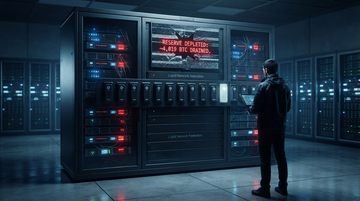
BTC drained from Liquid federation wallet
~4,019 BTC
Reported by Bitcoin Magazine and Liquid Network on Sept. 6, 2026; transferred via a single peg-out request
Dollar value at attack time
~$320M
BTC price ~$79,750 at withdrawal; total reserve of ~4,200 BTC reduced to ~207 BTC
L-BTC reserve backing after attack
~4.7%
Per The Bitcoin Manual: each L-BTC coin is now backed by only ~0.047 of a real bitcoin
Functionary keys used
11 of 15
11-of-15 multisig signed a transaction Liquid Network said was technically valid
BTC main-chain reaction
−0.7%
Bitcoin held near $79,400 on Sept. 7, 2026 per CoinDesk and CoinGecko live data
The Multisig Worked Exactly As Designed — And That's the Problem
The attack on Liquid Network on Sunday, Sept. 6, 2026, was not a phishing campaign, not a stolen key, and not a compromised operator. Every one of the 15 federation keys held by functionaries around the world stayed in its hardware security module; the 11-of-15 multisig on the federation's BTC reserve behaved exactly as the whitepaper promised. The drain executed as a regular peg-out request — Liquid confirmed the SideSwap Peg-out Authorization Key 'was not compromised, nor were any others'.
- An Elements-code consensus bug let the attacker engineer two transactions that produced the same range-proof cache key, so the second transaction bypassed re-verification and minted >4,000 L-BTC that did not previously exist
- SideSwap burned that fake L-BTC through its own PAK and requested a real peg-out — the HSMs happily signed because, to them, the burn looked legitimate and the destination address was on the whitelist
- Blockstream's response within hours: bridge nodes disabled, the sidechain paused, and a PGP-signed onchain message at Bitcoin block 965,875 confirming the patch; the attacker has said in OP_RETURN messages that they will return most of the funds once every node is upgraded
- The unsettling conclusion: every defense Liquid designed worked; the bug lived one layer above them, in code that consensus treats as truth
Anatomy of the Drain
| Time (UTC) | Event | Source |
|---|---|---|
| 14:06:10 | Peg-out request for 3,996.02 BTC submitted on Liquid block 4,050,349 via SideSwap PAK | DeFi Prime |
| 14:28:56 | 11-of-15 federation HSMs sign the 83-input transaction on Bitcoin block 965,783; federation pays out 3,996 BTC to attacker's address | DeFi Prime / Protos |
| 16:01–16:48 | Two further small peg-out batches (4.14 BTC, 1.02 BTC) processed after ~95% of reserves gone | DeFi Prime |
| 18:30:10 | Attacker posts OP_RETURN: 'we are whitehats. contact us on chain' and sends 1,000 satoshis back to the federation address | DeFi Prime |
| Sept. 7 (later) | Blockstream publishes PGP-signed message: 'Bridge nodes are patched, safe to return the funds'; attacker reiterates offer to return most of the 4,000 BTC once patch is verified | The Block / Yahoo Finance |
| Sept. 7 | Bitcoin holds $79,000–$79,500; mainnet absorbs the news without a meaningful drawdown | CoinDesk / CoinGecko |
L-BTC's Reserve Just Collapsed 95%
| Metric | Before exploit | After exploit | Change |
|---|---|---|---|
| BTC held in federation reserve | ~4,200 BTC | ~207 BTC | −95% |
| L-BTC outstanding (per liquid.network audit) | ≈4,200 L-BTC | ≈4,205 L-BTC | ≈+0.1% (unbacked) |
| Real-btc backing per L-BTC | 1.00 BTC | ~0.047 BTC | −95% |
| SideSwap-tracked withdrawal | 0 BTC | −4,019.4 BTC | First ever unauthorized |
| Fee paid to drain 4,019 BTC | — | ~$0.21 | Penny-cost attack |
Why Bitcoin's Mainnet Barely Noticed
The crucial design choice that protected Bitcoin's main chain — a separate UTXO set and a separate consensus for the sidechain — also contained the blast radius. Liquid's L-BTC is an IOU redeemable at the federation; real BTC never left Bitcoin's base layer other than through that one 11-of-15-signed peg-out. With ~4,019 BTC in attacker hands, only ~$320M of supply pressure exists — and even that is held by a party that has publicly offered to return it.
- Bitcoin spot was quoted at $79,400 on Robinhood's market at 2 a.m. EDT on Sept. 6 and held the $79,000 line through Sept. 7 per CoinDesk live coverage
- CoinGecko's daily tracker shows BTC at $79,454, down 0.70% in the 24 hours straddling the attack
- Other Liquid-issued assets — USDT, DePix, BMN2 security tokens, tokenized RWAs — were structurally untouched, per Liquid's official notice, because they sit on the issued-asset ledger, not on the L-BTC reserve
- That separation is exactly what the architecture promised; it is also why a $320M drain can coexist with a flat main-chain tape
Who Actually Carries the Bag
| Entity | Role | Exposure today |
|---|---|---|
| L-BTC holders (retail, exchange desks) | Bearer of the sidechain IOU | Effective redemption suspended; trading at a discount to BTC until reserves are restored |
| Coincheck Group (parent: Monex Group, Liquid federation member via Coincheck) | Federation member + LBTC deposit/withdrawal partner | L-BTC rails paused; operational, not balance-sheet, hit in the near term |
| Bitfinex (iFinex) | Federation member; converts L-BTC ↔ BTC at 1:1 | L-BTC deposits/withdrawals suspended; no disclosed balance-sheet loss |
| SideSwap | Holds the PAK used to authorize the peg-out | Reputational drag; legal/regulatory review likely; no confirmed loss |
| Blockstream | Liquid operator, functionary HSM vendor, BMN2 issuer on Liquid | Must fund patch, post-mortem, and likely federation recapitalization |
| Strategy, MARA, Riot, CleanSpark | Hold or mine Bitcoin, no direct L-BTC exposure | Sentiment exposure to BTC tape; sub-1% main-chain move caps near-term drag |
The bear case for Liquid itself is structural, not transactional. Liquid processed 1,163,119 transactions in Q1 2026 — nearly 5x the year-earlier quarter and a 72% jump over Q4 2025, per the Liquid Federation's own quarterly update. Most of that real-world volume is the L-BTC↔USDT corridor run by Tether and Bitfinex. With the peg broken, every exchange that routed L-BTC through Liquid must now decide whether to widen internal two-way quotes, hold higher L-BTC inventory against depeg risk, or migrate flow to Lightning or to a competing sidechain such as Stacks or Botanix.
What Comes Next — Both Horizons
- Days to weeks: Watch the attacker's BTC address for outbound moves; any sale on a major venue would force the first real reprice of the L-BTC discount and re-test the sub-$79,000 floor
- Weeks to quarters: Blockstream's bridge-node patch plus a federation vote to either return the funds or recapitalize the reserve will set the L-BTC ↔ BTC peg for the rest of 2026; expect tightened PAK whitelisting and possibly a temporary cap on peg-out size
- Quarters to a year: The bigger question is whether other Bitcoin sidechains — and competing layer-2s holding stablecoin liquidity — benefit from migration; USDT on Liquid is still the sidechain's largest real-world use case, so any meaningful volume shift would be the first hard data point
- One to three years: The exploit forces a redesign conversation Liquid has avoided since launch — formal verification of Elements consensus code, larger over-collateralization, or an emergency-pause mechanism on the federation wallet itself; whichever way the federation picks will define what 'Bitcoin sidechain' actually means as a regulated product
Investable read-throughs
- Parent Monex Group operates Coincheck, a Liquid federation member — the cleanest listed line of sight to a sidechain that just lost 95% of its reserve backing
- Paused L-BTC deposits and withdrawals directly hit Coincheck's federation rail, and a multi-quarter depeg would weigh on the institutional transaction revenue that drove Q1 fiscal 2027's 36% revenue jump to $703M
- Watch the Sept.–Dec. 2026 quarterly prints: any disclosure of L-BTC inventory write-downs or federation recapitalization costs becomes the first hard read for public investors
- Risks: federation fully recapitalizes from member treasuries and the attacker's BTC is returned, in which case CNCK rerates sharply off the $1.97 trough
- Holds 846,000 BTC as of Q2 2026 (per Strategy's July 30, 2026 press release) — the largest single-issuer exposure to Bitcoin price
- Mainnet BTC barely flinched — down 0.70% — so MSTR's NAV risk is muted for now; the watch item is whether an attacker-led sale of the 4,000 BTC cracks the $79,000 floor
- Convertible debt reduced 18% to $6.7B in Q2 2026, with a $2.4B USD reserve built as a buffer — that war chest is the moat against a forced BTC sale in any contagion event
- Q2 2026 revenue $174.9M, down 27% YoY, with a $611.3M net loss on BTC price moves — the mining-pure-play with the most leverage to a BTC drawdown
- Holds 35,577 BTC at quarter-end, down 29% YoY after two quarters of destocking
- A sub-$79,000 break on a real BTC sale by the Liquid attacker would re-rate MARA sharply; conversely a clean return of funds removes the depeg tail risk
- Pure-play BTC miner with no L-BTC or stablecoin exposure — pure sentiment read on the Bitcoin tape
- The Sept. 6 attack produced only a 0.7% BTC move, so RIOT's fundamental damage is limited; the catalyst to watch is attacker wallet activity
- If federation votes to recapitalize Liquid from member treasuries, the read-through to U.S.-listed miners is mild but slightly negative — it pulls marginal BTC demand away from spot
- Another BTC-mining pure play; trades with similar beta to BTC as MARA and RIOT
- Indirectly exposed only through BTC price; no federation membership or L-BTC inventory disclosed
- Catalyst: any meaningful L-BTC depeg discount widening would force more L-BTC selling back to BTC, putting incremental supply pressure on the main chain
- Not a Liquid federation member, so no direct L-BTC exposure — but operates the largest U.S. institutional custody and spot BTC venue
- Short-term, any BTC tape weakness from a forced attacker sale is a fee-volume headwind; longer-term, custody competitors that did route through Liquid lose share back to Coinbase
- Mixed because the same event that pressures COIN's trading revenue validates Coinbase's 'stay on the main chain' marketing message
- Crypto-native prime broker and asset manager; trades with high beta to BTC and to crypto-market liquidity
- A persistent L-BTC depeg would force institutional clients to migrate stablecoin rails, a process Galaxy is positioned to intermediate
- Mixed: short-term sentiment drag, long-term opportunity if liquidity re-anchors at non-Liquid venues