
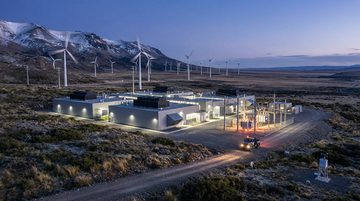
Hyperscalers are increasingly constrained by the same bottleneck everywhere AI capacity is planned: power plus cooling, delivered with bankable contract terms.
In a Sept. 7 Reuters story, Argentina’s Patagonia enters the conversation as a potential next anchor—where wind-power economics and a cold climate could change the siting math for massive AI data-center builds.
The key investor takeaway: this is not just a geography headline. It’s a supply-chain and contract-structure headline—because who can credibly supply power at scale (and for long enough) tends to be the same group that determines which data-center projects get financing approvals.
What Reuters says changed in the siting map
Patagonia moves from “off the grid” to “on the capex spreadsheet”
Reuters reports that hyperscalers are exploring mega data-center builds in Argentina’s Patagonia, including projects targeting very large capacity. The story frames Patagonia’s appeal around two linked factors:
1) Wind-power cost leverage via nearby renewable generation and associated offtake contracting; and 2) Cold-climate cooling advantages, because lower ambient temperatures can reduce cooling energy and operating complexity versus warmer sites.
Reuters also notes the projects are still early-stage—investors want initial pilots before scaling to larger deployments.
The supply chain behind the headline
This is a power-contract story first, a data-center story second
- Upstream power producers are positioning to sell energy and/or link to offtake arrangements that can be packaged for hyperscaler demand.
- Midstream is the grid + transmission buildout: even “cheap kWh” doesn’t matter if electrons can’t flow when the IT load ramp starts.
- Downstream demand comes from hyperscalers that need long-duration capacity visibility to justify data-center capex and financing.
- Cold-climate siting can lower cooling energy intensity, but the dominant driver remains whether power contracts and grid timing are financeable.
From the Reuters report, the most obvious upstream entities tied to the Patagonia narrative include Argentine power/energy players such as Pampa Energia, renewable developer/operator Genneia, and energy exposure linked to Vaca Muerta mentioned in the story (e.g., Vista Energy as reported).
On the downstream side, the story references hyperscalers and major cloud platforms—most notably Amazon, Alphabet, and Meta Platforms—as part of the broader “big tech” interest in mega campuses that would need consistent, large-scale power and cooling economics.
A second-order mechanism investors can price
Why cold + wind can matter more than headline power prices
Most siting debates obsess over the headline electricity price. Patagonia’s argument is more subtle: cold weather can reduce cooling energy intensity, which changes the effective cost per MW of IT capacity delivered over time.
If cooling loads drop, power draw per unit of computing capacity falls. That can:
- Reduce the urgency of oversizing grid capacity on day one.
- Improve the economics of liquid-cooling migration (if and when deployed), because total facility energy still has to balance against power contract terms.
In other words, cold climate can turn “same power price” sites into different delivered capacity costs—which can shift where hyperscalers decide to stage initial pilots and where they commit to full-scale campuses.
What this implies for listed investors today
Where the listed money should look: power sellers, hyperscaler buyers, and data-center landlords
Amazon market scale (context for capex risk)
TTM valuation multiples
Key valuation metrics for Amazon, TTM through Sep 7, 2026 (valuation and cash-flow multiples).
Alphabet market scale (context for AI capex risk)
TTM valuation multiples
Key valuation metrics for Alphabet, TTM through Sep 7, 2026 (valuation and cash-flow multiples).
Meta market scale (context for AI demand absorption)
TTM valuation multiples
Key valuation metrics for Meta Platforms, TTM through Sep 7, 2026 (valuation and cash-flow multiples).
Digital Realty and Equinix (data-center capacity exposure)
TTM valuation multiples
Key valuation metrics for Digital Realty Trust and Equinix, TTM through Sep 7, 2026 (valuation and cash-flow multiples).
Why the listed map matters:
- Hyperscalers (Amazon, Alphabet, Meta Platforms) decide whether to translate pilot interest into major campus commitments.
- Data-center operators with scale and financing capability (Digital Realty Trust, Equinix) can benefit if hyperscalers prefer partners that can finance and stage capacity responsibly.
- Argentine energy exposure (Pampa Energia, Vista Energy) is relevant because power availability and offtake packaging are the upstream inputs that make (or break) the entire siting logic.
Short-term vs long-term investor lenses
What to watch next: pilots first, then grid + offtake certainty
- Short-term (weeks to quarters): signaled project momentum moves first through pilot sizing and offtake/contract structure (Reuters’ reported emphasis on initial pilot demand).
- Short-term: if major hyperscalers confirm participation beyond “exploring,” the market will likely re-rate the certainty premium for the most execution-ready operators.
- Long-term (1–3 years): grid buildout milestones and power-delivery timelines determine whether Patagonia’s economics actually scale beyond early stages.
- Long-term: any policy-driven changes (Argentina’s investment framework and tax/industrial incentives referenced in the Reuters piece) can accelerate or stall offtake contracting and construction timelines.
The most investable question isn’t whether Patagonia has wind and cold. It’s whether the upstream-to-downstream contracting chain can be completed with enough timing certainty that hyperscalers can finance multi-hundred-megawatt commitments.
Related listed stocks tied to the Patagonia siting chain
- Hyperscaler site optionality can reduce delivered power + cooling cost pressure and support faster deployment schedules for capacity-intensive workloads.
- If Patagonia pilot decisions harden, capex execution risk may decline versus markets with slower grid and cooling economics.
- Over 1–3 years, power-contract leverage can favor cloud operators willing to lock long-duration terms early.
- Alternative site economics can improve cost-per-MW of usable capacity if cooling energy drops in colder climates.
- If interest becomes commitments, capacity planning uncertainty may fall for AI workloads that need reliable power delivery.
- Over 1–3 years, grid-and-offtake execution by suppliers becomes a competitive differentiator for hyperscalers.
- Cold-climate siting can lower cooling energy intensity, but policy and contracting execution still drive whether costs actually realize.
- If pilots scale, unit economics could improve for AI inference and training footprints.
- Over 1–3 years, any delays in power delivery would raise schedule risk more than desktop-level power price changes.
- If hyperscalers choose operator-backed staging, capital-market access can speed campus timelines once contracts mature.
- Patagonia’s pilot-to-build dynamic implies early capacity deals reward flexible capacity providers with execution track records.
- Over 1–3 years, buildout waves can improve utilization and cash-flow visibility for landlords with global footprints.
- If the next data-center wave prioritizes power-credible jurisdictions, interconnection-demand can rise around new hyperscale campuses.
- Cold-climate efficiency can support more compute per facility power envelope, helping demand for carrier-neutral capacity.
- Over 1–3 years, new campus clusters can reinforce higher-value ecosystem services where connectivity density grows.
- Reuters’ Patagonia framing links interest to regional power supply strategies; that can increase contracted demand visibility for upstream power supply if offtake structures close.
- If large AI loads commit, scale-up of generation and delivery infrastructure becomes more financeable for producers tied into those plans.
- Over 1–3 years, bankable capacity delivery can translate into longer-duration revenue streams versus purely spot exposure.
- The Patagonia story references Vaca Muerta-linked energy dynamics; if demand concentrates around that supply chain, midstream energy economics can improve through new long-term arrangements.
- In the short term, project-specific contracting timing is the swing factor (pilot approvals vs delays).
- Over 1–3 years, integration risk remains if grid and permitting lag data-center construction schedules.