
Industry news • Data centers / cloud infrastructure • Sept. 5, 2026
TCS is buying into the hyperscale buildout—not just selling services
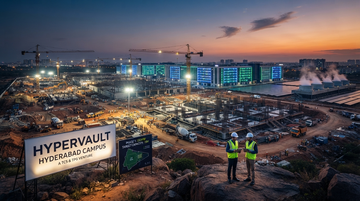
On Sept. 5, 2026, Tata Consultancy Services said its subsidiary HyperVault (with partners) will invest up to ₹70,000 crore (about $7.41B) to develop a purpose-built AI data center campus of up to 1GW on 264 acres in Hyderabad, Telangana. That’s a hyperscale capacity bet, not a project-services play—because the headline decision is about owning (and managing) compute availability in India at the scale hyperscalers require.
Verified deal terms (as disclosed)
Campus footprint
264 acres
HyperVault land secured in Hyderabad, Telangana (HyperVault press release)
Planned capacity
Up to 1GW
Described as “up to 1 gigawatt” AI data-center capacity (HyperVault press release; Reuters confirmation)
Total investment commitment
Up to ₹70,000 crore (~$7.41B)
HyperVault and partners expected to invest (HyperVault press release; Reuters)
Strategic partner named
TPG
Named as a strategic partner backing HyperVault (HyperVault press release)
Reuters and the HyperVault announcement both frame the campus for frontier AI companies and hyperscalers, emphasizing high-density, liquid-cooled compute. Liquid cooling and high-density design push the economics upstream, since they intensify requirements for power delivery, heat rejection, and rack-level infrastructure—areas where pricing and lead times often decide who can actually deploy GPUs fastest.
How the money flows • Upstream: GPUs + datacenter infrastructure • Downstream: capacity access
Why this build reshapes competitive pricing in India’s AI capacity market
AI hyperscale expansion is increasingly a “capacity scheduling” game. In practice, the campus decision determines (1) whether buyers can secure enough power and cooling headroom for dense GPU clusters, and (2) whether deployment timelines compress. HyperVault’s 1GW campus moves the bottleneck from IT contracting to infrastructure readiness—which can ripple into pricing pressure for competing colocation and AI infrastructure providers.
- Unlocks hyperscaler-grade deployment in Hyderabad by pairing a 1GW-scale plan with liquid-cooled, high-density compute (HyperVault campus disclosure).
- Raises the bar for “availability” offers in India because customers can underwrite plans against a larger, purpose-built footprint rather than piece-meal sites.
- Shifts bargaining toward power and cooling suppliers, since dense liquid-cooled builds increase the share of capex tied to electrical distribution and thermal systems (implied by liquid-cooled, high-density framing).
Supply chain • Hardware-infrastructure linkage
The “hyperscale entrant” signal matters for rack-and-power exposure
When a new hyperscale-grade campus is announced, the practical second-order effect is on what infrastructure gets specified. HyperVault’s own language highlights high-density, liquid-cooled compute and an energy model mixing green power and reliability, which typically translates into higher rack/infrastructure demand per MW deployed. That strengthens demand visibility for datacenter infrastructure vendors tied to dense AI racks—even if the campus sponsor is an IT-services firm rather than a server OEM.
| Supply-chain layer | What the announcement implies | Illustrative listed beneficiaries |
|---|---|---|
| AI compute deployment | Hyperscaler + frontier AI tenancy implies large GPU cluster volumes | NVIDIA via GPU content per training/inference deployments |
| Rack-level infrastructure | Liquid-cooled, high-density staging increases demand for power/cooling systems and control hardware | Vertiv as a proxy for datacenter infrastructure exposure |
| Networking/compute interconnect (indirect) | Large clusters typically drive sustained switching/ASIC demand over multi-quarter builds | Broadcom as a proxy for networking/compute infrastructure exposure |
| Server/accelerator platform buildout (indirect) | Dense AI deployments often concentrate procurement around server rack ecosystems | Super Micro Computer as a proxy for server-platform exposure |
This isn’t a claim that these companies are named counterparties. It’s a thesis that campus-scale, liquid-cooled hyperscale infrastructure announcements can change the probability distribution of capex allocations across the datacenter build ladder—especially when the plan targets hyperscalers explicitly.
Investor lens • What to track next
Near-term vs. long-term: the catalyst is real, but the payoff depends on phasing discipline
In the next weeks to quarters, the market will likely price (a) whether India AI capacity “availability” tightens further and (b) whether other providers must adjust build timetables, pricing, or both. The first test is whether hyperscaler procurement cycles can absorb a 1GW campus without schedule slippage—because hyperscalers can reject sites that can’t deliver sustained, dense power-and-cooling performance.
- Short-term (0–6 months): watch for power and site execution signals tied to the 264-acre Hyderabad campus footprint (HyperVault disclosure).
- Short-term (0–6 months): watch for pricing commentary from listed AI infrastructure operators; pricing power tends to tighten or loosen based on near-term MW commitments.
- Long-term (1–3 years): monitor whether “up to 1GW” converts into contracted, operational MW—conversion rate determines whether this is strategic infrastructure or mostly announced capex.
Listed stocks most directly linked to the hyperscale build-downstream
- Repositions TCS from services to capacity enablement by committing up to ₹70,000 crore (~$7.41B) toward an up to 1GW hyperscale campus (HyperVault press release; Reuters).
- Creates a longer runway for AI infrastructure-led contracting if the campus converts “up to 1GW” into operating MW on schedule (HyperVault phasing language).
- Improves bargaining leverage with hyperscaler demand by offering a purpose-built, high-density liquid-cooled site model in Hyderabad (HyperVault disclosure).
- Benefits from increased probability of GPU cluster expansion as hyperscalers target dense capacity in an up to 1GW AI campus (1GW campus disclosure).
- Supports sustained AI spend per deployment cycle given liquid-cooled, high-density compute requirements (HyperVault campus design language).
- Near-term sentiment can lift with India build announcements even before contracted MW is operational (timing uncertainty).
- Faces higher demand for power/cooling infrastructure because the campus is framed around high-density, liquid-cooled compute (HyperVault).
- Can see multi-quarter revenue visibility if datacenter infrastructure deliveries align with the phased buildout of a 1GW campus (phasing language).
- Competitive differentiation can improve when hyperscalers prioritize reliability alongside green power goals (energy model language).
- May gain incremental networking/compute-infrastructure pull-through as hyperscaler deployments scale inside a dedicated campus (hyperscaler tenancy framing).
- Is exposed to timing risk because benefits depend on whether “up to 1GW” converts into operational deployments quickly (conversion uncertainty).
- Near-term read-through is sentiment-led until customers commit capex to running cluster expansions.
- Could see higher server-platform demand probabilities given hyperscaler-grade, dense AI cluster positioning (liquid-cooled compute framing).
- Near-term upside depends on rack ecosystem orders tied to phased campus execution rather than headline capacity alone (phasing uncertainty).
- Long-term exposure strengthens if hyperscalers consolidate deployments around Hyderabad’s purpose-built site model (1GW campus objective).