
Event verified in primary reporting
Goldman is building an AI engineering footprint in Bellevue, explicitly to hire technologists for AI and cloud transformation
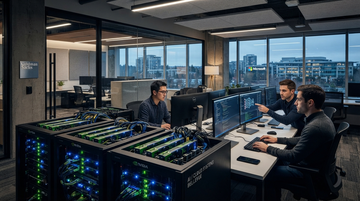
Goldman GS opened a new engineering office in Bellevue, Washington as a dedicated location for more than 125 employees focused on AI and cloud transformation. Primary reporting also places Goldman’s rationale in the Pacific Northwest talent pipeline, with the office framed as part of a broader push to scale AI engineering capabilities.
What the primary sources concretely establish
Where the office is
Bellevue, Washington
Reported as a newly opened, dedicated engineering location by Reuters and Marketscreener coverage.
What the office is for
AI and cloud transformation engineering
Reuters and Marketscreener both describe the workforce focus.
How big the initial footprint is
More than 125 employees
Stated in the Reuters write-up and repeated in Marketscreener coverage.
How Goldman anchors the buildout
Hiring exceptional technologists into the region’s talent pool
Marketscreener coverage attributes the emphasis to leadership messaging on hiring.
Supply-chain lens: from chips to shipped software
The “GPU line item” story misses the bottleneck: turning model capability into production value is a talent + systems problem
Investors often debate AI spend as if it were mostly a hardware spreadsheet. But production AI is an end-to-end supply chain: compute gets you model capability; engineering gets you reliability, latency, monitoring, data governance, and safe integration into workflows. Goldman’s Bellevue office is a visible move along the “systems integration” leg of that chain — the part that is hardest to scale quickly because it depends on scarce experienced builders.
- Engineering buildouts convert frontier models into repeatable internal services, shifting cost from one-time experiments toward ongoing operations.
- Talent concentration in the Pacific Northwest reduces execution lead times compared with recruiting dispersed teams without a dedicated engineering hub.
- Cloud and AI transformation work bundles model deployment with platform engineering, so the spend shows up as people + tooling more than as “raw inference compute.”
Regulatory angle
Banks that want to use frontier models are effectively hiring compliance-aware engineering — not just “AI users”
Bank AI adoption isn’t only about accuracy; it is about governance: audit trails, access controls, model-risk documentation, and how systems behave under unusual inputs. A dedicated engineering site for AI and cloud transformation suggests Goldman intends to build (and maintain) the control plane around model usage, not merely to call models via a vendor interface.
- Dedicated AI engineering moves model-risk work into engineering throughput, reducing reliance on ad-hoc teams for each new use case.
- When governance is embedded in the platform, deployment cycles shorten but ongoing oversight headcount rises.
- That dynamic makes the AI arms race look like a budgeting fight between “compute purchases” and “governance-capable teams.”
Investor read-through with fundamentals context
For Goldman, the office is small versus total scale — but it changes what “AI spend” structurally means for margins and execution speed
Goldman’s current business scale is large; however, the marginal economics of AI engineering can still matter. In recent financial-trend metrics, Goldman shows return on equity of roughly the mid-to-high teens in FY2023–FY2025 ranges (as captured in key metrics), which means incremental cost pressure and productivity payback are both investor-sensitive. The Bellevue office is therefore most likely to influence the near-term by accelerating buildout velocity, and the medium-term by making AI execution capacity an ongoing fixed-ish commitment rather than a variable experiment.
Goldman returns on equity
13.7% (FY2025)
FY2025 key metrics, reported for year-end.
Goldman returns on equity
11.7% (FY2024)
FY2024 key metrics, reported for year-end.
Goldman returns on equity
7.3% (FY2023)
FY2023 key metrics, reported for year-end.
Who benefits downstream
The tactic is a talent arms race that feeds big-tech model platforms — even if the press debate stays GPU-centric
Goldman is not the only actor building frontier-adjacent systems. Microsoft, Alphabet, and Meta all run AI platforms where the limiting factor is often how quickly teams can deploy, iterate, and integrate AI features safely. If banks also treat engineering teams as a gating factor, it raises the probability that enterprise AI demand shifts toward platforms that can deliver end-to-end tooling — and away from “best-effort” integrations that require heavy in-house engineering.
What to watch next
Near-term: hiring velocity and early production deployments. Long-term: a platform shift in how banks buy and govern frontier AI
- In days-to-quarters, watch whether Goldman’s AI engineering expansion shows up in faster feature rollouts (less “pilot mode,” more production workflow integration).
- In quarters-to-1–3 years, watch whether banks increasingly standardize governance tooling around frontier-model usage — which could reduce per-use-case engineering but increases baseline platform spend.
- If talent remains concentrated, the competition for scarce engineers can raise the effective cost per deployed capability, making “GPU availability” less explanatory than “engineering throughput.”
The office is intended to support AI and cloud transformation with a dedicated engineering footprint in Bellevue — a move that treats AI execution as a buildout category, not a one-off project.
Listed companies likely most exposed to the talent-throughput and platform shift
- In quarters, the Bellevue buildout raises AI platform execution speed but can also tighten near-term cost discipline if hiring ramps faster than monetization.
- In 1–3 years, embedding governance into engineering can reduce per-use-case delivery friction if Goldman standardizes tooling rather than building bespoke stacks.
- Relative to its recent ROE profile, incremental AI engineering spend can amplify upside or downside depending on whether productivity improves versus benchmarks.
- As enterprise AI moves from experiments to production, organizations with governance-heavy engineering needs lean harder on end-to-end platforms like those integrated into Microsoft’s stack.
- In quarters, customer integration demand can pull forward Azure AI consumption even when headline spend looks “software-first.”
- Over 1–3 years, if banks standardize model deployment workflows, platform providers benefit from recurring software attach rather than one-time compute surges.
- If the market concludes that engineering throughput is the constraint, workloads that require rapid iteration shift toward mature model and tooling ecosystems where integration time is shorter.
- In quarters, continued enterprise AI adoption can support higher utilization across cloud and AI services, even if GPU commentary dominates headlines.
- In 1–3 years, standardized governance tooling at customers increases stickiness for suppliers who provide safety, monitoring, and deployment primitives.
- In quarters, faster production engineering can improve feature delivery cadence—but it may also raise cost intensity if talent markets stay tight.
- In 1–3 years, if platform-level tooling becomes the differentiator, Meta can benefit from compounding internal deployment knowledge across products.
- The risk is that tighter margins from talent costs outweigh incremental engagement gains in a slower ad cycle.
- Even if “GPUs aren’t the only bottleneck,” AI engineering buildouts keep compute demand structurally alive because production iteration increases usage frequency.
- In quarters, monetization of frontier features can support higher inference utilization even when budgets emphasize platform tooling.
- Over 1–3 years, if deployment standardization spreads, suppliers that sit at the compute layer capture recurring acceleration cycles rather than one-time training spikes.
- If Goldman’s Bellevue office reflects a broader bank pattern, peers like JPMorgan may accelerate AI engineering buildouts to defend workflow integration speed.
- In quarters, investors will watch whether competitor headcount and platform spend shows up in AI-linked productivity metrics rather than only cost growth.
- In 1–3 years, the winner may be the bank that most effectively standardizes governance + deployment tooling to lower marginal engineering per use case.