
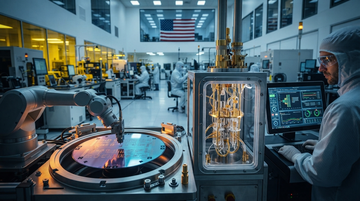
PsiQuantum CHIPS award (finalized Sept 8, 2026)
$100M
Definitive award under CHIPS R&D Office; supplements PsiQuantum's own ~$200M of 2025 spend with US suppliers across 38 states.
Total quantum CHIPS package (Sept 8 finalizations)
$2.0B
Split across IBM ($1B foundry), GlobalFoundries ($375M), plus $100M each to PsiQuantum, Quantinuum, D-Wave, Rigetti, Atom Computing, Infleqtion, and $38M to Diraq.
PsiQuantum private valuation (May 2026 round)
$10.5B
Up from $7B post Series E in Sept 2025; round led by BlackRock, joined by NVentures, Temasek, Baillie Gifford.
GlobalFoundries silicon photonics revenue Q2 2026
$277M
+62% YoY; management targets >$1B SiPho annualized run-rate by exit 2028 — the foundry's fastest-growing line.
Lumentum full-year FY2026 revenue
$3.01B
+83% YoY; Q4 FY2026 revenue $1.01B (+109% YoY) on AI optical demand that also serves quantum-class laser needs.
Applied Materials Q3 FY2026 revenue
$9.12B
Record quarter, +25% YoY; semiconductor systems up15% sequentially as photonic fab tooling pulls forward.
The U.S. Commerce Department finalized a $100 million award to PsiQuantum under the CHIPS and Science Act on September 8, 2026, converting photonic quantum computing from a well-funded research bet into a line item on America's semiconductor manufacturing schedule. The same morning, the Department finalized $100 million each for Quantinuum, D-Wave and Rigetti; $375 million for GlobalFoundries' quantum foundry business; and a separate $1 billion for IBM's Anderon superconducting foundry in Albany, NY. PsiQuantum is the only photonic architecture in that set — and photonic is the only modality that runs on commercial300mm silicon photonic tooling, the same equipment that Lumentum, Coherent and Applied Materials supply to the broader AI/datacom build-out. That overlap is the trade.
The event
What the $100 million actually buys — and why it isn't another CHIPS LOI
PsiQuantum signed a Letter of Intent for $100 million on May 21, 2026, alongside eight other quantum companies; the September 8 signing converted that LOI into a definitive award tied to milestones. Commerce's stated use of funds: scale domestic manufacturing of barium titanate (BTO) optical switches, high-temperature superconducting single-photon detectors (SNSPDs), and advanced packaging — three bottlenecks that PsiQuantum's own technical paper in Nature had identified as the gating items for utility-scale photonic quantum. Unlike the IBM Anderon award, which is a foundry grant to a separate subsidiary, PsiQuantum's check goes straight into a private-company production line that already ships to a real customer pipeline: a $125 million DARPA QBI contract (July 22, 2026), an A$940 million Australian/Queensland government commitment for Brisbane, and a $200 million2025 spend with American suppliers across 38 states.
The headline number undersells the shift. The May LOI raised PsiQuantum's total committed U.S. public + private funding stack to roughly $450 million across federal R&D, DARPA, and Brisbane; the September award is the first to be tied to a manufacturing schedule, not a research milestone. That distinction is what changes PsiQuantum's role in the listed supply chain from \"anchor customer\" to \"anchor customer with co-funded U.S. capacity,\" and it is what re-rates the photonic component ecosystem attached to it.
Upstream layer1 — silicon photonic foundry
PsiQuantum's only domestic foundry partner is the $375M winner
PsiQuantum has been locked in a 300mm silicon photonics partnership with GlobalFoundries since 2019, fabricating the photonic chipset that integrates SNSPDs, single-photon sources and the BTO-based switches at GlobalFoundries' Malta, New York fab. On September 8, GlobalFoundries closed its own definitive $375 million CHIPS award — five times PsiQuantum's — explicitly to scale a \"secure, domestic quantum foundry for leading architectures and multiple modalities.\" That puts PsiQuantum's photonic chips inside the first U.S. quantum fab explicitly funded to host multiple modalities, which protects single-customer concentration risk for GlobalFoundries and turns PsiQuantum into a captive anchor tenant.
| Period | Revenue | YoY change | Silicon photonics | Notes |
|---|---|---|---|---|
| Q1 FY2026 | $1.634B | +3% | ~$170M (est.) | SiPho up materially off small base |
| Q2 FY2026 | $1.786B | +6% | $277M (+62%) | Management: SiPho to more than double in FY2026 |
| Q3 FY2025 | $1.688B | +0% | n/d | Cyclical trough quarter |
| Q4 FY2025 | $1.830B | +5% | n/d | Sequential step-up into FY2026 ramp |
| FY2026 full year | $6.94B | +5.8% | > | Target: >$1B SiPho run-rate by exit 2028 |
Two implications. First, GlobalFoundries is the only U.S. foundry that can simultaneously serve PsiQuantum's photonic line and the broader AI/datacom silicon photonics market — the same wafer lines run quantum photonics,800G/1.6T transceivers, and co-packaged optics. Second, the $375M CHIPS award is now the U.S. government's direct investment in a foundry that has PsiQuantum as its flagship quantum tenant. That makes GlobalFoundries the cleanest listed exposure to \"photonic quantum becomes a U.S. factory schedule\" — without the customer-concentration risk of betting on PsiQuantum's IPO timing.
Upstream layer 2 — photonic components
Three laser/photonic names feed the optical layer
PsiQuantum's photonic stack depends on components the broader AI optical build-out already buys by the container load: high-power InP lasers for single-photon sources, ultra-low-loss silicon nitride waveguides, high-efficiency photodetectors, and optical fiber interconnect for the cryostat-to-control-electronics link. Nvidia's venture arm committed $4 billion in March 2026 across Lumentum and Coherent in non-exclusive supply agreements specifically to lock down this layer for Spectrum-X networking — the same lasers and the same packaging feed photonic quantum. Marvell added Polariton in April 2026 to bolster its electro-optics and custom silicon photonic portfolio; Applied Materials runs the deposition and etch tools that pattern the silicon nitride waveguides.
Latest reported quarter revenue — listed photonic-component suppliers
Each name is positioned for AI optical demand that materially overlaps with quantum photonic-class components.
Unit: USD billions
Applied Materials Q3 FY26
Record; +25% YoY
9.1
Marvell Q1 FY27
Record; +28% YoY
2.4
Coherent Q2 FY26
+17.5% YoY
1.7
Lumentum Q4 FY26
+109% YoY
1
- Lumentum FY2026 revenue $3.01B (+83% YoY) — InP lasers used in quantum photonic sources ship on the same fab lines as AI datacom lasers; Q4 FY2026 was +109% YoY at $1.01B.
- Coherent FY2026 TTM revenue $7.12B — silicon photonics transceivers, VCSEL arrays, lenses and couplers overlap with photonic quantum packaging and beam-delivery optics.
- Marvell FY2026 revenue $8.20B record — custom silicon plus optical DSP and transimpedance amplifiers for high-bandwidth quantum-class interconnect; Polariton acquisition (Apr 2026) deepens electro-optics.
- Applied Materials Q3 FY2026 revenue $9.12B record — semiconductor systems segment +15% sequentially; the deposition tools used in SiPho waveguides and300mm BTO integration come from this book.
Upstream layer 3 — cryogenics, control, packaging
The cold stack: SLAC, STFC Daresbury and a private cryogenics market the public market can't see
Photonic quantum needs cryogenics only at the detector stage — far less than superconducting, but still a non-trivial infrastructure investment. PsiQuantum has spent two years building that capacity directly: a September 2023 partnership with SLAC to install cryogenic quantum modules inside SLAC's LCLS-II cryoplant, and a March 2026 UK R&D facility at STFC Daresbury's National Cryogenic Facility for \"next-generation high-power cryogenic systems.\" The cold-supply market itself is privately held (Bluefors in Finland, Maybell Quantum in Colorado, Oxford Instruments NanoScience, recently divested by Oxford Instruments and absorbed by Quantum Design International) and Quantum Machines (Israel) and Zurich Instruments (Switzerland) hold the bulk of the quantum-class control electronics.
That gap is the article's most important caveat. Investors looking for a clean public-market line on the cryogenic and control-electronics layer behind the CHIPS quantum awards will not find a U.S.-listed name; the listed exposure sits one step upstream, in photonic components and silicon photonic wafer fabrication. If the U.S. government decides to onshore this layer next — which the IBM-HRL acquisition (closed August 26, 2026) and Honeywell's 58% stake in Quantinuum implicitly argue for — that is the trade that gets created next, not the trade that exists today.
Comparison vs the TSMC Arizona lane
Why $100M for photonic is a different CHIPS lane — not a TSMC rerun
TSMC's CHIPS lane is built around $6.6 billion in direct CHIPS funding plus a $265 billion cumulative Arizona investment program, of which $100 billion was incremental and announced in July 2026. That lane is fab capacity — millions of wafers a year of advanced logic, packaging, and HBM-adjacent silicon. PsiQuantum's $100 million does not buy wafer volume; it buys photonic quantum process development, three component categories, and an early-stage U.S. supply base for a modality that does not yet ship in volume. The two lanes share the legal chassis (the CHIPS and Science Act) and the supply-chain security framing, but they target different revenue lines: TSMC's $265B serves AI compute, PsiQuantum's $100M serves a future quantum utility-scale market that the Quantum Insider sizes at roughly $1 trillion in economic value by 2035, but which generates essentially zero hardware revenue today.
| Lane | Headline check | Customer base | Revenue today | Strategic target |
|---|---|---|---|---|
| TSMC Arizona | Up to $6.6B direct CHIPS + $265B cumulative plan | AI hyperscalers, mobile, HPC | AI-driven, generating cash now | Onshore leading-edge logic + packaging |
| PsiQuantum photonic | $100M CHIPS R&D + $125M DARPA QBI | DARPA, NIST, future enterprise | Pre-revenue (private) | Domestic photonic quantum utility-scale line |
| IBM Anderon foundry | $1B CHIPS + $1B IBM cash | Superconducting quantum +3rd-party | IBM Quantum services revenue | Purpose-built superconducting quantum wafer fab |
| GlobalFoundries QTS | $375M CHIPS R&D (5-yr milestones) | PsiQuantum + multi-modality | SiPho +$62% YoY in Q2 2026 | Domestic multi-modality quantum foundry |
Peers in the package — and one notable absence
Four other $100M checks plus IBM's $1B foundry rewrite the quantum board
PsiQuantum is not alone in the package — but it is the only photonic winner. Quantinuum ($100M, trapped-ion, the only trapped-ion recipient; Honeywell majority-owned, ~48% of voting power post-IPO) uses a wholly different supply chain dominated by ion-trap fabricators and UV lasers. D-Wave ($100M, annealing + 10,000-qubit gate-model) and Rigetti ($100M, superconducting) both need dilution refrigerators and superconducting wafer fab — the same cryogenic gap noted above. Atom Computing ($100M, neutral atom) and Infleqtion ($100M, neutral atom) need vacuum and laser systems. Diraq ($38M) targets silicon spin qubits, a fifth modality. And then there is IBM's $1B for the Anderon foundry: not a modality bet but a foundry bet on superconducting quantum, paired with the August 26 close of the HRL Laboratories acquisition to fold in-house cryogenic and materials expertise.
The packaging tells a story. Of the $2.013B announced in May and finalized in stages through September,68% goes to foundry capacity (IBM + GlobalFoundries) and 32% to discrete modality bottlenecks — and within the modality bucket, photonic quantum wins the cleanest check: a single architecture with an existing commercial foundry relationship, a DARPA QBI Stage C validation, and a multi-billion-dollar private capital base. The defensible read: Commerce is funding quantum the way it funded semiconductors — anchor foundries first, specialty fabs second, and modalities that lean on existing commercial tooling get a faster check. Photonic is exactly that modality.
Horizons
What moves first, what compounds, and what to watch
Days to quarters: the immediate catalyst is PsiQuantum's September 8 award driving incremental domestic pull-through at GlobalFoundries' Malta fab — SiPho revenue ($277M Q2 2026, +62% YoY) is the line that re-rates. Lumentum and Coherent continue to ship into AI datacom first; quantum is upside optionality, not yet a driver. Marvell's optical interconnect book is the same: AI-driven with photonic quantum as a secondary tailwind. The first-quarter-and-a-half trade is GlobalFoundries; the second-quarter trade is the photonic component layer as quantum specification awards trickle out through2027.
One to three years: the structural bet is that photonic quantum achieves utility-scale — DARPA's QBI program targets 2033 for \"industrially-useful\" quantum. If PsiQuantum's Brisbane site, Chicago IQMP, and the Malta SiPho line ramp as planned, photonic becomes the modality with the only domestic foundry (GlobalFoundries) hosting a real multi-modality quantum fab. The listed winners are the photonic component ecosystem that doubles for AI. The risks are commercial (fault-tolerance milestones slip), geopolitical (export controls fragment the photonics supply chain), and competitive (a third modality — neutral atom, ion trap, or a Chinese photonic entrant — gets a faster federal check).
- Near-term catalyst: Q3 2026 earnings season will show whether the CHIPS/DARPA awards translate into GlobalFoundries' SiPho line hitting the company's >$1B run-rate target by exit 2028.
- Long-term milestone: PsiQuantum's Chicago IQMP site (broke ground September 30, 2025) targets utility-scale build-out through 2028 — a concrete delivery date the public market can track.
- Watch: any secondary CHIPS quantum award to a cryogenics or quantum-control-electronics supplier would create the next public-market pure-play; nothing on the announced list fills that slot today.
- Watch: PsiQuantum's IPO timing remains undisclosed. A listing would convert the $10.5B private valuation into a public tape the supply chain can hedge against.
Investable read on the photonic quantum supply chain
- PsiQuantum's anchor SiPho foundry just got a co-funded $375M CHIPS award the same week, locking in domestic quantum capacity at the Malta, NY fab.
- SiPho revenue already grew +62% YoY to $277M in Q2 FY2026; management targets >$1B annualized run-rate by exit 2028 — photonic quantum is incremental upside on top.
- Multi-modality mandate means GFS can host PsiQuantum (photonic) and IBM Anderon-adjacent (superconducting) volume, de-risking single-customer exposure over2027–2028.
- FY2026 revenue $3.01B (+83% YoY); Q4 FY2026 +109% YoY — InP lasers for photonic quantum single-photon sources ship on the same lines now running at AI optical capacity.
- Nvidia's $4B non-exclusive supply agreement (Mar 2026) confirmed InP laser scarcity; quantum photonic customers compete for the same slots.
- Best short-term AI trade with longest quantum optionality — sits in the laser/photonic layer PsiQuantum depends on.
- FY2026 TTM revenue $7.12B with silicon photonics, VCSEL arrays, and packaging overlap into quantum-class photonic components.
- Nvidia's $4B non-exclusive commitment adds same laser/photonic allocation dynamic as Lumentum.
- Diversified exposure across datacom, 3D sensing, and now a CHIPS-funded quantum component supply chain — quantum is small but high-margin.
- Q1 FY2027 record revenue $2.418B (+28% YoY); FY2026 full year $8.195B — optical DSP and transimpedance amplifiers are the same chips quantum control stacks need.
- Polariton acquisition (Apr 2026) deepened electro-optics IP directly applicable to photonic quantum interconnect.
- AI optical trade first, quantum-class interconnect second — earnings leverage comes from datacom, quantum is the long-tail catalyst.
- Q3 FY2026 record $9.12B (+25% YoY); Semiconductor Systems +15% sequentially on deposition and etch tool demand from SiPho wafer ramps.
- Photonic quantum fab tooling pulls the same semiconductor equipment book — PsiQuantum, GlobalFoundries, IBM Anderon all buy from AMAT's catalog.
- Highest-quality compounder in the cohort; quantum is a small but durable incremental driver over a 1–3 year horizon.
- PsiQuantum Series E investor (Sept 2025) and CUDA-Q collaborator (Mar 2026) — the only hyperscaler-grade name inside PsiQuantum's cap table.
- Nvidia's $4B across Lumentum and Coherent (Mar 2026) locks photonic laser capacity that photonic quantum also consumes.
- Mixed because the AI GPU thesis dominates earnings; quantum relevance is strategic positioning, not yet a revenue line.
- Majority owner of Quantinuum (trapped-ion, post-IPO voting stake ~48%); the $100M CHIPS award and trapped-ion roadmap (Apollo by 2029) sit on Honeywell's books indirectly.
- Diversified industrial conglomerate with $66B market cap — Quantinuum exposure is real but not the equity driver.
- Mixed: stable industrial cash flows offset the binary quantum optionality; useful as a hedged route into trapped-ion alongside direct photonic plays.