
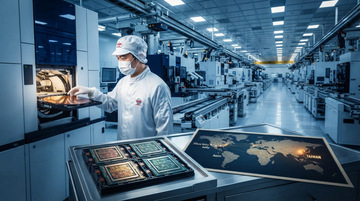
On September 7, 2026, Reuters reported that Taiwan Semiconductor Manufacturing Chairman C.C. Wei and President Lai Ching-te spent the week of SEMICON Taiwan pitching the island as a democratic AI supplier — explicitly framing chips as a diplomatic tool against diplomatic isolation. Commerce Secretary Howard Lutnick used the same stage to warn of tariffs for companies that don't make chips in the U.S. The message crossed: Taipei is no longer asking for chips access; it's setting terms.
The article below traces the leverage — what Taipei holds, what NVIDIA and AMD now have to bargain around, and what the U.S.–China AI talks scheduled for mid-September 2026 actually mean when the indispensable middleman is sitting at a different table.
TSMC Arizona committed capex
$265B
per Reuters, Sept 7, 2026; expansion announced March 2025
Taiwanese add-on U.S. investment
+$20B
Economy Minister Kung Ming-hsin, SEMICON, Sept 2026
Share of advanced logic chips made in Taiwan
~90%
Stimson Center, May 2026; consistent with industry reporting
TSMC 2026 capex (raised)
$60–64B
TSMC Q2 2026 earnings call, July 17, 2026; up from $52–56B guide
Foxconn share of global AI server market
>40%
Chairman Young Liu, AGM, May 29, 2026
The leverage
Taipei Converted Scarcity Into a Negotiating Asset
Taiwan Semiconductor Manufacturing is now the most-cited national-security asset on Earth. Per the Stimson Center, roughly90% of advanced logic chips are physically fabricated in Taiwan — every NVIDIA Blackwell, every AMD Instinct accelerator, every Apple M-series SoC and every Broadcom custom AI ASIC in the western pipeline depends on Taiwanese capacity. SEMICON Taiwan 2026 was the moment Taipei decided to behave like a sovereign supplier, not a sub-tier.
- Taiwan Semiconductor Manufacturing is investing $265B in Arizona alone, per Reuters' Sept 7, 2026 dispatch; Economy Minister Kung Ming-hsin added another $20B from other Taiwanese firms at SEMICON, taking the bilateral pipeline above $285B.
- The January 2026 U.S.–Taiwan deal already capped reciprocal tariffs at 15% and lets Taiwanese chipmakers import up to 2.5x planned capacity duty-free while U.S. fabs are built — a tariff lever Taipei can now extend to Brussels and Tokyo.
- EU's Kilian Gross attended SEMICON to pitch Chips Act 2.0 directly to Taiwanese executives — a parallel customer courting the same scarce supplier, sharpening Taipei's bargaining position.
- Deputy Foreign Minister Francois Wu spoke at the French pavilion, branding Taiwan's chip stack as technology that 'connects with the world, not controls it' — a pointed counter to the U.S. framing of export controls.
Capex math
TSMC's 2026 Capex Just Got Bigger — and More Political
Taiwan Semiconductor Manufacturing raised its 2026 capex guide to $60–64B on the Q2 2026 earnings call (July 17, 2026), up from the original $52–56B — a ~22% step-up on the midpoint. CFO Wendell Huang framed the lift as AI/HPC demand-driven, but the capex ratio (capex ÷ operating cash flow) at 0.63 in Q2 2026 is the highest since the 2022 cycle, and ~$31B of the 2026 envelope now sits in Arizona. Capex per share climbed to TWD 301, a record. Taipei is funding the diplomatic dividend by spending more, not less.
| Period | Revenue (TWD B) | Gross margin | YoY revenue growth | Capex / OCF |
|---|---|---|---|---|
| Q2 2025 | 933.8 | 58.6% | +33% | 0.60 |
| Q3 2025 | 989.9 | 59.5% | +31% | 0.67 |
| Q4 2025 | 1,056.0 | 62.3% | +20% | 0.48 |
| Q1 2026 | 1,134.1 | 66.2% | +35% | 0.48 |
| Q2 2026 | 1,270.4 | 67.7% | +36% | 0.63 |
Note: Q2 2026 gross margin of 67.7% is the highest since the AI build-out began. Higher capex and higher margins at the same time is the unusual signal — TSMC is now pricing scarcity into its contract renewals while simultaneously bankrolling the geographic diversification its customers demand. That combination is what gives Taipei its diplomatic muscle.
Upstream chokepoints
The Leverage Is Real — But It Rests on a Fragile Stack
The diplomatic story collapses without the upstream stack that makes Taiwan the only viable maker of sub-3nm logic. ASML Holding is the sole supplier of EUV lithography — every wafer TSMC runs at 2nm and below depends on a single Dutch monopoly. Within Taiwan, ASE Technology Holding is the world's largest outsourced packaging and test provider with a 44.6% OSAT share and an $8.5B 2026 capex plan, adding 15 sites this year alone to feed advanced-packaging demand. The advanced-packaging market is projected to hit $61.8B in 2026, up ~76% YoY — and the bottleneck is in Taiwan.
- EUV: ASML Holding holds a monopoly at the lithography layer; any export-control action ripples back to TSMC's roadmap.
- Advanced packaging: ASE Technology guided 2026 advanced-packaging revenue to double to $3.2B (Feb 2026); raised advanced-packaging quotes >20% in July 2026 — pricing power is back in Taiwan.
- Critical inputs: gallium, germanium, helium and EUV-grade photoresist remain geographically concentrated; a single chokepoint in any of them can idle a2nm line within weeks.
Downstream customer map
The U.S. Semi Customer Map Sits on the Wrong Side of the Table
Every U.S. AI chip on the 2026 buy-sides roadmap — NVIDIA Blackwell and Rubin, AMD MI400, Broadcom custom-XPU, Qualcomm PC-grade AI silicon — is fabbed at Taiwan Semiconductor Manufacturing or ASE Technology-packaged in Taiwan. NVIDIA's Q2 FY2027 (quarter ended July 26, 2026) delivered $96.2B of revenue at a 75.0% gross margin, on TTM revenue of $302.9B — and every data-center accelerator in that mix touched Taiwan. The leverage math is: if Taipei tightens export licensing or prioritizes EU capacity, NVIDIA's near-term roadmap doesn't slip — the multiple does.
| Fiscal quarter | Revenue ($B) | Gross margin | Net income ($B) | EPS |
|---|---|---|---|---|
| Q1 FY2026 (Apr 2025) | 44.1 | 60.5% | 18.8 | $0.77 |
| Q2 FY2026 (Jul 2025) | 46.7 | 72.4% | 26.4 | $1.08 |
| Q3 FY2026 (Oct 2025) | 57.0 | 73.4% | 31.9 | $1.31 |
| Q4 FY2026 (Jan 2026) | 68.1 | 75.0% | 43.0 | $1.77 |
| Q1 FY2027 (Apr 2026) | 81.6 | 74.9% | 58.3 | $2.40 |
| Q2 FY2027 (Jul 2026) | 96.2 | 75.0% | 59.7 | $2.47 |
Below the chip designers, Foxconn (Hon Hai) assembles >40% of the world's AI servers — its chairman used SEMICON to declare customers must 'make with Taiwan, not in Taiwan; make with Taiwan in the country where the market is.' That sentence reframes the entire U.S. reshoring agenda: Taiwan Semiconductor Manufacturing builds the chip, ASE packages it, Foxconn integrates the rack. The U.S. has the customer (Amazon, Microsoft, Alphabet) but Taiwan owns every step in between.
Policy crosscurrents
The Mid-September AI Talks Just Got a Third Player
Reuters reported (Sept 4, 2026) that Treasury Secretary Scott Bessent will lead the U.S. side in mid-September AI safety talks with China — the first dedicated bilateral AI dialogue of this cycle, positioned as a deliverable ahead of a possible Sept 24 Trump–Xi summit. The agenda centers on joint monitoring of AI-driven cyberattacks and a proposal that U.S. and Chinese AI labs police themselves. Export controls are explicitly not on the table. But Taiwan now sits adjacent to both sides: Washington can't negotiate AI safety with Beijing while letting Taipei set chip-allocation terms, and Beijing can't press for relief on NVIDIA's H200 export flow while Taipei courts the same allies.
- What's on the table in mid-September: AI safety dialogue, AI-lab self-policing, joint monitoring of cyberattacks; chip export controls are formally excluded from the agenda.
- What's not on the table but is in the room: H200 shipments to China (resumed Dec 2025 with a 25% tariff, per Brookings June 17, 2026), Section 232 chip tariffs, and the January 2026 U.S.–Taiwan framework's 2.5x duty-free import allowance.
- Taiwan's parallel play: Taipei is using SEMICON to court the EU and France in real time — Brussels is pitching Chips Act 2.0, giving Taipei an explicit second customer if U.S. terms tighten.
- The risk: A U.S.–China deal that quietly loosens chip flow to Beijing undermines Taipei's bargaining chip with Washington; a deal that tightens flow gives Taipei more leverage, but raises the chance of a Chinese export-licensing retaliation against TSMC's Nanjing and Shanghai operations.
Export controls
Taipei Is Quietly Building Its Own Leverage on China
On June 9, 2026, Bloomberg reported Taiwan is considering stricter AI-chip export controls on China — including potential criminal penalties for smuggling — to align with U.S. measures. Per the Taipei Times (June 10, 2026), the move would give Taipei its own legal tools against diversion of NVIDIA-based AI servers. This is the quiet punchline of the SEMICON display: Taipei is no longer outsourcing its China policy to Washington — it is writing one. That makes Taipei a third regulatory authority on AI chip flows, complicating any U.S.–China deal that touches export licensing.
For U.S. fabless customers, the practical consequence is that Taiwan is now the swing voter on three policies at once: U.S. Section 232 tariffs, EU Chips Act 2.0 industrial subsidies, and its own export-licensing regime toward China. The customer map has to plan for all three simultaneously — and none of them were on the 2025 roadmap.
What it means for investors
Short-Term Catalysts vs. the 2027–2029 Structural Reset
Over the next 1–2 quarters, the actionable signals are (1) the mid-September AI talks and any Bessent–He Lifeng readout, (2) any announcement on Taiwan's own AI-chip export licensing bill, and (3) the pace of EU Chips Act 2.0 funding flows into Taiwanese vendors. Each event moves the multiple on NVIDIA and AMD more than their next earnings print, because the lever now sits on the supply side, not the demand side.
- Near-term (days–quarters): Watch the Sept 24 Trump–Xi summit for any H200/allocation language; watch TSMC's Q3 2026 capex disclosure (mid-October) for further upward revisions; watch the EU Chips Act 2.0 funding framework for Taiwanese fab packaging subsidies.
- Long-term (1–3 years): TSMC's Arizona ramp to 2nm/1.6nm (target ~2028) is the structural hedge that lets U.S. customers reduce Taiwan concentration risk — but ASE Technology's 15-site packaging buildout in2026 locks advanced-packaging capacity in Taiwan for at least three more years.
- The bear case: If the U.S.–China AI talks produce a chip allocation deal that bypasses Taipei, Taiwan's bargaining chip collapses and TSMC's Arizona capex becomes stranded cost.
- The bull case: If the talks deadlock or U.S. policy tightens, Taipei's leverage compounds — and TSMC's 67.7% gross margin (Q2 2026) becomes the ceiling, not the peak.
Stocks exposed to Taiwan's chip-diplomacy push
- TSMC's Q2 2026 gross margin hit a multi-year high of 67.7% on AI pricing power; Taiwan's diplomatic leverage adds a structural premium to scarcity-priced contracts.
- 2026 capex raised to $60–64B with ~$31B to Arizona — a higher spend ratio that simultaneously funds the geographic hedge and the diplomatic dividend.
- Watch the Q3 2026 capex update (mid-October) for further upward revision; capex-to-OCF at 0.63 is the highest since the 2022 cycle.
- TTM revenue $302.9B on75% gross margin (Q2 FY2027) is built entirely on Taiwan-fabbed silicon — Taiwan's diplomatic leverage on capacity allocation is now a direct multiple variable.
- Mid-September AI talks and any H200/allocation language is the largest near-term catalyst; bull case is allocation security, bear case is premium compression.
- U.S. reshoring via TSMC Arizona partially de-risks the 2027+ roadmap but advanced packaging still flows through Taiwan-based ASE.
- World's largest OSAT (44.6% market share) and the bottleneck in advanced packaging; 2026 advanced-packaging revenue guided to double to $3.2B (Feb 2026).
- Raised advanced-packaging quotes >20% in July 2026 — the clearest signal that pricing power has returned to the Taiwan packaging layer.
- 2026 capex raised to $8.5B with 15 new sites (6 greenfield + 7 SPIL) and U.S./Arizona expansion planned — directly captures the 'make with Taiwan in the country where the market is' theme.
- Chairman Young Liu used SEMICON to publicly endorse 'make with Taiwan, not in Taiwan' — positioning Foxconn as the inevitable AI server integrator for any Taiwan-anchored supply chain.
- Foxconn holds >40% of global AI server market and counts the top five cloud providers as customers; AI rack shipments guided to double in 2026.
- $1.4B Foxconn-Nvidia Taiwan supercomputing cluster slated for 1H 2026 readiness — direct evidence Taiwan is keeping flagship AI infrastructure domestic.
- MI400 and Instinct roadmap is fabbed at TSMC's leading nodes and ASE-packaged in Taiwan — same exposure as NVIDIA, but with a smaller scale buffer to absorb any Taiwan allocation friction.
- U.S. reshoring via TSMC Arizona partially de-risks the 2027+ roadmap; near-term, watch for any mid-September AI talk implications for MI300/MI400 China-related allocation.
- Custom AI ASIC (XPU) revenue target of $100B implied by management's 'secured the supply chain' comment (March 2026, per WSJ) is built on Taiwan-fabbed capacity.
- Larger customer concentration (hyperscalers) means Broadcom has more direct negotiation leverage with TSMC than smaller fabless players — bull case if scale wins allocation priority.
- Sole-source EUV monopoly means every Taiwan diplomatic win that accelerates TSMC's roadmap also pulls forward ASML's tool shipment schedule.
- Advanced packaging buildout ($61.8B market in 2026, up ~76% YoY) drives incremental EUV demand at the next node; any Taiwan/U.S. capacity split adds tools on both sides of the Pacific.
- Largest Taiwan-headquartered fabless designer; benefits from the same diplomatic tailwind as TSMC, with lower direct U.S. tariff exposure than foundry peers.
- Custom AI ASIC partnerships and NVIDIA collaboration (per recent disclosures) position MediaTek as the design-layer beneficiary of Taiwan's 'sovereign supplier' framing.