
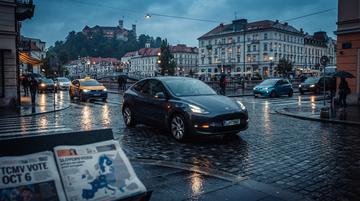
The event
Six EU countries, one TCMV vote, and an approval clock that's almost done
Tesla's FSD Supervised is now legal on the roads of six EU member states: Netherlands (April 10, 2026), Lithuania, Estonia, Denmark, Belgium, and Slovenia (announced September 7, 2026, per the Tesla Europe account on X). Slovenia is the first new approval since Belgium in June and the first to land inside the four-week window before the Technical Committee on Motor Vehicles (TCMV) is expected to vote on bloc-wide recognition — currently scheduled for October 6, 2026.
EU countries with FSD Supervised approval
6
As of Sept 7, 2026 (Netherlands, Lithuania, Estonia, Denmark, Belgium, Slovenia)
TCMV EU-wide vote
Oct 6, 2026
Requires ≥15 states representing ≥65% of EU population
Tesla's claimed EU crash-rate edge
4.1× lower
FSD vs manual across 100M km, Sept 1, 2026 safety dashboard
Tesla EU registration share, Feb 2026
33% of BEV
Per ICCT Feb 2026 monitor; Tesla was #2 in EU BEV registrations
The TCMV vote matters because it would lift the Dutch RDW's type approval into all 27 member states at once, bypassing the slow country-by-country grind Tesla has run since April. The bloc hasn't voted on FSD yet — the June 30 TCMV session was discussion-only, and Finland's Traficom has publicly flagged October as the next real window. Reuters reported the October 6 timing on September 8, citing Tesla's own briefings to EU regulators.
Why this is a binary
France is opposed, Sweden is sceptical, and Tesla's own safety data is the exhibit
- France's transport minister said publicly on July 22, 2026 that FSD would not be authorised in its current form — France is the bloc's second-largest car market and a 'no' weight on the qualified-majority math.
- Sweden signalled it may vote against over how FSD handles posted speed limits, per ETSC's letter to EU transport ministers.
- The ETSC itself urged ministers to delay, pressing four questions: independent crash-rate evidence, US-federal investigations, driver-overreliance risk, and — critically — who investigates a fatal crash in Europe where the US has an NTSB equivalent and Europe doesn't.
- Tesla published its safety dashboard on September 1 to head off the criticism, claiming FSD is 4.1× less likely to crash than manual driving across 100M km of EU roads. Earlier numbers from the same dashboard were higher (5.2× in July, 3.5× in the Netherlands in June) and earlier-milage figures were lower — a decline the article notes may reflect statistical reversion as more kilometres accumulate.
What the EU unlock is worth
Tesla's FSD revenue line is already running at ~$775M annualised — Europe is the multiplier
Tesla ended Q2 FY2026 (quarter ended June 30, 2026; 10-Q filed July 23, 2026) with 1.48 million active FSD subscriptions, up 56% YoY and 15.6% sequentially, per the Tesla Q2 2026 Update. At the $99/month subscription price, that translates to roughly $775 million of annualised FSD subscription revenue — a line that didn't exist at scale 24 months ago. Total Q2 revenue was $28.24 billion (+26% YoY), but services and other revenue grew faster, up 50% to $4.6 billion, with services gross margin hitting a record 14.1%, per Tesla's Q2 2026 earnings coverage.
Tesla FSD subscription economics, Q1 → Q2 FY2026
Quarterly progression of FSD subscribers and Tesla services revenue. Sources: Tesla Q2 2026 Update; Tesla Q2 2026 10-Q.
Unit: M subscribers / $B
FSD subscribers Q1
Million, per Q1 2026 update
1.3
FSD subscribers Q2
Million, per Q2 2026 update
1.5
Services revenue Q2
$B, +50% YoY
4.6
FSD ARR run-rate
$B, derived from 1.48M × $99/mo
0.8
Europe is the lever that turns that line from a US-centric subscription business into a global one. Tesla European registrations more than doubled year-on-year in May 2026, lifting EU market share from 0.9% (May 2025) to 2.3% (May 2026), and the ICCT's February 2026 monitor put Tesla at 33% BEV registration share in Europe — second only to BYD at 45%. With roughly 1.2 million Tesla vehicles on European roads (per industry registration aggregates) and FSD priced at €7,500 outright or €99/month in the EU, a 20–25% EU attach rate inside 18 months of bloc-wide approval would add ~$300–400 million to the subscription line on top of the existing run-rate.
Who's locked out
Mobileye, Mercedes and BMW all need a different answer if Tesla clears Europe first
The supply chain for advanced driver assistance in Europe runs through three lanes: camera-and-chip incumbents like Mobileye (EyeQ family, supplied to most major OEMs); European OEMs with in-house Level 2/3 stacks like Mercedes-Benz and BMW; and pure-play AV operators like Alphabet-owned Waymo, Amazon-owned Zoox, and Aurora Innovation. Tesla's EU approval doesn't change the chip supply picture, but it changes the political timeline for everyone else.
| Company | EU regulatory status (Sept 2026) | Robotaxi / Level 3 plan | Key exposure to EU unlock |
|---|---|---|---|
| Tesla | 6 member states; TCMV vote Oct 6 | Robotaxi in Austin + 6 US cities; Cybercab pending | Direct beneficiary — FSD subscription ARPU |
| Mobileye | Supplies ADAS chips to EU OEMs; no L4 EU approval yet | Vertically integrated robotaxi launch Munich + Tel Aviv 2027, per CNBC, Jun 16, 2026 | Indirect — slower L4 EU approval if FSD monopolises regulator attention |
| Mercedes-Benz | Drive Pilot Level 3 approved in Germany; urban rollout end-2026 | Scrapped updated Level 3 plan in Jan 2026; pivoting to Level 2+ MB.DRIVE ASSIST PRO | Direct — already at the cap of EU L3 regulation; FSD approval raises consumer bar |
| BMW | First OEM to get DCAS hands-off approval in Germany (Nov 2025) | Urban automated driving in Germany end-2026 | Direct — DCAS approval now needs to compete with FSD in customer consideration |
| Alphabet (Waymo) | Testing in Munich; UK London debut 2026 | London 2026; Munich 2027 — first EU commercial launch | Indirect — Waymo timetable now looks late if FSD opens EU consumer market in 2027 |
| Aurora Innovation | US-only; trucking-focused, not relevant to EU L2/L3 | 200 driverless trucks target by YE 2026; $14–16M 2026 revenue | Limited — Aurora's trucking TAM is US, not EU passenger AV |
Mobileye's Q2 FY2026 (quarter ended June 27, 2026; earnings release dated July 23, 2026) was the soft patch that makes the EU dynamic worse: revenue of $508 million, flat YoY, and adjusted operating income of $155 million, down 46% YoY, per the Mobileye Q2 2026 earnings release. The market reacted by marking the stock down premarket despite the beat on consensus revenue. Mobileye's full-year 2026 revenue guide is now $1.97–2.02 billion — implying 4–7% growth at the midpoint — and the company is betting the vertically integrated robotaxi (Munich and Tel Aviv in 2027) is the growth lever that ADAS chip sales can't be anymore.
Cross-industry spillover
Waymo's $126B raise and Zoox's Munich test both look late if FSD opens the EU in 2026
Two non-Tesla Western AV operators are racing into Europe from a different angle — purpose-built robotaxi service rather than consumer-owned FSD — and the Slovenia approval changes their timeline math. Alphabet-owned Waymo closed a $16 billion funding round at a $126 billion post-money valuation in February 2026, led by Alphabet itself. Its stated European plans, per Reuters and Automotive World coverage, are a London robotaxi launch in 2026 and a Munich commercial launch in 2027 — both unsupervised Level 4 service in geofenced areas, not the consumer-car Level 2+ system Tesla just got cleared in Slovenia.
Amazon's Zoox is also testing in Munich ahead of a planned 2027 launch, and began paid robotaxi service in Las Vegas on August 10, 2026. The strategic gap is real: Waymo and Zoox are chasing a robotaxi service TAM that may take until 2028 to reach EU scale, while Tesla is unlocking a consumer-vehicle subscription TAM that monetises from day one of approval. Two different businesses, two different regulatory paths, but the same EU regulators — and that bottleneck is what Slovenia just handed Tesla a head start in.
- Uber — partnered with Pony.ai in August 2026 to deploy 2,000 robotaxis in Europe and expand into the Middle East, per CNBC, Aug 14, 2026; Pony.ai also runs the Zagreb commercial robotaxi service with Verne, the first of its kind in Europe.
- Aurora Innovation — Q2 2026 revenue of $2 million, net loss of $270 million, full-year 2026 revenue guide of $14–16 million; targeting 200 driverless trucks by year-end, per Aurora Q2 2026 results via FreightWaves. Orthogonal to EU passenger AV but illustrative of how thinly monetised pre-commercial AV still is.
- Amazon — owns Zoox; EU timing now depends on whether regulators treat purpose-built robotaxis and consumer-owned FSD as separate approval tracks.
Horizons
Days–quarters: October 6 vote and Q3 deliveries. Years: who runs EU robotaxi in 2028
Short-term (days to quarters): the October 6 TCMV vote is the catalyst. A 'yes' pushes Tesla FSD attach into the 21+ EU states that haven't approved unilaterally; a 'no' leaves Tesla running the same six-country grind and shifts the EU narrative toward Mobileye's slower Munich 2027 robotaxi and Alphabet's London 2026 / Munich 2027 Waymo launches. Q3 deliveries will also test whether Tesla's EU sales momentum (May 2026: +100%+ YoY, EU share 2.3%) holds once Model Y refresh noise fades.
Long-term (1–3 years): the structural question is whether EU consumers treat FSD as a car feature or a robotaxi substitute. If FSD becomes the default expectation, Tesla services revenue compounds at 40–50% annually through 2028 (a 50%-growth path on the $4.6 billion Q2 services base puts services at ~$10 billion by Q4 2027); if regulators constrain it to highway-only, Mobileye's L4 Munich launch and Waymo's Munich 2027 commercial start get the operating-data advantage instead. The most likely outcome is bifurcation: FSD for owned vehicles, Waymo/Zoox/Mobileye Drive for robotaxi — but the order in which each clears regulators will decide which company gets the marketing narrative, and Slovenia just put Tesla first in that queue.
Stocks this event touches
- Slovenia + 5 EU approvals position TSLA as the only Western AV vendor with a national-clearance footprint in the EU; Q2 FY2026 services revenue rose 50% YoY to $4.6B with a record 14.1% gross margin, per the 10-Q filed July 23, 2026.
- A bloc-wide TCMV 'yes' on October 6 could add ~$300–400M to FSD ARR within 18 months on existing EU vehicles at a 20–25% attach rate — material vs. the current ~$775M annualised run-rate from 1.48M subscribers (Q2 FY2026).
- Near-term: October 6 vote is the binary; downside if France and Sweden sink the qualified majority, leaving TSLA stuck on six-country rollout and capping EU FSD attach at 6/27 states through 2027.
- Q2 FY2026 revenue flat YoY at $508M and adjusted operating income down 46% to $155M, per the Mobileye Q2 2026 earnings release (July 23, 2026) — the ADAS-only model is decelerating.
- Tesla's October 6 vote is a regulatory-attention risk: if TSLA clears the EU first, MBLY's planned Munich/Tel Aviv 2027 robotaxi launch lands into a market where consumers already associate 'self-driving' with Tesla, not Mobileye Drive.
- Upside if TCMV rejects FSD: MBLY's vertically integrated robotaxi business gets 12–18 months of uncontested EU regulator mind-share and its OEM customers face less consumer pressure to mimic Tesla.
- Already approved for Level 3 Drive Pilot in Germany at 95 km/h; urban MB.DRIVE ASSIST PRO targets German cities end-2026, but Mercedes scrapped an updated Level 3 plan in January 2026, per The Verge.
- Tesla FSD EU unlock raises the consumer bar for what 'advanced driver assistance' means in showroom conversations — bad for DMLRY's premium-pricing story unless Drive Pilot moves faster than the current end-2026 plan.
- Long-term: Mercedes is structurally exposed because its Level 3 moat (German motorway at 95 km/h) is the segment Tesla's vision-only FSD also targets — if Tesla gets full EU clearance, the regulatory asymmetry disappears.
- First OEM to receive DCAS (Driver Control Assistance Systems) approval in Germany in November 2025, per BMW Group press; urban automated driving system planned for end-2026 in Germany.
- BMWYY is positioned as the OEM best-prepared for EU harmonisation under DCAS — if TCMV votes 'yes' on Tesla FSD, BMW's DCAS approval becomes the template European regulators may retrofit Tesla into, softening the competitive blow.
- Catalyst to watch: BMW's end-2026 German urban launch; a 'no' on October 6 protects BMW's regulatory lead, a 'yes' forces BMW to either match Tesla's breadth or partner with Mobileye for a Level 4 push.
- Waymo closed a $16B raise at $126B post-money valuation in February 2026; EU plans are London 2026 launch and Munich 2027 commercial debut — Tesla FSD approval does not directly compete with Waymo's robotaxi service, but it changes the EU marketing narrative.
- Near-term: London launch is the first test of whether Waymo's geofenced Level 4 service can monetise EU consumers who may soon have access to FSD in their own Tesla.
- Long-term risk: if Tesla's October 6 win triggers EU harmonisation, Waymo's Munich 2027 launch faces a regulatory environment more receptive to vision-only L2+ systems, narrowing Waymo's L4 differentiation pitch.
- Zoox started paid robotaxi rides in Las Vegas on August 10, 2026 and is testing in Munich ahead of a 2027 launch, per Reuters; total Zoox fleet targeted at 2,500 vehicles over two years per TechCrunch.
- Tesla FSD EU approval is an indirect catalyst for AMZN — it validates EU consumer appetite for self-driving, but it also means regulators face pressure to act on consumer-owned AV before purpose-built robotaxi frameworks are codified.
- Watch the Tesla October 6 vote outcome: a 'yes' likely accelerates EU work on a unified robotaxi framework (good for Zoox); a 'no' keeps the patchwork, which slows Munich 2027.
- Partnered with Pony.ai in August 2026 to deploy 2,000 robotaxis across Europe and expand into the Middle East, per CNBC; Pony.ai and Verne already launched Europe's first commercial robotaxi service in Zagreb in April 2026.
- Tesla FSD EU unlock is broadly bullish for Uber: more EU self-driving miles raise consumer comfort with ride-hail autonomy, and Uber's platform-aggregator model captures volume from whichever AV stack wins — Tesla, Mobileye, Pony.ai, or Waymo.
- Watch: Q3/Q4 2026 earnings for first disclosure of robotaxi ride volumes from the Zagreb + new EU markets — that's the proof point that AV demand is real, not just regulatory.
- Q2 2026 revenue of $2M and net loss of $270M; full-year 2026 revenue guide $14–16M with a target of 200 driverless trucks by year-end, per FreightWaves — the EU passenger AV race is largely irrelevant to AUR's US trucking TAM.
- Indirect read-through: Tesla FSD EU approval demonstrates regulators are willing to clear autonomous systems on safety data alone — a positive template for AUR's eventual autonomous trucking approvals outside its existing Texas/Arizona lanes.
- Risk: AUR's $14–16M revenue base vs. $270M quarterly loss shows how far behind commercial reality AV plays still are; if the EU vote triggers a rotation into 'AV is real' momentum, AUR benefits, but the operating leverage is far weaker than Tesla or Waymo.