
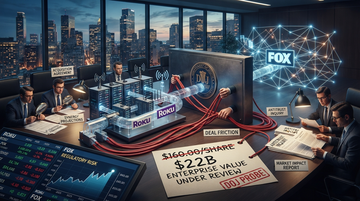
Policy & deal risk
What changed: DOJ is widening the antitrust inquiry into the Fox–Roku combination
Reporting from Sept. 8 says the U.S. Department of Justice is widening its antitrust inquiry into the Fox–Roku deal. The same reporting indicates the DOJ is moving toward a deeper information request (“second request” framing), which typically increases deal-friction, timelines, and compliance burden.
Transaction headline price
$160.00
Fox’s planned offer price per Roku share, announced Jun 15, 2026
Roku enterprise value (headline)
~$22B
Fox’s described transaction value, announced Jun 15, 2026
Verified deal terms
Fox is buying more than an app store: management is underwriting distribution leverage through TV households and monetization
Fox and Roku announced a definitive agreement on Jun 15, 2026 under which Fox will acquire Roku for $160.00 per share and an enterprise value of about $22B. Fox described the strategic logic as combining Fox’s premium live content and Tubi with Roku’s connected-TV platform, first-party data, and direct relationships with “more than 100 million” global streaming households.
Economics lens
Why antitrust risk matters for streaming economics: it can delay (1) distribution access, (2) ad-load growth, and (3) churn-avoidance improvements
When regulators focus on distribution deals, the practical economic mechanism is usually not “will the product exist?” but “will the combined distribution and monetization plan execute on the expected timeline and at the expected bargaining power?” In connected TV, bargaining power influences ad-load growth (pricing and fill) and churn (retention engineering via richer engagement signals). If the DOJ expands the inquiry and the path to closing stretches, management has less leverage and fewer operating months to convert planned synergies into actual subscriber and ad performance.
- Deal-friction delays the monetization integration window, which can push ad-load and performance improvements past the period when investors assumed they’d hit.
- Longer uncertainty can weaken subscriber retention initiatives, because product, data, and commercial operating changes often need coordinated governance post-close.
- Extended review can reduce negotiation leverage with content and ad partners, because counterparties may price-in a less certain future platform mix.
Fundamental checks (pre-deal baseline)
Baseline financial capacity: Fox generates high cash from operations, while Roku has been at the “scale-but-lumpy” stage
| Company | Revenue level | Free cash flow (latest annual/TTM) | Operating cash flow (latest annual/TTM) |
|---|---|---|---|
| Fox | $17.13B (FY2026 TTM) | $3.60B (FY2026 TTM) | $3.84B (FY2026 TTM) |
| Roku | $4.74B (FY2025) | $483.6M (TTM through Dec. 31, 2025) | $483.7M (FY2025) |
Fox’s reported (TTM) cash generation suggests it can fund the deal consideration through the review window without immediate balance-sheet stress, but a prolonged timeline still risks delaying accretion. Roku’s recent path shows much smaller absolute cash generation; Roku’s smaller cash base makes revenue and margin conversion timing more important if the combined distribution plan can’t execute promptly.
Supply-chain and platform transmission
Supply-chain map: who is upstream (ads/monetization stack), who is downstream (TV distribution), and why the leverage shifts
In TV streaming distribution, the upstream layer typically includes ad buyers, measurement, and sell-side monetization tools; the middle layer is the platform/distribution layer that controls access, discovery, and data; and the downstream layer includes advertisers and payers whose spending (and churn pressure) depends on how effectively impressions convert into engagement. A regulator scrutinizing a platform deal is implicitly checking whether the combined entity would gain excessive control over the middle layer, which can then distort upstream monetization economics.
What to watch (next 3–6 months vs. 1–3 years)
The near-term catalyst is process; the long-term catalyst is whether distribution leverage actually shows up in ad and subscriber metrics
- Near term: watch for deeper DOJ information requests and any incremental process signals that extend the review timeline beyond initial expectations.
- Near term: watch Roku and Fox guidance tone for monetization timing; deal uncertainty often shows up as “timing flexibility” language rather than revised fundamentals.
- Longer term: watch whether connected-TV monetization improves post-close—specifically whether any promised synergies translate into ad-load and retention outcomes.
Listed stocks most directly exposed to the Fox–Roku distribution-deal friction
- Fox’s reported FY2026 TTM operating cash flow supports deal funding through review, but longer antitrust timelines can delay accretion the company is underwriting.
- If DOJ requires deeper process, Fox may carry higher uncertainty costs before monetization integration and before any synergy run-rate shows up in results.
- Over 1–3 years, closing plus platform leverage should determine whether synergy economics materialize, not the headline $22B value.
- Roku’s FY2025 cash generation (~$483.7M operating cash flow) limits its tolerance for prolonged uncertainty, increasing the importance of timing.
- If integration is delayed, Roku could face softer near-term monetization momentum versus a clean close scenario.
- Over 1–3 years, the combined distribution model must show up in ad and retention metrics for the deal thesis to outperform.
- If regulators constrain platform integration, ad-tech monetization budgets may re-phase, affecting near-term demand-side flows.
- If the deal ultimately strengthens first-party distribution leverage, Magnite’s sell-side demand routing could see improved auction efficiency—but direction depends on post-close tech governance.
- Catalyst to watch: deal timeline updates and any operational statements around monetization stack integration (post-close).
- If connected-TV distribution concentrates, distributors like Comcast can face higher negotiating pressure on app/platform access and ad packaging.
- If the DOJ delays or narrows the combined platform’s scope, Comcast may retain more leverage in the near term (timing-dependent).
- Over 1–3 years, the winner is the party that converts viewing reach into stable advertising performance—regulatory outcomes shape that bargain.