
Deal mechanics
GE Aerospace is buying its way around castings scarcity
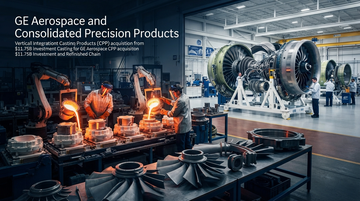
On Sept. 8, 2026, GE Aerospace signed an agreement to acquire Consolidated Precision Products (CPP) for a cash purchase price of $11.75 billion (subject to closing adjustments). The stated goal is to expand mission-critical castings capacity—a move aimed at tightening the upstream portion of the aircraft-engine supply chain instead of treating delivery delays as a purely downstream scheduling problem.
Deal size
$11.75B
Cash purchase price, Sept. 8, 2026 (subject to closing adjustments)
Expected synergies
$200M
Expected net synergies, stated in GE Aerospace’s acquisition presentation (Sept. 8, 2026)
Closing timing window
2H 2027
Expected transaction close timing, stated in GE Aerospace’s acquisition presentation (Sept. 8, 2026)
Supply-chain map
What “bottleneck monetization” really means in engine castings
Engine “bottlenecks” often show up as schedules slipping because casting lead times, yield rates, and qualified machining/finishing capacity don’t scale as fast as demand. CPP sits in that constrained upstream layer: high-value, tightly qualified metal components that must meet both structural performance and durability requirements. By moving that capacity under GE Aerospace, the company is trying to convert three economic levers into durable economics: (1) fewer expediting costs and less rework from qualification churn, (2) lower risk of lost deliveries when downstream assembly is ready but castings are not, and (3) better ability to sustain margins if customers accept longer-term supply agreements tied to mission-critical parts.
- In the near term, owning the casting constraint should reduce delivery volatility that can otherwise cap booked deliveries in backlog-heavy quarters.
- If customers keep facing qualification/lead-time friction, owning the bottleneck can stiffen effective pricing and contract terms for mission-critical components.
- If throughput improvements raise margins less than expected, the deal can still help cash flow by cutting working-capital stress (less expediting, less premium freight, fewer scramble purchases).
What GE can earn on
Where the profit uplift is most likely to show up on GE’s income statement and cash flow
GE Aerospace’s headline scale matters because the acquisition’s economics likely express through both segment-level profitability and group-level cash conversion. For example, GE Aerospace reported revenue of $50.639B and gross profit of $15.724B for the trailing twelve months used by the platform metrics, with an EBIT margin of about 22% (TTM). The bigger point for investors: even modest improvements in manufacturing yield, supplier pass-through costs, and backlog-to-delivery efficiency can matter disproportionately when fixed-cost absorption and service mix are stable.
| Metric | Value | What it helps explain for the CPP deal |
|---|---|---|
| Gross margin (TTM) | 35.4% | How much incremental cost control at the casting layer can translate into gross profit. |
| EBIT margin (TTM) | 22.3% | The sensitivity of operating profit to manufacturing and supply-chain cost execution. |
| Operating margin (TTM) | 20.8% | Whether execution improvements can realistically show up before large restructuring. |
Competitive implications
Why owning castings can change bargaining power across the engine value chain
The strategic shift is that GE Aerospace is effectively internalizing a component that many rivals still buy externally—making it harder for customers or other engine OEMs to arbitrage supply availability. If demand outpaces casting capacity across the broader industry, the OEM that controls qualification-capable casting capacity is better positioned to (a) protect deliveries, and (b) sustain contractual terms. That matters not only for commercial engines but also for defense-related propulsion where qualified castings can be embedded in long-cycle programs.
- Upstream: CPP-like casting capacity is constrained by tooling, scrap/yield, and qualification timelines; ownership should reduce bottleneck-driven cost overruns.
- Downstream: if castings arrive reliably, OEMs can convert backlog into deliveries more predictably; that can improve revenue recognition timing.
- Customer impact: suppliers that lose constraint leverage may see less pricing pressure; but the OEM that owns the choke-point can capture incremental margin instead of distributing it to constrained suppliers.
Short-term vs long-term
What investors should watch between now and the 2H 2027 close
In the short term, the stock reaction will likely hinge less on CPP’s integration and more on whether GE can prove it is gaining throughput reliability before the broader engine casting market normalizes. In the long term (2028–2029), investors should examine whether the casting capacity expansion creates sustained pricing/margin resilience or whether it merely clears a temporary shortage. With the expected closing in the second half of 2027, the “durable profit” question is essentially whether GE’s internal castings scale closes the gap faster than the rest of the supplier base can add qualifying capacity.
Investor angles
5 data-backed research angles this deal makes actionable
- Synergy credibility: whether the $200M expected net synergies show up without offsetting integration costs.
- Throughput economics: whether improvements show up as better operating leverage (margin stability) rather than one-time effects.
- Working capital: whether owning castings reduces expediting and inventory stress (a common bottleneck symptom).
- Durability test: whether pricing/contract terms tighten once industry casting capacity starts to recover.
- Risk mapping: whether qualification or yield ramp constraints delay the expected profit pathway despite ownership.
Listed stocks most exposed to the bottleneck economics
- The $11.75B CPP acquisition internalizes the supply choke-point GE needs to protect deliveries, with the expected close in 2H 2027.
- The $200M expected net synergies sets a measurable path to higher operating profit, but durability hinges on yield/qualification ramp versus one-time benefits.
- If GE’s vertically integrated castings reduce external demand in constrained categories, it can redirect volumes away from specialized aerospace metal suppliers.
- In the near term, casting capacity investments can raise industry competition for the same qualified material streams, pressuring pricing.
- Safran’s engine supply chain can benefit if industry castings remain tight and OEMs keep paying for reliability; that can support pricing for mission-critical parts.
- But if rivals owning castings capture margin, Safran can face relative margin pressure versus an OEM with more control of bottleneck capacity.
- More reliable supply from vertically integrated rivals can tighten competition for constrained castings, potentially hurting margin if Rolls can’t match supply control.
- If Rolls’ external supplier base expands qualification faster than expected, the bottleneck effect can fade quickly, turning margin support into a headwind.
- If casting-led engine delivery reliability improves, Boeing can see fewer propulsion delivery constraints on commercial programs in 2027–2028.
- The watch item is whether OEM bottleneck relief translates into aircraft schedule acceleration; timing depends on downstream engine integration throughput.