
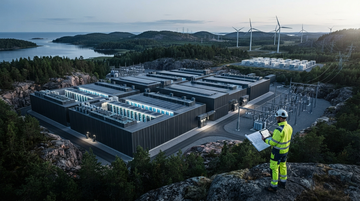
Verified capex event in Europe
Google is backing AI infrastructure with region-specific power and reliability—starting in Finland
What Google disclosed
Investment size
At least €13B
AI infrastructure investment planned for Finland over the next two years
Time window
2027–2028
Google’s Finland buildout timing described as “next two years” in the announcement
What it funds
Data centers + grid improvements + clean energy/batteries
Google linked the spend to energy affordability, grid resilience, and battery/grid flexibility
Real-economy outputs
Jobs and GDP contribution disclosed
Google cited construction-phase and operations-phase employment and GDP effects
On September 9, 2026, Google disclosed a Finland-focused AI infrastructure investment of at least €13B for 2027–2028, explicitly tying the program to data-center buildout plus electricity grid improvements and clean energy and battery initiatives. The core analytical move for investors is to treat this as a wager on utilization and economics: when a hyperscaler secures lower-friction power and reduces reliability bottlenecks, it can schedule training and inference more efficiently, delay or avoid higher-cost redundancy, and (if demand tracks) convert capex into measurable operating leverage.
The counter-question is equally important: hyperscaler capex is often judged as a cycle, and Europe-specific energy and permitting complexity can turn “strategic leverage” into a cash-flow burn if workload ramps don’t keep pace with commissioning.
Supply chain map
The “Texas of Europe” thesis is really about where constraints move: power first, then cooling, then packets
- Grid upgrades and battery projects try to make electricity availability and price volatility less of a training/inference constraint.
- Cooling and thermal management become more valuable when power delivery is optimized, because heat removal determines how closely the operator can run hardware to nameplate efficiency.
- Once power and cooling are steadier, network capacity and switches become the next binding constraint—especially for distributed training and high-throughput inference.
A region-specific capex plan like Finland’s is structurally different from a pure data-center footprint story. When the hyperscaler funds grid improvements and pairs clean generation with storage, it can reduce the probability that compute goes idle due to energy limitations. That can improve effective utilization (usable compute time vs. outage- or curtailment-driven downtime) and reduce the need for expensive stand-by options.
The second-order supply-chain angle is that “AI infrastructure” spending tends to concentrate spend in the physical layer: electrical distribution, power conditioning, and thermal control—then it expands into the switching/routing layer once racks can run at sustained duty cycles.
Causal chain
Can capex turn into leverage, or is it mainly a burn? The answer depends on conversion timing
Here’s the simplest conversion model investors can apply:
1) Build and electricalize first (grid, substations, storage contracts) so future capacity is deliverable. 2) Then commission hardware and connect networking so the cluster can run. 3) Finally, map committed workloads (training runs, inference traffic) onto that delivered capacity.
If Google’s Finland timeline (2027–2028) lines up with workload acceleration, capex can translate into (a) higher utilization and (b) better cost per delivered token/service. If it doesn’t, the market will likely price this as a near-term cash-flow headwind.
Google’s disclosures explicitly attempt to de-risk timing by choosing locations with existing grid infrastructure and by pairing clean energy with battery flexibility. That’s a strong argument that the plan is designed to reduce “power-denied compute.” But the market will still demand evidence that the installed capacity converts quickly into revenue and/or margin.
What to monitor next (short-term and long-term)
The measurable milestones are not just gigawatts—it’s reliability, utilization, and how fast capacity turns into unit economics
Google’s Finland AI infrastructure spend and disclosed build window
Event disclosures framed as at least €13B across 2027–2028
Unit: €B / years
AI infrastructure investment (Finland)
At least €13B disclosed
13
Build window
Next two years (2027–2028)
2
- In the next 6–12 months: watch for follow-on grid/energy contracting milestones tied to the Finland plan (battery operations timing, clean-energy add-ons).
- In 2027–2028: track whether announcements shift from construction/job outputs to operational readiness signals (commissioning schedules, capacity ramp language).
- Over 1–3 years: look for evidence that the physical constraint improvements (power + flexibility) translate into improved per-workload economics—cost and performance—rather than only larger absolute compute footprints.
The investor edge is to separate “capacity growth” from “constraint removal.” Google’s own messaging links the Finland program to grid resilience and energy affordability, suggesting it expects constraint removal to matter for unit costs and service-level delivery.
Even if investors agree with the direction, the tradable question remains: how quickly delivered capacity converts into measurable operating leverage.
Listed supply-chain and ecosystem names most exposed to the power→cooling→network conversion bet
- Google’s Finland plan prioritizes grid and energy flexibility that should help protect utilization during 2027–2028 ramps.
- Capex-heavy buildouts can pressure free cash flow until workload conversion catches up.
- AI data-center buildouts tied to power and reliability increase demand for thermal and power-management gear into 2027.
- If utilization improves as planned, Vertiv’s installed-base services should benefit from higher uptime needs over 1–3 years.
- Grid improvement and power-delivery upgrades support demand for electrical distribution and automation in hyperscaler builds.
- If battery and clean-energy integration expands as described, Schneider should see higher value in power reliability offerings over 1–3 years.
- Power-path investment for AI campuses tends to lift order flow for UPS and power protection systems into 2027.
- If hyperscalers reduce curtailment using flexibility, Eaton can benefit from more predictable data-center duty cycles over 1–3 years.
- Once the Finland program adds sustained operational capacity, higher east-west traffic makes high-performance switching more valuable into 2027–2028.
- If utilization rises with fewer power interruptions, Arista should gain from more continuous cluster networking needs over 1–3 years.
- More AI infrastructure commitments should support longer-run demand for accelerated compute as clusters ramp in 2027–2028.
- The bear case is timing: if capacity takes longer to convert into workloads, NVIDIA’s near-term demand can get delayed even if the end-state is constructive.