
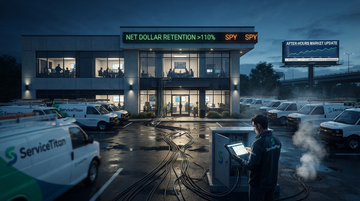
Earnings read-through for SaaS in the trades
If “AI scheduling” is monetizing, the first proof should be durable retention and repeatable expansion
For home-services and light construction contractors, after-hours scheduling is a classic lever with two very different monetization paths: either it expands the active customer base with fewer missed calls, or it simply reallocates demand that contractors already intended to capture.
From an investor’s standpoint, that distinction matters because it changes what shows up in KPIs. If the product is genuinely improving the customer’s unit economics (fewer missed opportunities, higher conversion, more booked jobs per technician), retention and spend expansion should hold up even when scheduling demand normalizes.
What’s verifiable from filings
ServiceTitan’s only clearly disclosed durability KPI in the latest period: net dollar retention above 110%
Net dollar retention (NDR)
Over 110%
Three months ended July 31, 2026
ServiceTitan disclosed that its net dollar retention rate was over 110% for the three months ended July 31, 2026—a durability signal that existing customers are expanding their spend with the platform.
What this does not prove: whether the incremental dollars were specifically driven by “after-hours AI scheduling,” because the primary filing language visible here did not break out an AI scheduling revenue line or provide AI-specific guidance mechanics.
Interpreting the “after-hours” narrative
After-hours scheduling can be seat-selling—or workflow automation—but filings don’t yet attribute it to guidance
Here’s the clean way to separate the two monetization stories once the full earnings release / guidance table is available:
- If AI scheduling is workflow automation: you’d expect retention to stay high and you’d see margin-friendly scaling (e.g., cost per booked job falling) because automation reduces labor/overhead.
- If it’s seat-selling: retention may still look strong, but expansion would more likely track platform packaging—more seats, more add-ons—without a cost-to-serve improvement tied to booking automation.
Today’s limitation: the filing excerpt available here provides retention durability, but not an AI scheduling attribution for guidance or for the revenue bridge.
Supply-chain lens (what must be true for monetization to stick)
Even if AI helps booking, ServiceTitan still depends on third parties for payments and operational infrastructure
A supply-chain aware read matters because “AI scheduling” affects operational execution, but monetization flows through the platform’s ability to convert jobs into finished payments.
ServiceTitan’s SEC disclosures include that for its platform/fintech usage, it works with third-party processors/financing partners for payments and settlement, and it records certain transaction fees net because it does not control the underlying payment settlement/financing. That dependency means the durability of any AI-driven booking uplift ultimately competes with the cost and eligibility constraints of third-party payment/financing rails.
In practical terms: if an after-hours automation feature drives more bookings, but financing/payment conversion is constrained, the platform may still show strong retention while missing margin or ARPU upside.
- AI scheduling should improve the booking funnel, but monetization must still pass through payment/financing rails controlled by third parties.
- If conversion bottlenecks persist, retention can remain >110% while ARPU growth is less impressive than investors expect.
- Unit-economics proof requires cost-to-serve metrics tied to booking automation, not just feature adoption language.
Investor checklist: what to watch next to confirm “AI scheduling” is real revenue durability
The next quarter’s KPIs should show margin-friendly expansion or explicit AI attribution
| Observation in next disclosures | What it would suggest | Why it matters |
|---|---|---|
| Retention stays >110% and expands alongside a clear AI scheduling driver | Workflow automation is expanding value, not just seats | It links feature → conversion → spend expansion |
| Retention holds, but ARPU/margins fail to improve | Seat-selling or demand digestion dominates | AI helps some jobs get booked, but doesn’t improve durable economics |
| Explicit margin-friendly cost-to-serve commentary tied to automated scheduling/after-hours handling | Cost per booked opportunity is falling | Automation is likely scaling without proportional overhead |
Listed plays touched by the payment-fintech + software durability chain
- ServiceTitan’s customer bookings can increase financing usage, but Affirm’s economics still depend on consumer eligibility and underwriting outcomes.
- If booking automation lifts installment demand near-term, it should show up as higher transaction volumes over coming quarters.
- If AI booking shifts demand toward lower-ticket jobs, average loan economics may not improve even with higher activity.
- More after-hours booking capacity can raise financing plan take rates, but it can’t remove underwriting and fraud controls.
- Near-term sensitivity: if financing demand rises, funded balances can trend higher within quarters.
- Downside: if automation increases high-risk conversion, loss rates can offset volume gains.
- ServiceTitan is currently showing durable customer expansion with net dollar retention above 110% for the three months ended July 31, 2026.
- The core open question is whether after-hours AI scheduling drives ARPU and margins, not just seat packaging.
- Next catalyst window: the next quarterly guidance/earnings bridge should explicitly connect AI scheduling to monetization.