
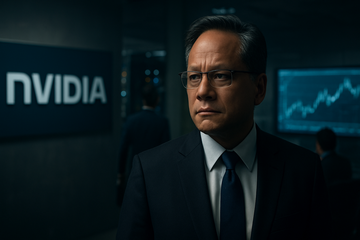
The U.S. Justice Department opened a formal antitrust probe into NVIDIA's December 2025 licensing deal with Groq and has already sent the chipmaker a written request for information, the New York Times reported on September 9, 2026 (via Reuters). The deal — labeled a \"non-exclusive license\" to Groq's inference IP plus the transfer of roughly ninety percent of Groq's engineering staff, including founder Jonathan Ross and president Sunny Madra — was Nvidia's largest transaction on record. The DOJ's theory is that the structure was engineered to sidestep Hart-Scott-Rodino premerger review. Even with the probe in early stages, the action quietly reframes every other \"license-and-hire\" deal Nvidia has signed in the last year.
What the DOJ Is Actually Testing
NVIDIA announced the Groq arrangement on December 24, 2025 as a \"non-exclusive inference technology licensing agreement,\" with Groq continuing to operate independently under new CEO Simon Edwards. The deal was reported at roughly $20 billion (the DOJ's working figure, per the Times, is closer to $17 billion) and included the absorption of senior Groq talent and most of its engineering team. Senators Elizabeth Warren and Richard Blumenthal had already pressed CEO Jensen Huang in March 2026 over whether the structure was a deliberate workaround for antitrust review, citing the company's roughly 90% share of GPU shipments.
The DOJ's likely remedies run from a quiet close (least painful) through monetary fines (the Times reports unwinding the deal is unlikely) to a consent decree with behavioral remedies such as mandatory FRAND licensing, royalty-rate caps, or limits on future acquihires. The probe does not need to end in a breakup to matter — it changes the discount rate on Nvidia's entire IP-consolidation strategy.
The Reverse-Acquihire Portfolio Already Deployed
The Groq deal is the largest line item in a playbook Nvidia has been quietly running since September 2025. Across the past twelve months the company has committed roughly $30 billion of capital through similar structures: an Enfabrica chip-interconnect license plus CEO hire (~$900 million, September 2025), the Groq arrangement (~$20 billion, December 2025), a Poolside Model Factory non-exclusive license plus equity (~$7 billion combined, mid-2026), an equity investment in SB Energy ($1.5 billion, August 2026) to anchor an OpenAI data center, a $3.5 billion convertible bond in MediaTek (August 2026), and ongoing discussions to back Perplexity at a $30 billion-plus valuation (August 2026).
| Date | Target | Structure | Reported value |
|---|---|---|---|
| Sep 2025 | Enfabrica | IP license + CEO acquihire | ~$900M |
| Dec 2025 | Groq | IP license + ~90% of engineers | ~$20B |
| Aug 2026 | SB Energy | Equity for OpenAI data center exclusivity | $1.5B |
| Aug 2026 | MediaTek | Convertible bond + NVLink Fusion partnership | $3.5B |
| Aug 2026 | Poolside | Model Factory license + equity at $12B pre-money | ~$7B |
| Aug 2026 | Perplexity | Equity round talks (also considered tech license) | $30B+ valuation |
| Sep 2026 | DOJ probe opens | — | — |
The legal hook is straightforward: a license is not a change of control, and people moving between firms are not assets under HSR. Stitching the two together — IP rights to the company, talent to the acquirer — buys the economic substance of an acquisition without the filing trigger. That is the loophole the DOJ is now probing.
Nvidia's Fundamentals Don't Make the Probe Cheaper to Endure
Nvidia is profitable enough to absorb a fine, but the optics matter for a stock trading near $224 against an analyst target of roughly $328 and a market cap of $5.42 trillion. The company posted $81.6 billion of revenue in Q1 FY2027 (period ended April 26, 2026) with data-center revenue of $75.2 billion, up 92% year over year, and a GAAP gross margin of 74.9%. Q2 FY2027 (period ended July 26, 2026) extended the run with $96.2 billion of revenue and $59.7 billion of GAAP net income. On a trailing-twelve-month basis through September 10, 2026, the company booked $303 billion of revenue, $192.9 billion of net income, and $7.95 of diluted EPS.
Q2 FY2027 revenue
$96.2B
period ended Jul 26, 2026; reported Aug 26, 2026
Q1 FY2027 data-center revenue
$75.2B
up 92% YoY; period ended Apr 26, 2026
TTM revenue (Sep 10, 2026)
$303.0B
trailing twelve months
GAAP gross margin (Q1 FY2027)
74.9%
non-GAAP 75.0%
Market cap
$5.42T
as of Sep 9, 2026
The rich valuation is itself a transmission mechanism. At 28.6x trailing earnings and a beta of 2.22, the stock discounts years of forward execution; any structural impairment to the IP-consolidation pipeline forces a multiple compression that growth alone may not offset.
Groq Is the Receipt, Not the Victim
The clearest priced consequence of the deal sits in Groq's own valuation. Three months before the December 2025 arrangement, Groq had raised a Series E at a $6.9 billion valuation. The $20 billion check from Nvidia funded large shareholder distributions, but the post-deal operating company — minus its IP, its founder, its president, and most engineers — was marked at $3.5 billion in an August 17, 2026 Series A led by Disruptive. That is roughly half the pre-deal private valuation, with planned NVIDIA participation in the new round underscoring how dependent the shell has become on the acquirer's ecosystem.
Groq's valuation path before and after the Nvidia license
Pre-deal private mark vs. the implied residual after IP and talent left the company
Unit: $B
Sep 2025 Series E
pre-Nvidia private valuation
6.9
Dec 2025 deal value
consideration paid by Nvidia
20
Aug 2026 Series A
post-deal residual valuation
3.5
Groq has pivoted to a neocloud model — 13 data centers today, scaling from 54 megawatts to 200 megawatts in 2027 — and is now buying Nvidia GPUs rather than selling competing inference silicon. The DOJ's question is whether the original deal was structured to extinguish a competitor while preserving the appearance of an independent rival.
The Supply Chain Reprices If the Playbook Breaks
If the DOJ imposes remedies, the impact radiates in three directions. Upstream, ASIC designers Broadcom and Marvell — which together control roughly 95% of the custom AI accelerator co-design market — gain negotiating leverage with hyperscalers that today default to Nvidia. Broadcom carried a $73 billion AI backlog entering 2026 and is targeting $100 billion of annual AI chip revenue by 2027, with OpenAI's first custom accelerator (the \"Jalapeño\" chip) deploying in 2H 2026 on TSMC 3nm/2nm processes. Marvell is projecting up to $11 billion of AI ASIC revenue in 2026, anchored to Amazon Trainium and Microsoft Maia.
- Broadcom AI backlog stands at $73B, with management targeting $100B of annual AI chip revenue by 2027 — a path that accelerates if Nvidia's IP consolidation is curtailed.
- Marvell guides up to $11B of AI ASIC revenue in 2026, anchored to Amazon Trainium and Microsoft Maia — both programs designed to reduce Nvidia dependence.
- ASIC shipments are projected to grow 44.6% YoY in 2026, nearly triple the 16.1% pace for merchant GPUs, per Tom's Hardware analysis of Trendforce data.
- Inference workloads are projected to account for two-thirds of all AI compute in 2026 — the segment where the Groq IP and ASIC alternatives most directly compete with Nvidia.
Midstream, TSMC's CoWoS allocation becomes more contested. Nvidia today absorbs roughly 60% of TSMC's advanced packaging capacity (about 595,000 wafers), with Broadcom at ~15% and AMD at ~11%. A regulatory cap on Nvidia's acquihire-driven IP build-out frees accelerator capacity for ASIC customers, modestly tightening Nvidia's foundry leverage but supporting TSMC's diversified mix. Downstream, neoclouds CoreWeave and Nebius — both of whom raise capital with Nvidia equity stakes and Nvidia GPU collateral — face renewed scrutiny over circular financing if the legal foundation of those transactions is challenged.
| Layer | Entity | Exposure to the probe |
|---|---|---|
| Upstream ASIC | Broadcom | Beneficiary — direct inference competitor, $73B backlog |
| Upstream ASIC | Marvell | Beneficiary — Amazon/Microsoft ASIC pipeline |
| Upstream foundry | Taiwan Semi (TSM) | Mixed — Nvidia CoWoS share pressured, ASIC mix rises |
| Midstream silicon | MediaTek | Watch — Nvidia's $3.5B convertible bond still settling |
| Downstream neocloud | CoreWeave | Mixed — Nvidia-dependent revenue, financing scrutiny |
| Downstream neocloud | Nebius | Mixed — Nvidia-dependent revenue, financing scrutiny |
| Central | NVIDIA | Subject of the probe; $20B+ of deal economics in question |
Short-Term Catalysts vs. the Long-Term Question
On a days-to-quarters horizon, the next data points are Nvidia's formal response to the DOJ information request (likely 60–90 days), the publication of any consent decree, and the next round of Senate pressure tied to the Warren-Blumenthal track record. Watch the OpenAI-Broadcom \"Jalapeño\" chip launch in 2H 2026 as the first physical proof point that ASIC supply is materially diversifying. A legal outcome that forces Nvidia to spin or re-license the Groq IP into a FRAND pool would reset the inference TAM and accelerate the ASIC mix shift already embedded in customer plans.
On a 1–3 year horizon, the structural question is whether \"reverse acquihire\" survives as a legal structure. The Poolside transaction explicitly used the same non-exclusive license template, and Perplexity talks reportedly included a tech-licensing alternative before settling on equity. If the DOJ wins the test case, every subsequent Nvidia deal above the HSR threshold faces automatic second-request review, and the implicit premium Nvidia pays for IP-and-talent bundles will compress toward market-clearing levels. The probe is small relative to Nvidia's $303 billion revenue base; the framework it sets is not.
The Groq story is a prime example of the American system working as designed to promote innovation, reward entrepreneurs, and benefit consumers.
Stocks whose setup is directly altered by the probe's outcome
- Trade at $224 vs. a $328 consensus target already discounts execution; a probe-driven IP framework reset compresses the premium embedded in 28.6x trailing earnings.
- Roughly $30B of deal value across Enfabrica, Groq, SB Energy, MediaTek, Poolside and Perplexity now sits inside DOJ scope; worst-case retroactive HSR penalties plus a structural rewrite of the IP-and-talent bundle.
- Forward path on inference pricing power weakens if FRAND licensing is forced, the headline scenario Senators Warren and Blumenthal are already demanding.
- $73B AI backlog and a $100B annual AI revenue target by 2027 lock in incremental share if Nvidia's IP build-out slows.
- OpenAI's 10GW custom accelerator program (3nm/2nm, deploying 2H 2026) is the most concrete proof point that hyperscalers are diversifying away from Nvidia.
- Roughly 95% share of the custom AI ASIC co-design market with Marvell turns Nvidia's IP retreat into Broadcom's pricing power.
- AI ASIC revenue projection of up to $11B in 2026 rides Amazon Trainium and Microsoft Maia ramps, both aimed at reducing Nvidia exposure.
- Inference workloads projected at two-thirds of all AI compute in 2026 shifts customer budget toward custom silicon, Marvell's specialty.
- Combined ~95% co-design share with Broadcom gives Marvell pricing power on any Nvidia retreat from non-exclusive license deals.
- 1.7 GW active-power target by year-end 2026 sits on Nvidia GPU allocations; any DOJ-driven delivery friction hits capacity first.
- Circular financing pattern (Nvidia equity, Nvidia GPU collateral, Nvidia demand) comes under SEC/FTC scrutiny if the licensing model is recharacterized.
- FY2026 revenue guidance of $12.6B assumes the Nvidia relationship stays open — watch the DOJ information request response for any delivery-restriction language.
- 800 MW–1 GW of connected-power target by end-2026 depends on Nvidia GPU shipments; any DOJ-driven supply discipline compresses the ramp.
- $9.3B of explicit 2026 capex sits inside a circular-financing narrative that would re-price downward if Nvidia's deal-making framework is curtailed.
- FY2026 revenue projection of $3.4B is structurally Nvidia-leveraged; the probe outcome is a binary catalyst for the financing structure that supports the ramp.
- Nvidia absorbs roughly 60% of CoWoS advanced-packaging capacity today; ASIC customers (Broadcom ~15%, AMD ~11%) reclaim share if Nvidia's IP ramp slows.
- OpenAI's Jalapeño chip on TSMC 3nm/2nm plus Broadcom's $100B 2027 AI revenue target shift TSMC mix toward ASICs over the next 6–18 months, broadly margin-neutral but higher-quality.
- The structural story stays constructive regardless of the probe; downside is limited to Nvidia-specific CoWoS reallocation, not a foundry slowdown.