
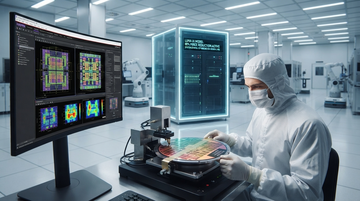
On September 8, 2026, OpenAI's CFO Sarah Friar framed AI for chip design as one of three specialized verticals the company is now selling into — alongside life sciences and financial services — at Goldman Sachs' Communacopia Technology Conference. The Reuters wire story moved the same evening. The announcement looks like a vertical go-to-market note; it is actually a structural event. OpenAI is now simultaneously a chip designer (it just bought EDA tools to tape out Jalapeño in nine months) and a chip-design tool vendor selling against the very suppliers it just paid. That is the line that matters for Synopsys, Cadence, and the privately held ChipAgents, which raised a $134M Series A in July 2026 to compete in the same wrapper layer.
What Friar actually said, and what the press release did not
The Reuters story lead is vertical-focused — chip design, life sciences, financial services — but two adjacent numbers in the same interview carry the investable signal. First, OpenAI cut the price of its Luna model by 80%, driving a roughly 10-fold increase in usage. Second, OpenAI's Codex coding tool has 25 million users, and enterprise revenue climbed 32% between June and July against a 20% overall annualized growth rate. That is not a chip-design announcement; that is a token-pricing war aimed squarely at the LLM layer that EDA vendors have been quietly bundling into their AI design suites since 2023.
- Luna price cut 80% — OpenAI's own framing: cheaper to deploy than Z.ai's GLM 5.3 on a cloud layer.
- Jalapeño taped out in nine months — designed with Broadcom, manufactured by TSMC, targeting initial deployment by end of 2026.
- Early Jalapeño samples show roughly 50% cost savings vs. typical AI GPUs, with 1.5–1.9× more AI work per watt at peak throughput on GPT-OSS 120B and DeepSeek R1 670B benchmarks (per OpenAI's own InferenceX results, Aug 25, 2026).
- Codex at 25M users and enterprise revenue +32% June→July show the AI-coding surface area is already built; chip design is the next vertical wrapper on top.
Which EDA revenue line actually gets repriced first
EDA breaks into three pricing layers: (1) the core place-and-route, signoff, and simulation engines, which are physics-based and unreplicable by LLMs; (2) the IP catalog (memory compilers, interface IP, standard cells), where design wins compound over years; and (3) the AI-assistant and copilot wrapper layer, where LLMs do RTL exploration, verification scripting, and natural-language EDA queries. OpenAI's move targets layer three. The market should not extrapolate that into a threat to layers one or two on a one-year horizon.
| Layer | Vendors / products | Replicable by a frontier LLM? | Time-to-reprice |
|---|---|---|---|
| Core P&R / signoff | Synopsys Fusion Compiler, Cadence Innovus, Siemens EDA Solido | No — physics-driven, decades of solver IP | Not on a 1–3 year horizon |
| Design IP catalog | Synopsys DesignWare, Cadence Star IP, Samsung foundry IP | Limited — physical design + tape-out history | Indirect, 2–3 years |
| AI assistant / copilot layer | Synopsys DSO.ai & AgentEngineer, Cadence Cerebrus AI Studio, ChipAgents | Yes — generic LLM + EDA plugin | Now (Luna 80% cut landed Sep 8) |
The interesting structural question is what percentage of the Big-3 EDA growth narrative is currently layer three. Cadence's IP business grew more than 40% YoY in Q2 FY2026 and its AI-related design products (Cerebrus, JedAI) drove the segment — but most of that is IP licensing and tool seats, not the copilot wrapper. Synopsys's Q3 FY2026 EDA revenue grew 8.5% and IP revenue grew roughly 11% YoY, both anchored to multi-year design wins, not to AI-copilot seat pricing. The layer-three exposure is real but probably under 15% of Big-3 revenue.
What the Big-3 themselves are reporting — the data that frames the fight
Synopsys Q3 FY2026 revenue
$2.477B
Up 42% YoY; FY2026 guide raised to $9.69B–$9.74B (reported Aug 26, 2026)
Both vendors are growing double digits, both raised 2026 guidance, and both have multi-billion-dollar backlogs locked in before the Luna pricing move. That backlog visibility is the cushion. The 2027 renewal cycle is where the layer-three pricing pressure lands — which is roughly when Synopsys and Cadence need to demonstrate that their first-party AI assistants (Synopsys's AgentEngineer, Cadence's Cerebrus) generate enough productivity uplift for chip designers that customers stay inside the EDA vendor stack rather than bolting on OpenAI's Codex or Luna as a generic front-end.
The supply chain reads through differently — these are customers, not competitors
OpenAI pitching AI for chip design does not threaten the foundry, IP, or compute supply chain. It amplifies demand on the chip-design-side of those businesses. Broadcom co-designed Jalapeño and shipped initial samples; that relationship is reinforced, not eroded. TSMC remains the manufacturing partner. Samsung Electronics deepened its OpenAI cooperation the same day (Sep 9) — joint production and research on next-generation chips, with Stargate memory commitments already in place. Cerebras, which already hosts OpenAI's GPT-5.3-Codex-Spark, picks up usage as the AI-coding surface area grows. NVIDIA's $2B Synopsys stake positions it as the GPU-acceleration layer EDA vendors will lean on to keep their own AI wrappers competitive. Only SK Hynix sits at the periphery here — relevant through the Stargate memory commitments and Jalapeño's HBM demand, not through the EDA story.
| Company | Role in OpenAI chip-design story | Direction |
|---|---|---|
| Broadcom | Jalapeño co-designer; multi-generation compute platform | Bullish |
| NVIDIA | $2B Synopsys stake; AI-EDA compute backbone | Bullish (indirect) |
| Samsung Electronics | Deepened chip cooperation Sep 9; Stargate memory supplier | Bullish |
| Cerebras | Hosts Codex-Spark; gains any Codex usage growth | Bullish (indirect) |
| Synopsys | Sells core EDA + IP to chip designers; competes with OpenAI wrapper | Mixed |
| Cadence | Same dual role as Synopsys | Mixed |
Short-term vs. long-term — where the timeline breaks
Over days to quarters, the read-through is muted. Synopsys just posted 42% revenue growth and raised guidance, and Cadence just hit a record $8.1B backlog. Neither company's core revenue is exposed to the Luna pricing action today — the AI-wrapper products are bundled into broader EDA seats or sold as optional add-ons that do not materially move quarterly numbers. Investors watching the Sep 10 tape should see the event as noise for FY2026 numbers and signal for FY2027/2028 contract renewals.
Over one to three years, the read-through tightens. The chip-design AI wrapper is the layer Cadence' Cerebrus AI Studio and Synopsys' AgentEngineer are built on; it is also where ChipAgents (private; expanded Series A to $134M in July 2026) is competing. If OpenAI's Codex — already at 25M users — is sold into chip design at Luna's token pricing, EDA vendors will face either compressed pricing on their AI add-ons or a step-up in customer-acquisition cost as enterprise buyers demand OpenAI compatibility inside their EDA stack. The likely equilibrium is interoperability (Codex plugs into Synopsys/Cadence tools as a coding front-end), but the negotiation leverage shifts toward the model provider.
Why this is not a Cadence-Killer, and not noise either
Three factors bound the downside. First, tape-out is not a coding task — OpenAI taped out Jalapeño in nine months not because OpenAI's models replaced physical design, but because OpenAI bought the standard EDA stack and used its models to compress the verification and RTL-exploratory phases. The physics engines (Synopsys' PrimeTime, Cadence' Tempus, Siemens EDA Solido) still did the work. Second, the IP catalog — Synopsys DesignWare and Cadence Star IP — is locked in by multi-year contracts tied to specific process nodes; Samsung's 2nm and TSMC's N2 IP commitments do not get repriced by a generic LLM. Third, NVIDIA's $2B Synopsys investment (Dec 2025) and Synopsys' AgentEngineer roadmap show the EDA vendors are not standing still — they are rebuilding the AI-wrapper layer with GPU acceleration as a moat.
Three factors bound the upside for OpenAI as an EDA competitor. First, customer inertia — chip designers have spent a decade building flows around Cadence and Synopsys tools, and a switch costs more in retraining than it saves in token costs. Second, the regulatory and IP-export overhang on AI-for-chip-design — the same audience that just watched OpenAI defend itself against Chinese open-source competition on pricing will not rush to put frontier-chip RTL in a third-party model. Third, frontier labs have a structural conflict of interest: OpenAI is also the largest single buyer of Broadcom inference silicon and a direct competitor for chip-design AI; chip companies may prefer a neutral AI layer, which is exactly the gap Cadence' Cerebrus and Synopsys' AgentEngineer are filling.
- Core P&R moat is intact; threat is concentrated in AI-copilot wrapper layer (<15% of EDA revenue).
- Big-3 backlog and FY2026 guidance absorb the Sep 8 announcement without multiple compression.
- NVIDIA's $2B Synopsys stake and Cadence' IP +40% growth anchor the long-term defensibility.
- Watch the FY2027 renewal cycle for first evidence of layer-three pricing pressure.
Investable takeaways
- Layer-three (DSO.ai, AgentEngineer) is the price-pressured product; core EDA + IP backlog ($9.69B–$9.74B FY2026 guide) is unaffected near-term.
- NVIDIA's $2B equity stake (Dec 2025) provides a structural moat through GPU-EDA integration that a generic LLM wrapper cannot match.
- Watch FY2027 renewal commentary for any disclosure of AI-wrapper pricing concessions; Q3 FY2026 EDA growth at 8.5% is the baseline to defend.
- Long-term: if agentic EDA becomes the primary user interface, Synopsys wins on integration; if a neutral model layer prevails, pricing power compresses.
- Record $8.1B backlog and IP revenue +40% YoY in Q2 FY2026 anchor the next 12 months against any Luna pricing pressure.
- Cerebrus AI Studio sits directly in the layer OpenAI is attacking; the Intel Star IP agreement is the bigger near-term driver.
- FY2026 guide raised twice in 2026 (to $6.26B–$6.34B), and AI design demand is the cited reason — a contradictory signal for EDA bears.
- Long-term: best-positioned among Big-3 if AI-wrapper competition fragments, because IP and signoff create switching cost.
- Jalapeño co-design (unveiled Jun 24, 2026) plus OpenAI's Sep 8 chip-design push points to more multi-generation ASIC demand.
- Inference-chip design is exactly the work Broadcom is best-paid for; OpenAI's verticalization adds demand, not competition.
- Long-term: as OpenAI pitches AI-for-chip-design to enterprise customers, Broadcom's reference-design relationship with the largest US frontier lab compounds.
- Near-term: initial Jalapeño deployment by end of 2026 is the first revenue inflection tied directly to the strategy.
- $2B Synopsys stake (Dec 2025, $414.79/share) makes NVIDIA the GPU-EDA backbone regardless of which AI-wrapper wins.
- AI-for-chip-design scales GPU compute demand at every layer — inference (Codex), training (Cerebrus), and physical verification acceleration.
- Indirect beneficiary if Synopsys/Cadence defend the AI-wrapper layer through AgentEngineer / Cerebrus GPU acceleration.
- Long-term: the customer-of-EDA becomes competitor-of-EDA trend validates NVIDIA's full-stack thesis — silicon, software, EDA tooling.
- OpenAI deepened Samsung cooperation on Sep 9, 2026 — same day as the chip-design announcement; chip-production joint work referenced.
- Stargate memory commitment already in place (with SK Hynix); new chip-design vertical adds foundry and advanced-packaging revenue potential.
- Jalapeño's 2nm-class inference workloads and ChatGPT Enterprise use cases favor Samsung's foundry and HBM roadmap.
- Long-term: enterprise AI customers buying OpenAI's chip-design service will likely buy through Samsung's foundry and packaging capacity.
- HBM demand rises with every Jalapeño and OpenAI-co-designed inference chip; Stargate memory commitments are a multi-year tailwind.
- Indirect exposure to AI-for-chip-design vertical through memory content per AI server, not EDA risk.
- Long-term: as OpenAI pitches AI to chip designers, the resulting chip volume expands HBM TAM; SK Hynix is supply-constrained.
- Near-term: HBM4 ramp and OpenAI memory LOIs signed in 2025 are the more concrete near-term catalyst than the Sep 8 announcement.
- Already hosts OpenAI's GPT-5.3-Codex-Spark (Feb 2026); any growth in Codex usage translates to Cerebras inference volume.
- AI-for-chip-design vertical adds enterprise agentic-coding workloads that benefit from Cerebras's low-latency inference.
- Long-term: if OpenAI pitches agentic chip-design workflows at scale, Cerebras is the natural inference substrate.
- Near-term: $5.55B IPO (May 14, 2026) at $185/share; first-day close $311.07 — valuation already reflects OpenAI partnership.