
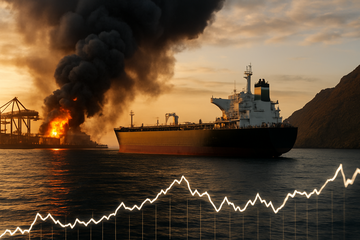
This is not the2024 Red Sea shock replaying on loop. The Houthis have just executed the largest single advance on Yemen's Red Sea coastline of the conflict: in roughly 48 hours they took the port city of Mokha, the Khalid ibn al-Walid military camp and the Red Sea island of Zuqar — moving within artillery range of the Bab el-Mandeb chokepoint that carries roughly 12% of seaborne oil and about 30% of all container traffic. The seizure coincided with a broader push along Yemen's west coast and a renewed missile-and-drone barrage against Saudi Arabian cities and oil facilities. Three markets are now repricing the geographic shift in parallel: oil, tanker freight, and marine war-risk insurance — and US-listed names sit across all three.
What changed in48 hours: the map, not just the news
The trigger event is concrete and dated. On the night of September 9, 2026, Houthi fighters pushed pro-government forces out of Mokha after fierce urban combat; by Thursday morning Houthi patrols were moving through the streets and a Yemeni commander, Maj Gen Tareq Saleh, confirmed a \"strategic retreat\" south of the city. A Houthi field commander told media that the Bab el-Mandeb Strait could now be considered \"under Houthi administration.\"
- Mokha (Taiz province) was the last major government-held port on the western Red Sea coast, ~150 km south of Houthi-held Hodeidah.
- ACLED estimated 276 fatalities across the five-day offensive; Saudi Arabia reported 73 civilians injured in retaliatory strikes on Abha, Khamis Mushait and Jazan.
- Saudi Arabia carried out at least 15 airstrikes between Sept 3–7, then54 more across Houthi-controlled Yemen after the Mokha seizure.
- The coalition said it would \"respond\" to the Houthi barrage; speculation is rising that Riyadh may invoke the mutual-defense clause of the Mecca agreement and request Pakistani or Turkish forces.
Oil just stepped into a different regime
Brent crude was already trading around $97.92 a barrel on September 8, when the Houthi barrage on Saudi oil tankers first lifted futures0.9%. The Mokha seizure changed the geometry: on September 10, Brent jumped to an intraday high of $109.62 a barrel — the highest level since May — before settling near $105.47 a barrel on September 11. Capital Economics framed the move explicitly: simultaneous fighting on both sides of the Arabian Peninsula raises the probability of further price increases over coming weeks.
Brent crude intraday high (Sept 10)
$109.62/bbl
Highest since May 2026; +12% from $97.92 on Sept 8
Brent month-on-month change
+18.5%
Through Sept 11, 2026 close
Saudi crude exports
3.2M b/d
Latest monthly data,10-year low
U.S. retail gasoline (avg.)
$4.28/gal
Up 34% year-on-year
Tanker day-rates are pricing the reroute — and the VLCC fleet has the cleanest exposure
Rerouting a loaded VLCC from the Persian Gulf to Europe via the Cape of Good Hope, instead of south through Bab el-Mandeb and west through the Suez Canal, adds more than three weeks and millions of dollars per voyage. With Houthi control now visible from the southern approach, owners are pulling ships off the Red Sea corridor. Kpler ship-tracking data showed only 12 vessels transited Bab el-Mandeb on Thursday September 11 — versus 30 on Wednesday, 26 on Tuesday and 29 on Monday. Only one of those 12 crossings was a vessel heading into the Red Sea; the rest were heading out, away from the strait.
| Benchmark | Current level | Reference |
|---|---|---|
| VLCC Middle East-to-China (TD3C benchmark) | ≈$800,000/day | Daily TCE, reported Sept 10 |
| VLCC aggregate daily earnings (Kpler view) | >$100,000/day through 2027 | Above2× historical norm of ~$45,000 |
| Suezmax (1M bbl) day-rate | ≈$100,000/day | Near2026 peak |
| Frontline FY2026 VLCC cash breakeven | ≈$23,800/day | Company-reported range |
| Frontline 2026 term-cover range | $75,000–$120,000/day | Company-disclosed charter book |
Morgan Stanley's latest note goes further: two-year VLCC time-charter rates could rise 20–30% on this signal alone, locking in revenue for operators with available tonnage through 2027 and 2028. The pure-VLCC names — Frontline (41 VLCCs), DHT Holdings (22 VLCCs) — sit at the apex of this curve. Mixed-fleet operators International Seaways, Scorpio Tankers and Teekay Tankers carry product-tanker exposure (LR2, MR, Handymax) that benefits from Red Sea rerouting but lags VLCCs on direct tonne-mile impact.
Tanker-operator scale by segment exposure
Fleet mix as of latest company disclosure, 2026
Unit: vessels
FRO VLCCs
41
INSW fleet
83
STNG tankers
90
TNK owned/leased
48
DHT VLCCs
22
War-risk insurance is the second-order lever — and brokers are the listed gateway
Every time Houthi activity rises, the Joint War Committee — the London-market body that sets listed \"war-risk zones\" for marine underwriters — expands the High Risk Area boundaries and triggers an automatic repricing of war-risk premiums. That pricing flows through to shipowners and charterers within hours. The current snapshot, per Reuters and Lloyd's Market Association data: indicative war-risk premiums for southern Red Sea voyages have risen to1–2% of hull value, from 0.3% a week earlier. For tankers calling at Saudi ports closest to Yemen — Jizan and Al Shuqaiq, plus Bab el-Mandeb transits — quotes have touched 3% of hull value. Even northern Saudi ports have repriced: Jeddah and Yanbu moved from 0.25% to about 1% in a single week. By contrast, Hormuz premiums have already pushed to 7.5–10% of hull value.
The corporate transmission runs through the three global insurance and reinsurance brokers with marine and energy practices large enough to absorb the work: Aon, Arthur J. Gallagher and Marsh & McLennan. Marsh, in particular, owns Guy carpenter — the world's largest reinsurance broker — and is the listed name most directly exposed to marine war-risk placements when the Joint War Committee revisits zones. None of the three is a pure-play on tanker war-risk; the upside is incremental revenue in a marine practice that, for the brokers, contributes single-digit percentages of total revenue. The bigger second-order play is reputational: when underwriters reprice fast, broker commissions reprice with them, and Aon and AJG have both publicly expanded their marine specialty teams this year.
Supply chain: who is upstream of the choke point, and who is downstream
- Upstream suppliers (crude lifters): Saudi Aramco — now exporting3.2 million b/d, the lowest in more than a decade; ADNOC, Kuwait Petroleum Corporation and Iraqi state oil also load in the Persian Gulf and would face identical rerouting economics.
- Upstream operators (named ship managers affected): Dynacom Tankers (Greece) — manages the Alexandros, which turned south in the Red Sea this week; COSCO Shipping (China) — manages the vehicle carrier Liu Jiang Kou and the tanker Xin Long Yang, both of which have U-turned in recent days; Formica Navigation (Singapore) — manages the products tanker Philoxenia.
- Downstream of the choke point: Asia-Pacific refiners in China, India, Japan and South Korea that lift Saudi and Gulf grades; the Suezmax and VLCC fleet that lifts them is dominated by Greek and Norwegian owners operating under U.S.-listed holding companies.
- Insurance market infrastructure: the Joint War Committee of the Lloyd's Market Association and the London insurance market sets listed-zone boundaries that drive automatic repricing — a non-equity mechanism, but the financial-services channel through which most of the premium move takes place.
Shipping data already shows the rerouting decision made before the higher insurance quote lands. Five tankers changed course on Wednesday September 9; two immediately signaled the Suez Canal as their new destination instead of continuing south toward Bab el-Mandeb. A sixth — the COSCO-managed vehicle carrier Liu Jiang Kou — turned away in the Gulf of Aden after listing Jeddah as her next port. None of those vessels were Houthi-flagged or Saudi-linked. They are responding to the spread of risk, not the target list.
Horizons: what moves in the next 30 days, and what shifts by 2028
Short-term (days to a quarter): Brent is most sensitive to any confirmation of further Houthi advances on Aden or direct fire on tankers in transit. Each confirmed attack on a named vessel — the Encelia and Layla are the recent Saudi tankers hit — historically adds $1–3 a barrel intraday. Conversely, a coalition ground response, or Houthi \"de-escalation\" rhetoric, can take $5 out of the front of the curve within48 hours. The next binary event is whether the Joint War Committee formally widens the listed zone to include the entire southern Red Sea; if it does, southern Red Sea premiums will re-anchor near 3% of hull value within hours.
Medium-term (one to two years): VLCC term rates are the right indicator to watch. Morgan Stanley's 20–30% two-year TC rate increase scenario implies that operators with tonnage available in late 2027 and 2028 — Frontline, DHT Holdings, International Seaways, Teekay Tankers — can lock in cash flow well above current spot. The risk is that the geopolitical premium fades faster than expected if the strait reopens; the VLCC fleet's recent earnings power has been anchored above $100,000/day for months already, and a swift Saudi–Houthi de-escalation would compress it back toward the $45,000 historical norm.
Long-term (one to three years): the structural read is that the Bab el-Mandeb corridor is being repriced for a multi-year risk premium, not a one-off shock. Saudi Aramco's planned 5 million b/d expansion now ships through the same chokepoint that just came under hostile artillery, and the East–West pipeline can move only a fraction of total Gulf exports. For the U.S. tanker operators that own the long-life VLCCs, this is a multi-year tailwind on top of an already tight fleet — but it is also a tailwind that depends on the geopolitics staying loud. The single largest risk to the bull case is a quiet deal.
What it means, in one sentence
Stocks this event actually moves
- Operates 41 VLCCs — the asset class most directly repriced by rerouting around Africa; VLCC cash breakeven is ~$23,800/day while spot TCE benchmarks print near $800,000/day on the Middle East-to-China lane.
- Q2 FY2026 results show TTM revenue of $2.71B and a P/E of 7.1; a 20–30% lift in two-year TC rates would compound onto an already record earnings base.
- Stock trades 14% below the 52-week high of $48.72 set in early September 2026, meaning the rally has begun but the fleet-level margin expansion is still ahead.
- Pure-play VLCC owner (22 ships), no product-tanker dilution — every basis point of Red Sea war-risk reroutes straight to its TCE.
- Highest dividend yield in the peer set at 23.4% on the latest dividend; Mokha-driven term-cover repricing lifts the cash-back ratio the buyback and payout are anchored on.
- Just locked a 3-year TC for the DHT Jaguar at $75,000/day from September 2026 — the floor case for the stock is already monetized, with spot upside on top.
- Mixed fleet of 83 vessels spans both VLCCs (crude) and product carriers (LR2/MR), so it captures both the crude-rerouting premium and the clean-product rate strength that follows.
- Q2 FY2026 net margin of 61.8% and trailing P/E of 6.6x leave the operating leverage unusually wide for a tanker name with this scale.
- Stock already up double-digits in the past month per Lloyd's List; a continued Bab el-Mandeb risk premium would extend the multiple re-rating from 6.6x to the 8–10x range typical of mid-cycle tanker booms.
- Product-tanker-skewed fleet (34 LR2, 42 MR, 14 Handymax) catches the product-rate uplift from Red Sea rerouting but misses the pure VLCC spike.
- Net-cash balance sheet (net debt/EBITDA of -1.0x) means management can sustain dividends at2.1% yield and accretively buy tonnage if rates stay above $50,000/day.
- Q2 FY2026 P/E of 5.1x is the cheapest in the peer set — the discount reflects the product-mix risk that has now turned into the product-rerating opportunity.
- Aframax- and Suezmax-heavy fleet gets the most direct mileage from Red Sea disruption because those ship sizes are the workhorses of Atlantic–Med–Asia routes.
- Net-cash balance sheet with debt/equity at 1.2% makes the dividend (currently 1.1% yield) and any opportunistic repurchase unconstrained by leverage through the rate spike.
- Q2 FY2026 P/E of 5.7x and TTM revenue of $1.15B imply meaningful operating leverage if Aframax TCEs sustain above $60,000/day into2027.
- Largest marine and energy specialty practice among the brokers — when Joint War Committee zones expand, Aon's brokerage commissions reprice alongside premiums.
- Insurance-brokerage revenue grew at single-digit pace in H1 FY2026 (latest revenue $17.58B TTM); Red Sea premium inflation is incremental, not a re-rating catalyst on its own.
- Stock trades near the low end of its 52-week range ($303.10–$381.47); the geopolitical tailwind is real but small relative to Aon's broader risk-capital and health solutions mix.
- Broker has been expanding its marine specialty team in 2026 — broker commission revenue from marine war-risk placements is rising but not separately disclosed.
- Q2 FY2026 earnings fell 10.7% YoY, so the headline number is not the lever; the lever is whether AJG can convert the marine expansion into a brokerage segment margin pick-up through FY2027.
- Watch the next earnings call (expected late October2026) for explicit commentary on Red Sea premium inflation and JWC zone updates.
- Owns Guy carpenter, the world's largest reinsurance broker — direct exposure to marine reinsurance treaty renewals each January, which is where Red Sea risk gets repriced fastest.
- Risk & Insurance Services revenue of $27.95B TTM with14.2% net margin means even a 100bps lift in marine-brokered premium drives material operating leverage.
- Q2 FY2026 revenue growth of 6.2% YoY is the right baseline; a sustained Bab el-Mandeb risk premium could push that into the high-single-digit range through FY2027.