
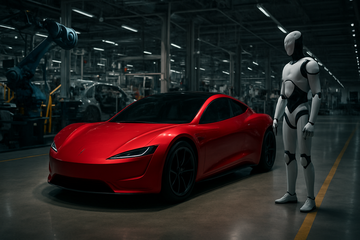
Roadster reveal
Oct 1, 2026
Tesla teaser confirms \"10.01\" event; production not until 2027–2028
Q2 2026 capex
$5.79B
+142% YoY; drove first negative free cash flow quarter of 2026 (-$1.09B)
2026 capex guide
>$25B
CFO Vaibhav Taneja on July 22, 2026 earnings call; ~3x 2024 baseline
Roadster base price
$200,000
Founders Series $250,000; standard deposits $50K, Founders $250K
Cybercab capacity
>125,000/yr
Listed at Giga Texas in Q2 2026 shareholder deck; first quarter in production
What Tesla actually confirmed
Oct 1 is a reveal event, not a launch — and the timing gap is the story
Tesla put a \"10.01\" countdown on its Roadster page Saturday and Musk reposted it, ending eight years of \"this year for sure\" promises. But neither Tesla's teaser nor the Reuters reporting on the event calls this a launch: production won't begin until 2027 or 2028, per Musk's November 2025 shareholder meeting. The Oct 1 stage is for a flying/hover demo of a SpaceX cold-gas thruster variant at McGregor, Texas — a piece of theater, not a volume catalyst.
That distinction matters for the capex-mix reframe the brief raises. A \"launch\" implies new tooling, new supplier commitments, and a second hit to operating cash flow on top of Cybercab and Optimus. A reveal implies none of those — it borrows visibility from the Q3 close (Sept 30) and hands the Q4 narrative back to Cybercab volume data and the Optimus production ramp already underway at Giga Texas.
Why the timing is forced
Tesla's $25B capex pile is already overcommitted — the Roadster slides in for marketing, not funding
Tesla spent $5.79B on capex in Q2 2026 alone, more than double the $2.39B it spent in the same quarter a year earlier, and CFO Vaibhav Taneja used the July 22 earnings call to confirm full-year 2026 capex will top $25B. Operating cash flow of $4.70B couldn't cover it, so free cash flow went negative $1.09B for the first time since Q4 2024, and the cash balance slid to $16.43B from $17.66B at the start of the quarter.
| Period | Operating CF | Capex | Free cash flow | Cash end of period |
|---|---|---|---|---|
| Q2 2026 | $4.70B | $5.79B | -$1.09B | $16.43B |
| Q1 2026 | ~$2.4B | $2.49B | +$0.15B | $17.66B |
| FY 2025 | n/a | ~$8.0B | +$6.22B | $17.66B (Q1 carry) |
Within that $25B, the Cybercab line at Giga Texas is the most concrete piece. The Q2 2026 shareholder deck added Cybercab to its installed-capacity table for the first time at more than 125,000 units per year — the same line where the Cybertruck sits — and Tesla confirmed employee rides began in July. Optimus is the larger line item: Tesla has parts orders sized for ~15,000 units in 2026, ramping to ~1,000/week by late September and ~2,500/week by year-end, with a 5.2 million square-foot Giga Texas expansion targeting ten million units per year in the long run. Both lines pull forward from the same cash pool.
Margin reality
Roadster math versus Cybercab math — the units-per-dollar gap is brutal
At a $200,000 base price and aspirational production in the low thousands annually, the Roadster is a halo product. Tesla has 50,000 standard reservations at $50,000 each and 250,000 Founders Series reservations at $250,000 each — a deposit float approaching $2.5B+ locked in since 2017, but with marginal capex needs until tooling begins. The Cybercab flips the math: even at an expected $30,000-ish price point, Tesla's 125,000-unit annual capacity at Giga Texas implies a $3–4B revenue stream once robotaxi deployment begins — and Tesla is targeting 2 million units per year at full scale.
| Vehicle | Price | Annual capacity | Revenue at full capacity | Marginal capex need |
|---|---|---|---|---|
| Roadster (2nd gen) | $200K base / $250K Founders | Low thousands (target) | ~$500M–$1B | 2027–2028 tooling |
| Cybercab | ~$30K expected | >125,000 at Giga TX (Q2 2026) | ~$3.75B+ | Already in capex |
| Optimus humanoid | n/a (internal use) | ~15,000 in 2026, ramping | n/a — cost center | 5.2M sq-ft TX expansion |
Q2 2026 already showed what happens when Tesla's price discipline slips: automotive gross margin fell to 16.9% (16.3% excluding regulatory credits), down from 19.2% a year earlier, after Tesla retired the Model S and Model X. The Roadster, with its SpaceX-derived cold-gas thrusters, custom carbon-fiber bodywork, and ultra-low-volume production, cannot improve that number — at best it stabilizes the brand while Cybercab ramps at the bottom of the price ladder and Optimus burns cash at the top.
Supply chain mapping
Who actually builds the three pillars — and why Roadster demand barely registers downstream
Cybercab, Optimus and Roadster pull on largely different supply pools. Cybercab depends on Tesla's 4680 cells at Giga Austin and LFP cells from CATL for its 48 kWh pack, plus Chinese-sourced structural components that Tesla resumed shipping from China for Cybercab and Semi production in May 2025. Optimus is the most externally exposed: Tesla placed a ~$685M linear-actuator order with Sanhua Intelligent Controls for ~180,000 Optimus V3 units, with deliveries beginning Q1 2026, and Taiwanese and Japanese precision-motor suppliers (Nidec among them) are extending into humanoid actuators. Tesla's own 4680 cell energy density (244 Wh/kg) remains 13% behind supplier cells, putting pressure on Tesla to keep buying rather than substitute in-house.
- Upstream — Cybercab: CATL (LFP cells, ~50% Tesla cell supply); Chinese structural component suppliers via Shanghai routes.
- Upstream — Optimus: Sanhua Intelligent Controls (~$685M actuator order); Nidec (precision brushless motors); Taiwanese actuator suppliers gearing up.
- Upstream — Roadster: SpaceX cold-gas thrusters (vertical integration with related-party); Tesla 4680 cells; bespoke carbon-fiber bodywork (no disclosed supplier list).
- Downstream — Roadster: 50,000 standard + 250,000 Founders Series reservations sitting since 2017; refund requests accelerating per Electrek reporting.
- Downstream — Cybercab: Tesla's own Robotaxi fleet first, consumer sales later; deployment gates are FSD software readiness and Austin/Phoenix regulatory approval.
- Downstream — Optimus: Internal Tesla factory use first, no external sales confirmed for 2026.
The Roadster's downstream demand is essentially stranded: at $200K–$250K with a Founders Series limit, peak annual production of even 10,000 units would be $1.5–2.5B — barely 10% of a single Cybercab line's potential revenue. Tesla has already eaten most of the Roadster demand signal: between the original 2017 unveil and now, multiple deposit holders (including MKBHD publicly) have requested refunds, and Tesla has made the refund process slow.
Competitive frame
The peer set reads Tesla's Oct 1 differently — halo halo, not a product war
In the $200K-and-up electric hypercar slot, the Roadster's real competition is the Rimac Nevera R and Pininfarina Battista — both ~$2.2M+, hand-built at roughly one car per week, and the same \"halo for the brand\" category. Tesla's pitch is the SpaceX-derived sub-one-second 0–60 mph with cold-gas thrusters, a feature none of the Rimac platform has. But none of those hypercars compete on capex or volume — they are marketing expenses for their makers. Lucid's position is the opposite: the Air sedan at $70K–$250K competes with Tesla's premium cars on margin and ASP, not on drama.
| Company | Relevant product | Price band | Volume posture | Tesla overlap |
|---|---|---|---|---|
| Lucid (LCID) | Air sedan | $70K–$250K | Low-volume premium | Replaces departed Model S/X |
| BYD (1211.HK) | Yangwang U9 / Han L | $150K / $40K | Mass premium | Targets Cybercab ASP band in China |
| NIO (NIO) | ET9 flagship | $80K+ | Premium sedan | Margins, not volume |
| Ferrari (RACE) | Internal combustion halo | $300K+ | Hand-built halo | Same brand-building logic as Roadster |
| Rivian (RIVN) | R2 / R3 | $45K–$70K | Mass-market crossover | Volume competitor, not halo |
The capex-mix question the brief raises really resolves into a simpler test: does Tesla's $25B-plus 2026 capex buy Cybercab volume first and Optimus factory second, or does the Roadster stage-show convince analysts to credit the brand with optionality? Q2 2026 already answered it — Cybercab moved from \"Pilot Production\" in the Q1 deck to \"Production\" with 125K+ capacity in the Q2 deck, and Optimus ramped parts orders, all while free cash flow turned negative. Roadster didn't need to take a single dollar from that pool, and the Oct 1 reveal was designed to make sure it doesn't have to.
What to watch next
Short-term catalysts and the real long-term capex mix signal
- Short-term (days–quarters): Oct 1 reveal itself; Q3 2026 earnings call in late October for the first Cybercab volume numbers and any Roadster capex disclosure; FSD v15 progression that gates Robotaxi deployment.
- Short-term: refund-rate disclosures for the $50K Roadster deposits — a proxy for how many customers still believe 2027–2028 timing.
- Long-term (1–3 years): the Giga Texas Optimus factory build pace; whether Cybercab reaches its 2 million-unit aspirational capacity or plateaus near the 125,000-unit current line; Roadster tooling decisions in late 2026/early 2027 that will reveal whether Tesla commits capex or quietly de-prioritizes.
- Long-term: Tesla's ability to fund the $25B+ annual capex envelope without further dilution if Q3/Q4 free cash flow stays negative — Q2's $1.23B cash burn brings the cash balance to $16.43B against a still-ambitious roadmap.
Investable takeaways
- Q2 free cash flow of -$1.09B against $25B+ 2026 capex forces a capex-mix reframe toward Cybercab and Optimus, away from the unstarted Roadster line.
- Cybercab moved from \"Pilot Production\" to >125,000-unit annual capacity in the Q2 deck, front-loading volume into 2026 while Roadster sits in 2027–2028.
- Automotive gross margin compressed to 16.3% ex-credits after the Model S/X retirement, so Oct 1's halo won't reset the near-term margin story.
- Cybercab's $30K target overlaps BYD's premium EV price band; Cybercab capacity of 125K+ at Giga Texas pressures BYD's overseas premium pricing from 2027.
- BYD's vertical battery integration remains the structural cost advantage Tesla still can't match with in-house 4680 cells (244 Wh/kg vs. supplier benchmark).
- Tesla's $25B capex relies on LFP cells for Cybercab and Tesla's continuing underperformance of in-house 4680 cells locks in CATL as the structural cell supplier through 2027–2028.
- Robotaxi fleet deployment adds a second high-volume cell customer to CATL's order book beyond existing Model 3/Y shipments.
- Roadster's 2027–2028 production is too low-volume to move LG's revenue line, but the 4680 underperformance issue keeps LG's 2170 cells in the Tesla supply book for Cybercab and existing models.
- If Tesla finally qualifies a higher-density 4680 variant for the Roadster's 200 kWh pack, LG's premium positioning could erode over 1–3 years.
- Panasonic's 2170 cells remain Tesla's primary energy-dense battery source; any Roadster-spec 4680 breakthrough is the binary catalyst for Panasonic's Tesla revenue share.
- Watch the November 2026 Tesla Battery Day equivalent (if held) for cell-supplier split disclosures alongside Q3 earnings.
- Lucid fills the price band Tesla vacated when it retired Model S/X at $70K–$250K; Cybercab at ~$30K doesn't directly threaten Lucid, but the Oct 1 Roadster reveal does compete for halo attention.
- Roadster's 2027–2028 timing — if it slips further — leaves Lucid's premium EV lane uncontested for at least another 18 months.
- Roadster's $200K Founders Series is a halo-by-the-numbers play in Ferrari's territory; if Tesla delivers a real 2027 launch, it forces Ferrari to defend the brand-experience premium that justifies its 30%+ margins.
- Ferrari's hand-built economics mean Tesla's Roadster scale questions are different from Cybercab scale questions — no direct margin fight, but a brand-credibility contest.
- Cybercab's path to commercial Robotaxi deployment depends on FSD software readiness — if Tesla's robotaxi rollout stalls, human-driven competitors like Pony AI benefit in the parallel robotaxi fleet market.
- Cybercab's 125K+ capacity disclosure sets a hardware ceiling that only executes if Tesla's autonomy stack clears regulatory gates; that timing risk spills over to all AV names through 2027.