
UAE investment package
€40B ($46.4B)
announced Sep 10, 2026 during President Sheikh Mohamed bin Zayed's state visit to Berlin
New data-center capacity
~1 GW
advanced digital infrastructure; Bavaria earmarked for ~€10B
Corporate MoUs signed in Munich
29 deals, €9.356B
UAE–Germany Business Forum; spans energy, AI, data centers, aviation
UAE existing German footprint
~€34B
cumulative; includes XRG's €14.7B acquisition of Covestro (closed Dec 10, 2025)
Frankfurt live vacancy, H1 2026
3.1%
tightest of FLAP-D markets; 24+ month grid-connection lead times
U.S. 2026 data-center slippage
~50% delayed or cancelled
per Reuters/Environmental Law Institute tracker; transformer and grid bottlenecks
The deal
The Largest Sovereign Capital Pivot Into European AI Compute
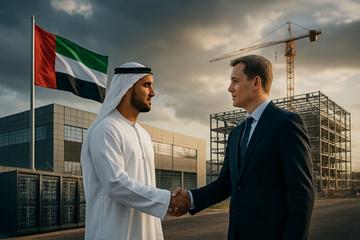
The package landed on day two of a three-day state visit by UAE President Sheikh Mohamed bin Zayed Al Nahyan to Chancellor Friedrich Merz, and the headlines were deliberately German-focused — bilateral trade, defence, and energy. The data-center line item was almost a footnote, yet it is the line that moves the most capital. Roughly 1 gigawatt of new capacity, €10B earmarked for Bavaria, and a new German–UAE Investment Council to channel the rest, all built on top of a corporate layer of 29 MoUs worth €9.356B at the Munich Business Forum.
Equinix's Frankfurt footprint and Digital Realty's Rhine-Main pipeline become the immediate physical beneficiaries, because the German federal strategy already targets a doubling of national data-center capacity and a quadrupling of AI compute by 2030. The UAE money slots directly into the highest-vacancy-pressure pocket in Europe, where Frankfurt H1 2026 vacancy sat at 3.1% — the lowest of any FLAP-D market — and where grid-connection lead times already run 24 months or more.
The timing
Why the U.S. Power Queue, Not the UAE, Forces the Pivot
The U.S. side of the AI buildout is grinding to a halt at the substation. An Environmental Law Institute tracker compiled in early September 2026 found that nearly half of U.S. data centers planned for 2026 are now facing delays or cancellation, with municipal moratoriums sweeping across counties in Virginia, Texas, and the Pacific Northwest. Former Google CEO Eric Schmidt's April 2026 Congressional testimony framed the math: 29 GW of additional data-center power by 2027, and 67 GW more by 2030 — capacity that the U.S. grid cannot physically deliver on the timelines hyperscalers need.
U.S. data-center buildout vs. grid constraint, 2026
Capacity on the table vs. capacity that can actually be energized, MW (illustrative ranges per Reuters/ELI tracker)
Unit: MW
U.S. data centers planned 2026
MW announced; ~50% slipped
28,000
U.S. data centers on track 2026
MW with firm grid interconnect
14,000
Frankfurt H1 2026 deliveries
MW; 24+ month lead times
45
Frankfurt pipeline (dev + planned)
311 MW in dev + 687 MW planned
998
UAE package to Germany
1 GW new build targeted
1,000
Gulf sovereign capital has been watching. The UAE's pivot from a $1.4 trillion U.S. investment commitment toward a $46.4B European AI deployment is the first sovereign check large enough to beget a competing buildout. The structural signal is sharper than the headline: sovereign money will follow the lowest-friction path to energized compute, and as of September 2026, that path runs through Frankfurt, Munich, and Berlin — not Loudoun County.
The regulatory unlock
The BIS Reset That Lets the Chips Actually Move
Three months before the Berlin announcement, the U.S. Bureau of Industry and Security quietly rewrote the export-control map. On July 10, 2026, BIS reclassified the UAE from Country Groups D:3 and D:4 into Country Group A:5, making the UAE eligible for License Exception Strategic Trade Authorization for the first time and removing the missile-technology and national-security end-use restrictions that had capped chip flows for two years.
The rule's appendix — Supplement No. 8 to Part 740 — names exactly which UAE and U.S. entities can now receive advanced computing items, including the 3A090.a and 4A090.a ECCNs that govern top-end NVIDIA accelerators, license-free. On the UAE side: G42 and Core42, both with a 270-day sunset. On the U.S. side: Amazon, Apple, Google, Meta, Microsoft, OpenAI, Oracle, and X.AI.
G42's own response to the cliff is the second tell. On September 4, 2026 — six days before the Berlin announcement — Reuters reported that G42 was exploring a sale of a majority stake to U.S. companies, with Microsoft already a $1.5B minority shareholder and Silver Lake and Mubadala co-investors. The strategic logic is simple: if the U.S. is the chokepoint for the chips that power 1 GW of German data centers, then becoming U.S.-owned is the cheapest way to keep the power on.
The supply chain
From Wafers to Switchgear: Who Actually Gets the Orders
| Layer | Listed beneficiary | Direct mechanism |
|---|---|---|
| Lithography | ASML | Every advanced node fab feeding the build is tooled on ASML EUV; TTM revenue $35.3B, +21% YoY |
| Compute silicon | NVIDIA | License-free 3A090.a exports to G42 and eight U.S. hyperscalers; TTM revenue $303.0B, gross margin 74.7% |
| Power & cooling | Vertiv | Liquid cooling, UPS, prefabricated power skids for new campuses; TTM revenue $11.5B, +24% Q rev growth |
| Switchgear & transformers | Schneider Electric | MV/LV switchgear, modular substation kits; TTM revenue ~$45B |
| Colocation & interconnection | Equinix | Frankfurt is EQIX's largest FLAP-D metro at 3.1% vacancy; $9.9B TTM revenue |
| Hyperscale build-to-suit | Digital Realty | 3.0 GW IT in service, 6.3 GW buildable; Frankfurt ground broken Q4 2025 for 11-building park |
| Utility & grid | RWE | German strategic-partner utility, renewables + gas peakers for data-center baseload |
| EU sovereign cloud | Microsoft / Amazon | AWS EU Sovereign Region (Germany) live Jan 2026; MSFT targeting 200+ EU sites by 2027 |
The supply-chain math is dense. At a 1 GW nameplate and an industry-standard 1.3 PUE, a German AI campus of this scale draws the steady-state load of a mid-sized German city. The first check that leaves the UAE account is not to a contractor; it is to an NVIDIA order book, where data-center revenue already grew 105% year-over-year in the most recent reported quarter. From there, the dollars fan out to Vertiv-grade power skids, Schneider Electric switchgear, ASML-enabled memory and logic, and finally to Equinix or Digital Realty shells where the racks actually get plugged in.
Why Germany, not the Gulf
The German Federal Strategy Is the Co-Sign That Makes the Capital Stick
Sovereign capital does not deploy into a vacuum. Berlin had spent the prior 18 months building the landing pad. The Federal Cabinet adopted Germany's first national Data Centre Strategy on March 18, 2026, with two hard targets: at least double national data-center capacity and quadruple AI/HPC capacity by 2030, measured against end-2025 baselines. A second signal — the August 27, 2026 Bloomberg report that Germany's digital minister publicly warned of an AI compute shortage — locked in political will to fast-track permits and grid connections.
The market opportunity is large enough to absorb €40B without crowding. Germany's colocation market is forecast to expand from $5.21B in 2025 to $9.34B by 2030, an 11.5% CAGR. That 4 GW of net new capacity (from 1.0 GW today toward 2.0 GW by 2030, plus 4× of the smaller AI-specific base) maps almost perfectly onto the UAE's 1 GW plus 9.4 GW of MoU-anchored industrial demand.
- UAE pre-existing German footprint is ~€34B, including the €14.7B XRG–Covestro transaction closed Dec 10, 2025 — the largest Gulf takeover of a German industrial company on record
- Covestro, RWE, ADNOC and Masdar are the named anchors in the MoU cluster, with RWE acting as the energy-side counterpart to a buildout that needs firm renewable PPAs
- AWS launched its EU Sovereign Region in Germany in January 2026, making Frankfurt the only EU member state with a full hyperscaler sovereign cloud at the time of the announcement
- The new German–UAE Investment Council gives Berlin a private-sector governance layer on top of the federal strategy, formalising project-by-project review rather than one-off political signals
The other side
Who Loses If Sovereign Capital Routes Through Frankfurt First
The U.S. side is not a monolith. The clear losers are the U.S. utilities and merchant generators whose 2026–2028 buildout thesis priced in continued hyperscaler dominance of the global capital pool. With $46.4B of sovereign AI capital now committed to Germany, the marginal NVIDIA, Vertiv and Schneider Electric order that was previously destined for a U.S. campus has a credible European alternative.
The clearest exposure sits at the intersection of U.S. nuclear power and data centers. Constellation Energy and Vistra have re-rated materially over 2024–2025 on the assumption that Microsoft and Amazon would sign long-dated power-purchase agreements inside the U.S. If a meaningful share of new hyperscaler capacity now lands in Frankfurt — where RWE baseload plus Masdar renewables can be packaged under German federal policy — the U.S. PPA pipeline thins. That is the source of the CEG read-across, and the reason its stock has begun to move on the German announcement.
| Tilt | Stock | Why |
|---|---|---|
| Direct beneficiary | Equinix | Frankfurt is its largest FLAP-D metro; 3.1% vacancy lets it reprice existing cabinets |
| Direct beneficiary | Digital Realty | 3.0 GW in service + 6.3 GW buildable; Frankfurt 11-building park ground broken Q4 2025 |
| Direct beneficiary | NVIDIA | G42/Core42 license-free path unlocks a third large AI training cluster after Stargate UAE and Stargate US |
| Direct beneficiary | Vertiv | Power and cooling kit for any 1 GW campus regardless of geography |
| Direct beneficiary | RWE | Named MoU partner; renewable + gas peaker baseload for new German data centers |
| Direct beneficiary | Microsoft | G42 partner; already has $1.5B stake; EU sovereign cloud expansion |
| Direct beneficiary | Amazon | AWS EU Sovereign Region Germany is the only live EU sovereign cloud of the four hyperscalers |
| Mixed | Constellation Energy | Still a U.S. AI-power winner, but marginal sovereign capital now has a credible German alternative |
Horizons
What Moves First — and What Could Break the Thesis
Over days and quarters, the read-throughs cluster around three near-term catalysts. First, the German–UAE Investment Council's first project list, expected before year-end 2026, will name the 1 GW site — most likely Frankfurt or Munich given grid readiness. Second, BIS Supplement No. 8 listing updates will signal whether G42's majority-stake sale to a U.S. company closes inside the 270-day window, which determines whether the chip pipeline stays open past late 2027. Third, U.S. municipal moratoriums will be tested in court; the outcome of any one of them is binary for the next data-center tranche.
Over one to three years, the structural question is whether the EU can actually deliver energized compute at German federal speed. The German grid buildout timeline is the binding constraint; prime powered land costs in Frankfurt are already up 82% since 2021. If Berlin streamlines interconnection for sovereign-funded projects, Equinix and Digital Realty capture the rent; if it does not, the 1 GW slips right and the U.S. moratorium story takes back the narrative.
Stocks the UAE–Germany pivot actually touches
- BIS Supplement No. 8 makes G42 and Core42 license-free for 3A090.a advanced computing from Jul 10, 2026, opening a third sovereign AI cluster after Stargate US and Stargate UAE
- TTM revenue of $303.0B and 74.7% gross margin show the data-center order book is already absorbing sovereign-scale demand
- G42's reported majority-stake talks with U.S. tech — Sep 4, 2026 — would lock in chip access past the 270-day cliff in late 2027
- Frankfurt H1 2026 vacancy of 3.1% is the tightest in FLAP-D, giving EQIX pricing power on existing cabinets the moment a 1 GW tenant lands
- JLL EMEA mid-2026 data confirms 24+ month grid-connection lead times in Frankfurt, so existing inventory is the only near-term supply
- The German Data Centre Strategy (Mar 18, 2026) doubles national capacity by 2030 — every increment first monetises through incumbent operators
- 3.0 GW in service plus 6.3 GW buildable makes DLR the only public REIT-scale inventory for a 1 GW tenant on a multi-year build
- Frankfurt 11-building park ground broken Q4 2025; first buildings targeted for as early as 2028, matching the German strategy's 2030 doubling target
- Q2 FY2026 revenue growth of 30% YoY shows hyperscale and sovereign demand already flowing through the platform
- Power, cooling, and prefabricated skid economics apply to any 1 GW build regardless of geography, so Vertiv captures the buildout whether the tenant is in Frankfurt or Loudoun County
- Q2 FY2026 revenue +24% YoY and gross margin of 37.5% reflect the AI-driven density step-up in liquid cooling demand
- Order book is already exposed to the EU sovereign cloud buildout (AWS Germany Jan 2026, Microsoft EU expansion)
- Already a $1.5B G42 minority shareholder and a named BIS-approved U.S. entity, so MSFT has a privileged seat on both the chip flow and the German data-center build
- Target of 200+ Azure sites across 16 EU countries by 2027 turns the UAE sovereign capital into a tailwind, not a competitor, for Azure's EU footprint
- Q4 FY2026 revenue +18% YoY; capex/revenue 34.9% confirms the capex curve is steep enough to absorb a sovereign-anchored German build
- AWS EU Sovereign Region in Germany launched January 2026 — the only live EU sovereign cloud of the four hyperscalers at the time of the deal
- Named BIS-approved U.S. entity, so AWS inherits the same license-free chip access as the UAE sovereign cluster
- Capex/revenue of 22.3% is the lowest of the big three, leaving room to step up German investment without breaking the AWS margin model
- Named MoU partner in the Sep 10, 2026 deal, alongside Covestro, ADNOC and Masdar — the only German-listed utility inside the agreement
- Renewables plus gas peaker portfolio is the natural baseload for a 1 GW German AI campus under federal policy
- Bundesnetzagentur streamlining for data-center interconnections is the regulatory tailwind; €10B Bavaria earmark is geographically aligned with RWE's southern German footprint
- U.S. nuclear PPA thesis still intact — Three Mile Island restart and Meta 20-year deal confirm a domestic premium
- But $46.4B of sovereign AI capital now committed to Frankfurt thins the marginal hyperscaler PPA pipeline into CEG's footprint
- Watch the 270-day G42 clock and any new EU sovereign cloud PPA: a single Microsoft or Amazon deal in Germany would be the first material read-through