
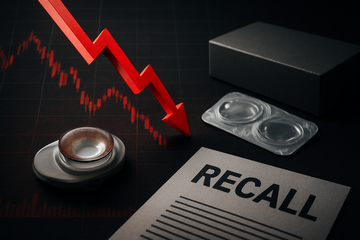
SHEIN's first consumer-product safety recall as a public company arrived on Sep 11, 2026 — ten trading days after a tepid HK$48.56 listing — and the timing matters as much as the bacteria. Product Safety New Zealand and the Australian Competition and Consumer Commission (ACCC) both pulled Syliuwa Zero-Powered Coloured Contact Lenses after a sample of the packaging solution tested positive for Burkholderia cepacia complex, an opportunistic pathogen resistant to several common antibiotics. Shein Distribution Australia Pty Limited is the named supplier. The lenses (SKU sb2408056243278800) were sold on the Shein NZ site from Aug. 7, 2024 to Aug. 19, 2026, and nationally through Shein in Australia from Aug. 7, 2024 to Aug. 15, 2026. The recall notice cites a UK user who developed an eye infection.
The recall
A costume contact lens, a packaging solution, and a regulator on each side of the Tasman
Syliuwa-branded coloured contact lenses are a low-priced cosplay and makeup product, sold in the same Shein catalogue as apparel. The hazard is not the lens itself but the packaging solution, which tested positive for Burkholderholderia cepacia complex — a bacterium the U.S. CDC flags as resistant to multiple antibiotics and a known cause of microbial keratitis in contact-lens wearers. The recall was published by Product Safety NZ on Sep. 11, 2026; the ACCC posted the Australian notice the same day. Both regulators instructed consumers to stop using the lenses and dispose of them safely, and Shein said it would offer full refunds to the original payment method.
Product
Syliuwa Zero-Powered Coloured Contact Lenses
SKU sb2408056243278800; white, marketed for cosplay and makeup
Hazard
Burkholderia cepacia complex
Detected in packaging solution; antibiotic-resistant; risk of microbial keratitis
Recall date
Sep 11, 2026
Published same day by Product Safety NZ and ACCC
Sales window
Aug 7, 2024 – Aug 19, 2026
Two years of marketplace listings before regulator action
Reported incident
1 UK user eye infection
Cited in NZ Product Safety notice as the trigger for testing
The market verdict
The 10% IPO drop stretched to 17.5% — and the recall day added another 3.5%
Shein priced its Hong Kong IPO at HK$48.56 a share on Aug. 27, near the midpoint of a HK$47.60–HK$49.50 range, raising HK$13.6 billion (about US$1.74 billion) at an implied valuation of US$26.5 billion — roughly a quarter of the ~US$100 billion private-market peak in 2022. On the Sep. 1 debut, the stock fell as much as 10% intraday to HK$43.80 before recovering to close at HK$48.50, almost flat with issue. Over the next ten sessions it slid steadily lower. By the Sep 11 close — the day both regulators published their recalls — SHEIN was at HK$40.06, down 3.47% on the day and 17.5% below the IPO price. The 52-week low hit HK$37.84.
Shein's slide from IPO to recall day
HK$ per share; closing or last-quoted price on each milestone date
Unit: HK$
IPO price (Sep 1)
HK$48.56 issue price
48.6
Intraday low (Sep 1)
~10% below issue
43.8
Sep 1 close
Recovered to near-flat
48.5
Prior close Sep 10
Reuters quote
41.5
Sep 11 close (recall day)
-3.47% on the day; -17.5% vs IPO
40.1
The drop is the first time SHEIN has been re-priced by a non-financial event as a public company. The IPO-day slide reflected growth and valuation anxiety — a Q1 2026 net loss of US$99 million against a US$395 million profit a year earlier, an 8% revenue print for2025 versus20.7% the year before, and a 14.3% slide in U.S. revenue as the de minimis exemption ended. The Sep 11 move layered a different concern on top: a regulator-cited safety event.
What changed
The de-minimis math has a product-safety variable the prospectus did not quantify
Shein's pre-IPO thesis ran on three pressures investors already had a number for: the loss of the U.S. US$800 de minimis exemption (closed May 2, 2025 for China and Hong Kong, and globally on Aug. 29, 2025), the related shift of customer acquisition costs back onto Shein, and the resulting 14.3% Q1 2026 drop in U.S. revenue. A Burkholderia cepacia recall is not in that spreadsheet. The Sep 11 notice opens a question that the prospectus did not have to answer at HK$48.56: how many marketplace sellers on Shein's platform sell regulated health products, and how much liability flows back to the listed entity when one is named on a regulator's recall page?
- FY2025 net income fell 38.7% to US$2.06 billion on revenue of US$41.85 billion — slower8% growth versus 20.7% in 2024.
- Q1 2026 swung to a US$99 million net loss, against a US$395 million profit a year earlier; operating margin compressed to 2.9% from 3.9%.
- U.S. revenue fell 14.3% in Q1 2026 to US$2.04 billion; the U.S. share of quarterly revenue dropped to 22.5% from 29.4% in 2023.
- Shein priced at 15x forward earnings on debut, more than double the multiple for PDD Holdings — and that multiple is now being tested against a new risk category.
Supply chain
From the Syliuwa factory to the platform — and the regulators who named it
Coloured contact lenses sold on global e-commerce sit in a regulatory grey zone: cosmetic-grade in some jurisdictions, medical-device in others. Australia's Therapeutic Goods Administration requires lenses to be supplied under specific conditions; New Zealand's Product Safety regime is stricter still on bacterial contamination. The Syliuwa brand is private, with no public listing, but the lenses trace to the cluster of Chinese colour-lens OEMs in Jiangsu and Gansu — most holding ISO 13485 certification — that supply marketplace sellers worldwide. The relevant listed beneficiary on the regulated side is EssilorLuxottica, which sells cosmetic coloured lenses through LensCrafters and Pearle Vision, and acquired South Korea's OLENS brand in 2023 to anchor its Asian colour-lens business.
| Layer | Name / Role | Relevance to the recall |
|---|---|---|
| Brand on listing | Syliuwa (private) | Chinese colour-lens brand; named on the recall notice |
| Platform of record | SHEIN Distribution Australia Pty Ltd | Named by ACCC as the supplier of record |
| Listed regulator-adjacent peer | EssilorLuxottica | Sells regulated coloured lenses via LensCrafters, Pearle Vision; OLENS owner |
| Logistics & fulfilment | Third-party 3PL network (private) | Distributed the lens to ANZ marketplace buyers Aug 2024–Aug 2026 |
| Direct fast-fashion peer (US-listed) | PDD Holdings | Temu parent; trades at ~8–9x earnings, lower than Shein's 15x |
| Direct fast-fashion peer (Europe) | Inditex | Zara owner; P/E ~26.5x; vertically integrated, no marketplace model |
| Direct fast-fashion peer (Europe) | H&M | P/E ~21x; brick-and-mortar anchored |
Peer lens
Why the Shein valuation math is the most exposed in the group
On debut, SHEIN traded at about 15x forward earnings — more than double PDD Holdings' multiple and well above the European incumbents. The premium was originally justified by Shein's 20%+ historical growth; the prospectus shows that growth is now 8%, with US revenue contracting. The recall event does not move the revenue line — coloured contact lenses are a rounding-error SKU in a US$41.85 billion apparel business — but it does give a regulator the standing to ask the next question, on a category that is not rounding error if it spreads.
Inditex and H&M do not sell regulated health products through their platforms; PDD Holdings faces the same marketplace-structure risk as Shein, though Temu's product mix is more general-merchandise than apparel. EssilorLuxottica is on the other side of the trade — its regulated status is a moat when regulator attention turns to unvetted marketplace SKUs.
Horizons
What moves first, what moves later — and the milestones that decide it
- Days to weeks: any further ANZ or U.S. product-safety notice on Shein marketplace SKUs. Watch the ACCC, Product Safety NZ, the U.S. CPSC, and the FDA's Centre for Devices and Radiological Health. One more notice on a different category (children's apparel, cosmetics, electronics) re-rates the platform-risk premium.
- Days to weeks: Shein's first post-IPO earnings print. The Q2 2026 result will set the first comparable base; consensus will be built off the US$99 million Q1 loss and the 14.3% U.S. revenue drop.
- Quarters: de minimis drag. The U.S. removed the US$800 threshold for Chinese and Hong Kong goods on May 2, 2025, and globally on Aug. 29, 2025; the full-year 2026 P&L is the first to be entirely post-de-minimis.
- One to three years: regulator response in ANZ and EU. The Australian TGA is reviewing cosmetic contact-lens supply rules; an EU restriction on marketplace sale of medical-device-adjacent SKUs would structurally affect Shein and Temu more than vertically integrated retailers like Inditex.
Synthesis
A first-recall multiple compression — small in dollars, large in meaning
The Sep 11 recall does not dent Shein's revenue or earnings in any meaningful sense — a single coloured-contact-lens SKU is a rounding error against US$41.85 billion of 2025 sales. What it does is take a U.S. dollar of expected earnings and re-price the multiple. SHEIN entered public markets at 15x forward earnings on the strength of growth that has since slowed from 20.7% to 8%; it now carries a marketplace-structure risk that did not appear in the prospectus disclosure. The contact-lens recall is the first line item in that new column. Whether it stays small is a question for ACCC, Product Safety NZ, and the CPSC over the next 90 days — not for the apparel P&L.
Stocks this recall actually touches
- Closed HK$40.06 on the Sep 11 recall day, down 3.47% on the day and 17.5% below the HK$48.56 IPO price; first regulator-cited safety event since listing.
- FY2025 net income already down 38.7% to US$2.06B; Q1 2026 swung to a US$99M loss — the recall layers marketplace-structure risk onto an already-pressured multiple.
- Next milestone: Q2 2026 earnings — the first post-IPO print and the first full quarter post-recall; consensus expects a comparison off a US$99M Q1 loss.
- Temu parent runs the same marketplace-structure model as Shein and is exposed to a similar platform-as-supplier risk if U.S. regulators extend contact-lens or other health-SKU action to cross-border platforms.
- Trades at ~8–9x earnings versus Shein's 15x — already at a discount that prices in growth deceleration; a Shein-style recall on Temu could compress its multiple further.
- Q2 2026 net income fell to RMB 27.18 billion yet beat the RMB 24.40 billion consensus — earnings are still beating, valuation cushion is the relative argument.
- Owns the regulated coloured-lens channel (LensCrafters, Pearle Vision, OLENS) — regulator attention on unvetted marketplace SKUs is structurally positive for established medical-device-channel players.
- The Burkholderia cepacia finding highlights the regulatory value of FDA/CE-cleared supply chains; EssilorLuxottica's vertical integration is a moat on category-by-category basis.
- Watch the TGA and EU MDR reviews of marketplace sale of cosmetic contact lenses — a tightening of those rules raises the barrier to entry against Asian marketplace colour-lens SKUs.
- Vertically integrated Zara parent does not sell regulated health products through its platform — structural insulator from a Shein-style recall event.
- Trades at ~26.5x trailing earnings, a premium to Shein's 15x and PDD's 8–9x; if Shein's product-safety drag spreads, the premium for vertical-integration moats in fast fashion could widen.
- Milestone: Q3 FY2026 sales update in December — first read on whether consumer migration away from Asia-sourced marketplaces is lifting European incumbents.
- Brick-and-mortar anchored; no marketplace-platform risk and no regulated-SKU exposure; benefits relatively from any Asia-marketplace stigma.
- 52-week SEK range145.05–164.75 — September 2026 print at the high end; recall-driven multiple compression at competitors can sustain H&M's re-rating.
- Catalyst: Q4 2026 trading update in late January 2027 — first comparable post-de-minimis, post-Shein-IPO holiday season.