
Europa peak performance
629 TOPS
INT8, per Axelera press release, Oct. 21, 2025; partner ecosystem expansion announced Sept. 15, 2026
Signed AI-factory contract value
Tens of millions (USD)
Per CEO Fabrizio Del Maffeo, Reuters, Sept. 15, 2026
Total sales pipeline
>$1.5B
Per Axelera launch release, Sept. 15, 2026; explicit 'potential sales' framing, not booked revenue
Deployments
600+ customers
Defense, robotics, drones, retail, security, AI factories, enterprise; Sept. 15, 2026 announcement
Series C funding (Feb. 23, 2026)
$250M+
Led by Innovation Industries; BlackRock and SiteGround Capital participated; brings total to $450M+ since 2021
EU AI gigafactory program
€10B public / €20B+ private
Up to 7 sites; EU Commission call for tenders launched Jul. 29, 2026
The product
Europa Ships at 629 TOPS—It's a Server Inference Chip, Not a Hyperscaler GPU
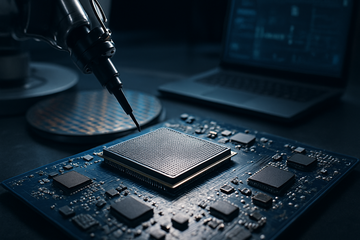
Axelera AI unveiled Europa in October 2025 and shipped it broadly in the first half of 2026; the September 15 partner-ecosystem announcement is the first major AI-factory customer reveal. The chip's headline figure is 629 TOPS at INT8, paired with 4,915 GOPS of non-AI compute from two clusters of eight RISC-V vector cores and a 200 GB/s LPDDR5 interface backed by 128 MB of on-chip SRAM. The integrated H.264/H.265 decoder lets one chip handle multiple 4K video streams before they hit the host CPU—a design choice optimized for retail, surveillance and physical-AI workloads, not for the multi-rack training clusters that NVIDIA sells into Microsoft and Amazon.
The RISC-V control plane is licensed from Taiwan-based Andes Technology, whose64-bit out-of-order AX65 core runs the Linux-compatible pre- and post-processing pipelines while Axelera's in-house Digital In-Memory Compute (D-IMC) cores handle 99% of neural-network inference. The architecture scales from a single-chip 16 GB PCIe card up to a four-chip 256 GB configuration. The chip's 35×35 mm package and 3-5× claimed performance-per-watt advantage over comparable accelerators matter because the buyers are EU AI factories with hard energy and cooling constraints, not hyperscalers chasing the largest possible token throughput.
The deals
€290M IT4LIA Is Mostly NVIDIA—Axelera Gets the Inference Partition
The flagship deployment is the IT4LIA AI Factory in Bologna, a €290 million contract awarded on April 22, 2026 to E4 Computer Engineering and Dell Technologies. The architecture is liquid-cooled NVIDIA GB200 NVL4: Grace CPUs, Blackwell GPUs and Quantum-X800 InfiniBand, delivering more than 160 exaflops of peak AI performance. Axelera AI does not replace that compute—it provides a dedicated inference partition alongside European-designed SiPearl CPUs.
- EuroHPC JU funds 50% of the €290M IT4LIA build via the Digital Europe Programme; Italy's Ministry of University and Research co-finances the balance.
- A parallel Dell–E4–Axelera deployment targets Luxembourg's AI factory; Reuters confirmed both sites on Sept. 15, 2026.
- CEO Fabrizio Del Maffeo told Reuters signed deals are 'worth tens of millions'—meaning Axelera's slice of IT4LIA alone is small relative to the headline €290M contract.
- Other deployments are via validated OEM systems: Dell XE5 and Supermicro 111AD servers ship the Axelera Edge 232p; Advantech, Axiemtek, Hewlett Packard Enterprise, Lenovo and Seco complete the channel.
This structure matters for the thesis. Europa is being slotted into the inference tier of an otherwise NVIDIA-dominant architecture, exactly as the EU Commission and EuroHPC JU want: European silicon for the inference workloads that touch regulated data, American silicon for the frontier training compute. The deal flow validates the architecture and gives Axelera a reference design, but it does not put Europa in front of the largest customers in AI infrastructure. The hyperscaler wallet still belongs to NVIDIA.
The gap
$1.5B Pipeline vs. 'Tens of Millions' in Signed Deals—the Real Story
Axelera AI says its sales pipeline exceeds $1.5 billion and its deployments span more than 600 customers across defense, robotics, drones, retail and security. The launch release is explicit: that $1.5B is potential sales, not booked orders. The CEO's confirmed signed-contract value sits in 'the tens of millions.' The conversion ratio from pipeline to signed deals is therefore low single-digit percent at best—normal for an early-stage silicon company, but a critical variable for anyone modeling the equity story.
Axelera commercial traction, Sept. 15, 2026
Pipeline is potential, not contracted; signed deals are CEO-attributed.
Unit: USD
Total funding to date
450
Series C (Feb. 2026)
250
Signed AI-factory contracts
30
Total sales pipeline (potential)
1,500
The funding base of $450 million since 2021—including $250 million Series C led by Innovation Industries in February 2026 with BlackRock and SiteGround Capital participating—is meaningful, but a private European AI-chip company burning tens of millions of dollars a quarter against 'tens of millions' of signed deals is not yet a profitable unit-economics story. The gap between $1.5B pipeline and tens-of-millions signed is the variable that determines whether the September 15 announcement marks the start of inflection or just another step in a long, capital-intensive road.
Supply chain
Foundry Side: TSMC and Samsung Foundry Carry the Volume
Axelera's manufacturing is split between Taiwan Semiconductor Manufacturing and Samsung Foundry, as confirmed in the company's Series C press release. The European AI-chip ecosystem depends on Asian foundries, which means the actual physical capacity utilization rides on TSMC's CoWoS and advanced-node lines. August 2026 monthly revenue at TSMC hit NT$514.81 billion (~$16.35 billion), up 53.3% year-over-year—the fourth straight monthly record—on AI demand that includes inference silicon from companies like Axelera, not just NVIDIA GPUs.
- TSMC August 2026 monthly revenue: NT$514.81B, +53.3% YoY; 2026 capex guide $52–56B.
- Samsung Foundry utilization crossed 80% in Q1 2026; Samsung separately raised advanced-node chipmaking prices as AI demand tightened supply.
- Andes Technology supplies the AX65 64-bit RISC-V control cores for Europa, embedding Taiwan IP into European AI silicon.
- Axelera also landed a €61.6 million EuroHPC JU grant in March 2025 to develop the Titania chiplet for data-center-scale inference—an EU subsidy underwriting the foundry relationship.
That last point is the key non-obvious thread. The Titania grant explicitly funds chiplet-based scaling of D-IMC into HPC and AI gigafactory workloads, with shipments targeted for 2027. If Titania ships into EU AI gigafactories alongside Europa, TSMC and Samsung capture two product generations of European inference demand rather than one. The flip side: foundry allocation becomes a single point of failure if hyperscaler demand crowds Axelera out of advanced-node capacity.
Competition
The Inference Map: Cerebras Just IPO'd, Groq Got Acquired, Broadcom Builds Custom
The competitive context for Europa is not training GPUs; it is the broader inference-specialist cohort. Cerebras Systems IPO'd on Nasdaq on May 14, 2026 at a roughly $40 billion valuation—the largest U.S. AI-chip IPO of the year. Groq sold its core assets to NVIDIA for $20 billion in December 2025, with NVIDIA planning to bring Groq racks online later in 2026. Broadcom and Marvell continue to design custom inference silicon for Alphabet, Meta Platforms and OpenAI. Astera Labs sits one layer below as a connectivity silicon vendor. Inside Europe, SambaNova and Hailo are chasing similar inference niches, while UK-based Fractile and Graphcore plus France-based SiPearl round out the field.
| Company | Listing | Latest valuation event | Primary customer signal |
|---|---|---|---|
| Cerebras Systems | CBRS (Nasdaq, May 14, 2026) | IPO at ~$40B | Public inference cloud; competing in training and inference |
| Groq | Acquired by NVIDIA for $20B, Dec. 2025 | Asset sale, not stock | Technology absorbed into NVIDIA; separate cloud arm reportedly raising |
| Broadcom | AVGO | $1T+ market cap, custom silicon for hyperscalers | Custom XPU and networking for Alphabet, Meta Platforms, OpenAI |
| SambaNova | Private, ~$11B2026 valuation | RDU/SN50 chips | Targets enterprise and EU sovereign inference |
| Axelera AI | Private | $450M+ raised; $1.5B pipeline | EU AI factories, defense, OEM partners |
Horizons
Short Term: Europa Conversion Rates. Long Term: Titania in Gigafactories
Over the next two quarters, the decisive data points are AI-factory order conversion and the depth of the Dell and Supermicro channel. If Dell PowerEdge XE5 systems with Axelera cards land meaningful orders beyond IT4LIA and Luxembourg, the $1.5B pipeline starts to look directional. If the Hewlett Packard Enterprise–HammerHAI Germany AI Factory (signed March 2026 with NVIDIA-centric silicon) gets an Axelera inference partition, it would mark a meaningful expansion beyond Italy and Luxembourg. Watch Supermicro's fiscal Q1 2027 disclosure for inference-revenue mix shifts and Dell's Q3 FY27 earnings call commentary on EU AI-factory contribution.
- Short-term (days–quarters): IT4LIA delivery milestone, Luxembourg site go-live, additional EuroHPC JU procurements using LUMI-AI (Aug. 31, 2026 contract) and HammerHAI patterns.
- Short-term: Andes Technology AX65 qualification into Europa production; any second-generation Europa PCI card wins at Dell or Supermicro.
- Long-term (1–3 years): Titania chiplet shipping into EU AI gigafactories, leveraging the €61.6M EuroHPC JU grant; foundry allocation decisions at TSMC and Samsung.
- Long-term: Whether the EU AI Gigafactories program converts the up-to-7-site ambition into real procurement that channels through Dell/Hewlett Packard Enterprise/Supermicro with Axelera as the inference tier.
The structural read is that the EU is buying itself an inference option, not a competitor to NVIDIA. The €30 billion AI gigafactory program (€10 billion public, unlocking €20 billion-plus private) explicitly runs on NVIDIA training compute with European inference layered on top. If Axelera AI captures even a low-single-digit share of EU AI-factory silicon spend across the seven planned gigafactories, the conversion math on the September 15 'tens of millions' base looks very different by 2028. The risk is that pipeline remains pipeline and the company remains structurally sub-scale relative to TSMC-bound NVIDIA demand.
Investable angles
- Dell is the validated OEM partner for Europa across PowerEdge XE5, and is co-deploying with E4 and Axelera AI in the IT4LIA and Luxembourg AI factories—a direct read-through to incremental server attach in EU AI factories.
- Dell's Q2 FY27 disclosure (revenue $47.0B, +58% YoY; $60.9B AI server orders in the quarter; $95B AI backlog) shows the AI-server funnel is open, but the September 15 announcement adds a second-source inference option against NVIDIA dependency.
- Short-term (quarters): more EU AI-factory contract flow through Dell; long-term (1–3 years): depth of validated Europa deployment vs. NVIDIA-only Hewlett Packard Enterprise HammerHAI pattern.
- Supermicro SYS-111AD is validated for the Axelera Edge 232p, giving the company an EU sovereignty narrative alongside Q4 FY26's $11.1B revenue (+93% YoY) and 17.5% gross margin.
- The trade is mixed: EU AI-factory demand is small relative to Supermicro's NVIDIA-driven top line, but a second inference silicon vendor broadens the addressable customer set.
- Short-term (quarters): watch Q1 FY27 disclosures for inference-mix commentary; long-term (1–3 years): whether Europa gains share inside the validated Supermicro catalog or stays a niche option.
- TSMC is one of two foundries for Axelera AI; the August 2026 monthly revenue print of NT$514.81B (+53.3% YoY) confirms AI inference silicon now contributes to the run rate, not just NVIDIA GPUs.
- TSMC's 2026 capex guide of $52–56B is the upstream commitment that lets it absorb both hyperscaler training silicon and European inference chips like Europa.
- Short-term (quarters): sustained monthly revenue records; long-term (1–3 years): Titania chiplet volume and advanced-node allocation across the EU gigafactory program.
- NVIDIA remains the dominant silicon in EU AI factories—IT4LIA runs on GB200 NVL4 with Axelera AI as a complementary inference partition, not a replacement.
- The Groq $20B asset acquisition (closed Dec. 2025) and the HammerHAI Germany contract (Mar. 2026) reinforce NVIDIA's grip on EU sovereign compute.
- Short-term (quarters): IT4LIA delivery on NVIDIA architecture, not Europa scale; long-term (1–3 years): risk is incremental inference silicon share loss to European alternatives if the €30B program expands.
- Cerebras is the listed U.S. parallel to Axelera—IPO'd at ~$40B on May 14, 2026, the largest U.S. AI-chip listing of the year.
- Watch Cerebras revenue traction vs. pipeline conversion; if Cerebras scales into inference cloud faster than Axelera closes EU gigafactory deals, the European AI-inference story loses its clearest public-equity benchmark.
- Short-term (quarters): Cerebras quarterly disclosures vs. Axelera pipeline conversion; long-term (1–3 years): whether sovereign procurement in Europe matches Cerebras's U.S. inference-cloud growth.
- Broadcom designs custom inference XPUs for Alphabet, Meta Platforms and OpenAI; a European sovereign alternative introduces optionality for EU customers who want non-NVIDIA silicon without U.S. hyperscaler silicon.
- If EU AI factories scale Axelera AI-style inference partitions, Broadcom's hyperscaler custom-silicon moat is untouched but the European addressable market opens for a second vendor.
- Short-term (quarters): no immediate read-through; long-term (1–3 years): sovereign procurement shifts could broaden the inference-silicon vendor set.
- Hewlett Packard Enterprise holds the HammerHAI Germany AI Factory contract (signed Mar. 16, 2026) on a NVIDIA-centric stack; it also sits in the broader Axelera AI partner ecosystem, which creates a channel-rotation risk.
- If EU AI factories expand to seven gigafactories and inference partitions become a real procurement line, Hewlett Packard Enterprise faces competition from Dell–Axelera AI–E4 consortia for non-training share.
- Short-term (quarters): HammerHAI delivery milestones; long-term (1–3 years): whether Hewlett Packard Enterprise integrates Axelera silicon or stays NVIDIA-only.
- ASML is the upstream EUV monopoly behind TSMC and Samsung Foundry; every additional AI inference chip—Axelera AI's Europa, Cerebras's wafer-scale engine, Broadcom's custom XPUs—compounds demand for advanced-node EUV layers.
- Axelera's Titania chiplet roadmap targets2027 data-center shipments, adding another advanced-node consumer alongside NVIDIA.
- Short-term (quarters): ASML bookings and EUV system utilization; long-term (1–3 years): advanced-node demand from a diversifying AI-silicon cohort.