
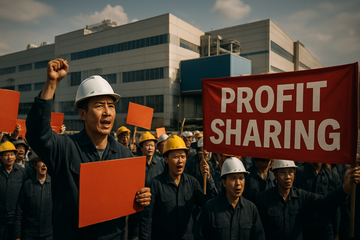
On September 1, 2026, two Micron Technology unions in Taiwan told Reuters they were moving toward a strike unless the U.S. memory maker agreed to overhaul its Incentive Pay Plan (IPP) and replace it with a system that allocates 15% of operating profit to workers, paid quarterly. The dispute is the first labor-driven margin test of the AI memory supercycle, and the second mediation between the parties is scheduled for September 21 — five trading days before Micron reports its fiscal Q4 2026 results.
Union members vs. Micron Taiwan headcount
~10,000 of 15,000
Taoyuan and Taichung fabs; Aug 2026 survey
Preliminary strike-vote support
≥80%
Internal union survey, late August 2026
Operating-profit share demanded
15%
Replaces IPP from FY2027, paid quarterly
One-off FY2026 demand
~83 months of salary
Equates to roughly seven years of base pay per worker
The IPP Math Is the Whole Argument
Micron's existing Incentive Pay Plan has been paying out around 2.6 months of salary per Taiwan worker on average, capped near five months — even as the company's quarterly revenue scaled from $9.3B in the year-ago quarter to $41.5B in fiscal Q3 2026, and net income leapt to $28.2B. The unions argue the IPP tracks revenue growth more than profit, and that Micron has not disclosed how the formula is calculated.
| Period | Revenue | GAAP net income | Operating margin | IPP payout (avg.) |
|---|---|---|---|---|
| Q3 FY2025 (May 2025) | $9.30B | $0.5B* | ~23% | ~2.6 months |
| Q2 FY2026 (Feb 2026) | $23.86B | $13.79B | 67.6% | ~2.6 months |
| Q3 FY2026 (May 2026) | $41.46B | $28.24B | 80.4% | ~2.6 months |
*Q3 FY25 GAAP net income not separately disclosed in the press release; figure approximated from the operating income line of $2.17B at ~85% tax burden. The point the unions are making is mathematical: profit moved roughly 56-fold while IPP moved effectively zero.
On September 11, Micron responded with what it called the strongest rewards package in company history: bonuses worth35 to 68 months of pay for fiscal 2026, a guaranteed minimum of NT$1.7 million (about $53,809) in cash, a NT$1 million (about $31,650) one-time cash bonus for employees hired before August 29, 2025, and an annual equity grant for every worker. More than 60,000 staff globally will receive scaled rewards. Taiwan's Taoyuan union has rejected the offer and is pushing for the structural reform.
Korea Already Drew the Line — and It's Well Above Micron's Offer
The Taiwan dispute is downstream of two Korean settlements. SK Hynix reached a tentative agreement in May 2026 to allocate 10% of annual operating profit to employee bonuses for ten years, then revised the proposal in August to remove the cap and pay roughly half in cash and half in stock — workers narrowly rejected that stock-heavy revision on August 25, sending the two sides back to the table. Samsung Electronics's union settled on May 21, 2026 for10.5% of chip-division operating profit, plus a 50% salary increase, in a deal Reuters valued at roughly $400,000 per chip employee.
| Company | Operating-profit share | Tenure | Source |
|---|---|---|---|
| Samsung DS (Korea) | 10.5% | Annual pool | Reuters, May 21, 2026 |
| SK Hynix (Korea) | 10% | 10-year commitment | Reuters, May 21, 2026 / Aug 25, 2026 |
| Macronix (Taiwan) | 15% of net profit | Standing | TechSpot, Sep 2026 |
| TSMC (Taiwan) | 4.7% | Standing | TechSpot, Sep 2026 |
| Nanya (Taiwan) | 6% | Standing | TechSpot, Sep 2026 |
| Powerchip (Taiwan) | 5% | Standing | TechSpot, Sep 2026 |
| Winbond (Taiwan) | 2% | Standing | TechSpot, Sep 2026 |
| Micron Taiwan (status quo) | IPP ≈2.6 months | Annual | Reuters, Sep 1, 2026 |
If Micron settles at the SK Hynix 10% benchmark rather than the demanded 15%, the annual cost on fiscal Q3 2026 operating income of $33.3B would still be on the order of $3.3B. At the union's 15% ask, the cost would approach $5.0B per quarter — material even against the company's $25.4B quarterly operating cash flow.
Why Taiwan Is the Pressure Point, Not Boise
Micron's memory map puts the most advanced DRAM and HBM packaging in Taiwan. The A3 fab in Taichung runs the 1-gamma node with EUV lithography, Fab 11 in Taoyuan does HBM front-end, and the company added PSMC's P5 fab for $1.8B in January 2026 to scale HBM packaging. A new HBM advanced packaging facility is ramping for 2027. The 10,000 union members the dispute touches are not back-office workers — they are the operators of the line that builds HBM4 for NVIDIA's Vera Rubin platform.
- Micron began high-volume HBM4 shipment in Q1 calendar 2026, designed into NVIDIA's Vera Rubin, PCIe Gen6 SSD and SOCAMM2.
- Management has said HBM capacity is sold out through the end of calendar 2026.
- Taiwan accounted for the bulk of Micron's $1.8B PSMC acquisition in January 2026 to scale HBM packaging.
- Q3 FY2026 operating income of $33.3B was the highest in company history and the basis for Q4 guidance of roughly $50B in revenue.
Under Taiwan's Labor Union Act and Act for Settlement of Labor-Management Disputes, a strike over economic interests is legal only after mandatory mediation has been exhausted, and the law explicitly prohibits strikes or other acts of protest during conciliation or arbitration proceedings. Mediation is typically resolved within 20 working days. That procedural floor is what the September 21 second-mediation date is operating against — and why the union's leverage, rather than a near-term walkout, is the operative variable.
What Actually Moves the Margin
Three layers of cost matter. Layer one is the explicit bonus pool: even a 10% match would consume roughly10% of quarterly operating income at current run-rates. Layer two is the second-order effect on Taiwan labor pricing for the rest of the semiconductor footprint — TSMC's 4.7% benchmark and Macronix's 15% net-profit formula already bracket the range, and any structural settlement at Micron reshapes negotiation leverage at ASE, SPIL and the smaller DRAM players.
Layer three is the most underappreciated: the cost-of-capital effect. Micron sells multi-year Strategic Customer Agreements to lock in HBM supply; the implicit margin on those contracts was struck on the assumption that the IPP bonus structure held. A 15% profit-sharing regime re-prices the long-tail of those agreements and tightens the headroom management can offer on future wafer allocations to NVIDIA and AMD.
Short-Term vs. Long-Term Catalysts
Days to weeks: the September 21 mediation is the binary catalyst. A settlement at or near10% removes the near-term strike risk and prices a known structural cost. A failure produces a formal strike vote among the 10,000 union members, which would still require exhausting conciliation under Taiwan law before any work stoppage.
Quarters: the fiscal Q4 2026 earnings release on September 30 — guided to roughly $50B in revenue and $30.73 in EPS — is the first opportunity for management to publicly quantify any structural cost. Investors should listen for any change to the IPP commentary, forward gross-margin range, or the language around Strategic Customer Agreement economics.
One to three years: the dispute is the third leg of a Korean–Taiwanese memory labor repricing. SK Hynix's 10% deal and Samsung's 10.5% deal are now the floor; a Micron settlement above 10% resets the Korean benchmarks at the next contract cycle (2027–2028). That is the structural risk for memory-gross-margin assumptions baked into consensus models today.
Where This Leaves the Supply Chain
Upstream, ASML is the critical input — Micron's 1-gamma DRAM node in Taichung runs on EUV lithography, and any work stoppage would tighten wafer-out at the front-end of the HBM pipeline long before it showed up in HBM stacks themselves. A pre-strike inventory build by Micron is the most likely near-term cushion, but only for one to two quarters.
Downstream, the HBM allocation question is the binding one for NVIDIA and AMD. HBM is the gating input on Vera Rubin and the MI400 generation; even a short disruption at the Taiwan packaging line forces a re-allocation between Micron, SK Hynix and Samsung. That re-allocation is what makes the wage dispute a memory-pricing story, not just a labor story.
| Supplier | Q2 2026 HBM share | Note |
|---|---|---|
| Samsung | 38% | Market leader; 10.5% profit-share deal with union |
| SK Hynix | 25% | HBM pioneer; 10% profit-share deal (revised Aug 2026) |
| Micron | ~21% | HBM4 qualified for NVIDIA Vera Rubin; sole HBM base in Taiwan |
Why the Tesla Precedent Matters
IF Metall's 1,021-day strike against Tesla in Sweden — the longest in modern Swedish history — ended on August 13, 2026 when Tesla bought out every remaining striking worker rather than sign a collective agreement. The pattern is now familiar: a foreign employer with a politically symbolic Taiwan footprint faces a labor dispute it cannot easily win on principle, and resolves it by paying through it. Micron's offer of 35 to 68 months of pay and a guaranteed $53,809 minimum cash component already looks like that playbook in motion, except the union is pushing for a structural rather than a transactional fix.
Where the dispute actually lands
- A 10% profit-sharing match claims ~10% of the $33.3B quarterly operating income the HBM supercycle is currently producing — a structural cost not priced into consensus models.
- Second mediation on Sep 21,2026 and Q4 FY26 earnings on Sep 30, 2026 set the two binary catalysts for the next move in the stock.
- Micron's Taiwan fabs build the HBM4 designed into NVIDIA's Vera Rubin platform;any work stoppage forces a re-allocation between Micron, SK Hynix and Samsung.
- A 15% Micron profit-share settlement re-prices long-dated Strategic Customer Agreements and tightens the wafer allocation available for Vera Rubin ramp.
- AMD is the secondary HBM customer behind NVIDIA; any Taiwan disruption cascades to MI400 allocation on roughly the same timeline as Vera Rubin.
- The AMD-Micron HBM4 contract terms are not publicly disclosed, so margin impact is harder to anchor than for NVIDIA.
- Already locked in a 10% operating-profit deal with its Korean union; that benchmark now travels east to Taiwan and protects SK Hynix's labor-cost position relative to Micron.
- A Micron settlement above 10% raises the ceiling at SK Hynix's next Korean contract cycle in 2027, keeping the Korean deal the floor of the regional range.
- Samsung's May 2026 10.5% chip-division dealestablished the upper benchmark the Micron Taiwan union is now invoking; Samsung's labor cost is already locked in.
- If Micron settles near 10% rather than 15%, Samsung keeps the regional premium on labor cost and preserves its HBM-pricing umbrella.
- Taiwan Comparable: TSMC pays ~4.7% of profits to workers, against Micron's IPP at ~2.6 months and Macronix at 15% of net profit — a Micron settlement resets the Taiwan labor curve TSMC negotiates against.
- TSMC has not faced a comparable union action; the Micron outcome is the closest thing to a public precedent for TSMC's own Taiwan labor cost trajectory.