
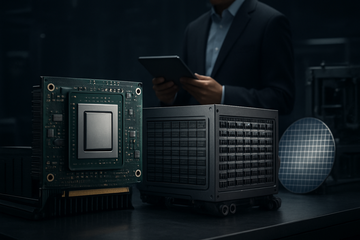
The first public roadmap of the cycle is now twelve months old, and the trajectory is intact. On September 18, 2025, Huawei Vice Chairman Eric Xu stood on the Shanghai stage of Huawei Connect and laid out four Ascend AI accelerators on a three-year schedule, plus the SuperPoD systems that bundle them by the thousands. The 950PR shipped in Q1 2026. The 950DT follows in Q4 2026. Then the chip the rest of the cycle is anchored on: the Ascend 960 in Q4 2027, fronting the 15,488-card Atlas 960 SuperPoD and the million-NPU Atlas 960 SuperCluster. Investors who missed the 2025 keynote have been reading the wrong filings; the chip that matters for 2027 dollars is already named, clocked, and under contract.
The 2027 chip and its ancestors
The Ascend 960 Doubles the 950—and Still Lands Three Generations Behind Nvidia
Huawei's own keynote, transcribed from the September 18, 2025 speech, is unambiguous on the 960: it doubles compute, doubles memory bandwidth, doubles memory capacity, and doubles the number of interconnect ports versus the 950. It also introduces HiF4, Huawei's proprietary 4-bit numeric format. What the keynote does not promise is parity with Nvidia's current Blackwell line. Independent analysis from Epoch AI puts the on-paper gap starkly: the 950PR is roughly half of an Nvidia H100 from 2022; the B300 delivers about 6.75x the FP4 throughput of the 950. The 960 closes part of that gap, but it does not close it.
Ascend 950PR mass production
Q1 2026
In production at SMIC since March 2026; 1.56 PFLOPS FP4 per Huawei, 2.87x Nvidia's H20 at 600W
Ascend 950DT launch
Q4 2026
Same die as 950PR; HiZQ 2.0 HBM at 144 GB and 4 TB/s bandwidth; powers Atlas 950 SuperPoD
Ascend 960 launch
Q4 2027
Doubles compute/memory/bandwidth/ports vs 950; introduces HiF4 4-bit format
Atlas 960 SuperCluster
1M+ NPUs
Q4 2027; 2 ZFLOPS FP8, 4 ZFLOPS FP4 across 15,488-card SuperPoD nodes
The market-share reversal
Huawei Already Has 50% of China's AI Chip Market—And It Bought That Share This Year
The 2027 chip is the story investors will trade in 2026, but the market-share story has already happened. Bernstein, cited by AP and the Washington Post, estimates Nvidia's China AI accelerator share collapsed from about 40% in 2025 to roughly 8% in 2026, while Huawei rose from a similar 40% to about 50%. TrendForce's separate domestic-server count is even more decisive: Chinese suppliers led by Huawei and Cambricon moved from 46% of the domestic AI server market in 2025 to 56% in 2026, with foreign suppliers dropping from 34% to 21%.
China AI accelerator market share: foreign share collapses in one year
Bernstein estimates, 2024–2026, % of China AI accelerator market
Unit: % share
Nvidia
66
Huawei
23
Cambricon & other domestic
11
Nvidia (2025)
40
Huawei (2025)
40
Others (2025)
20
Nvidia (2026E)
8
Huawei (2026E)
50
Cambricon & other (2026E)
42
The supply chain behind 2027
SMIC, CXMT, and Cambricon Are the Real 2027 Story
Whether the Ascend 960 ships on time depends on three bottlenecks Huawei does not control: leading-edge wafer capacity at SMIC, HBM supply at CXMT, and competitive pressure from Cambricon for the second-tier Chinese buyer. All three are moving in the right direction in 2026—but none of them is at the scale Nvidia's suppliers enjoy.
- SMIC reported Q2 2026 revenue of $3.0 billion (+20% sequentially) and a gross margin of 25.3%, up from 20.1% a quarter earlier, as AI demand tightened foundry pricing. The company is targeting a five-fold lift in advanced-node output over two years, with 7nm and 5nm-like capacity on the rise.
- CXMT (ChangXin Memory Technologies) is the only domestic HBM option Huawei can lean on. Per Epoch AI, its HBM wafer starts run 5,000/month at end-2025, 30,000 in 2026, 55,000 in 2027, and 100,000 in 2028. With only domestic HBM, Huawei's 2027 compute output stays near 1% of Nvidia's—HBM is the binding constraint, not silicon.
- Cambricon posted its first-ever full-year profit in 2025 (RMB 2.06 billion on RMB 6.5 billion revenue, +453% YoY) and is targeting 500,000 chips in 2026. Its stock hit an all-time high of CNY 1,620 in June 2026 on the same policy backdrop driving Huawei's gains.
- Foundry risk: SMIC's 7nm and 5nm-class N+3 node work without EUV tools but with sharply lower yield. SemiAnalysis pegs SMIC's total advanced-node capacity at ~45,000 wafers/month at end-2025, rising to ~60,000 in 2026—enough for roughly one million Ascend dies a year, but well short of Nvidia's TSMC allocation.
| Company | Role | Key 2026 metric | Source |
|---|---|---|---|
| SMIC | Foundry for Ascend 910C/950 | Q2 2026 revenue $3.0B, gross margin 25.3% | SMIC Q2 2026 earnings, Aug 14, 2026 |
| CXMT (private) | Domestic HBM supplier | Targeting HBM3 in 2026, HBM3E in 2027 | Epoch AI, Sept 4, 2026 |
| Cambricon | Second-source AI accelerator | Targets 500K chips in 2026; first annual profit in 2025 | TrendForce, Dec 12, 2025 |
| TSMC | Indirect competitor (capacity benchmark) | Q2 2026 revenue $40.2B, gross margin 67.7% | TSMC 2Q26 management report, Jul 16, 2026 |
Nvidia's response
Nvidia Lost China and Still Guides to $108 Billion
The paradox of the 2027 roadmap is that the loser of the China market is the biggest winner of everything else. Nvidia reported Q2 FY2027 revenue of $96.2 billion with data-center revenue of about $89 billion, and guided Q3 FY2027 to $108 billion (plus or minus 2%), well ahead of the $104 billion consensus. Hyperscaler revenue of roughly $49 billion grew 13% sequentially. The China hole, the H200 reopening, the Rubin ramp—they are line items, not the story. The story is that the AI capex cycle has years left.
Nvidia Q2 FY2027 revenue
$96.2B
Quarter ended July 26, 2026; +106% YoY; data center ~$89B
Nvidia Q3 FY2027 guide
$108B
Issued Aug 26, 2026; +2% above consensus; assumes zero China DC revenue
FY2028 growth target
+70%
Jensen Huang's Aug 26, 2026 outlook statement
H200 sales to China (Q2 FY27)
<1% of DC rev
After Dec 2025 reversal of export ban; Beijing still blocking bulk purchases
The demand engine
Hyperscalers Are Spending $100 Billion in 2026—And Buying Both Vendors
The 2027 chip will not struggle for buyers. Alibaba, Tencent, ByteDance, and Baidu together are on track for roughly $102 billion of AI capex in 2026, and they are not picking sides. ByteDance alone has earmarked about $5.6 billion for Huawei Ascend purchases in 2026 (roughly RMB 40 billion) on top of a separate $14 billion Nvidia H200 budget. Alibaba raised $10.2 billion in August 2026 specifically for AI infrastructure, halfway through a $56 billion three-year capex plan. The result is a bifurcated compute stack inside every major Chinese hyperscaler: Huawei for domestic training scale, Nvidia for advanced workloads and offshore inference.
- Alibaba capex rose 75% YoY to RMB 67.68 billion in Q1 FY2026 (quarter ended June 2026), with AI servers and GPU procurement the main line items; full-year $56B three-year plan tracking ahead of pace.
- Tencent told investors in Q3 FY2025 that capex had fallen 23% YoY because of GPU supply constraints; in Q1 2026 it guided for capex to \"jump\" in H2 as China-designed ASICs come online—i.e., as Huawei and Cambricon capacity frees up.
- ByteDance is the highest-spend single buyer in China: ~$30B 2026 AI capex target (up from a $23.5B plan), with Huawei Ascend and Nvidia H200 orders running on parallel tracks.
- The combined 2026 China AI capex (~$102B) is roughly equal to Nvidia's total Q2 + Q3 FY2027 data-center revenue—a rough sanity check on how much of the world's AI build is now happening inside China.
| Company | 2026 AI capex | Huawei Ascend orders | Nvidia H200 orders |
|---|---|---|---|
| ByteDance (private) | ~$30B target | ~$5.6B (RMB 40B) | ~$14B |
| Alibaba | $56B 3-yr plan; $10.2B placement Aug 2026 | Disclosed via T-Head (470K chips as of Feb 2026) | Not disclosed |
| Tencent | Capex to jump H2 2026 per company guidance | H2 ramp cited as driver | Limited by export licensing |
| Baidu (private) | Part of ~$102B four-buyer total | Indirect (cloud resell) | GPU cloud revenue +283% YoY in Q2 2026 |
The honest read
What 2027 Actually Buys You
Strip the geopolitics away and the 2027 Huawei chip is a known quantity: an H100-class AI accelerator on SMIC's 7nm, with HBM3E from CXMT, scaling to a million-NPU cluster. The honest read is that this is a 2022-vintage Nvidia chip shipping in 2027, by which time Nvidia's Rubin generation is ramping. The 50% China share Huawei has today does not require catching up on hardware; it requires only continuing to ship at a price Chinese hyperscalers will pay.
For investors, the practical question is who catches the spillover. TSMC is the structural beneficiary: the only foundry that can serve Nvidia's actual demand, and the only place outside China with the capacity to absorb the redirected spend. SK Hynix and Micron supply the HBM Nvidia needs; CXMT is the bottleneck Huawei is trying to break. SMIC trades at 9.4x trailing sales with margin expansion in flight. Cambricon is the second-source story, not the main one. And Nvidia, even after conceding China, is still the world's most profitable semiconductor company by a wide margin, with $108 billion of Q3 FY2027 revenue to prove the rest of the world is still buying.
Where the 2027 roadmap actually lands
- Loses ~$5B of China DC revenue it no longer prices in: Q2 FY2027 data-center revenue was $89B, with H200 to China at <1%; the $108B Q3 guide explicitly assumes zero China DC dollars.
- Still prints the dominant AI cash machine: Q2 FY2027 net income of $59.7B on $96.2B revenue, and Jensen Huang's 70% FY2028 growth guide rests on hyperscaler orders that don't touch China.
- The H200 reopening is a sideshow, not a thesis: Trump's Dec 8, 2025 reversal with a 25% surcharge cleared the legal path, but Beijing's import approvals are gated to a few thousand chips per buyer.
- Catches the spend Huawei's export ban redirects: Q2 2026 revenue $40.2B, gross margin 67.7%, and management called out memory shortages as the next constraint—capacity is the moat.
- 2nm ramp is on schedule: 5nm, 7nm, and 2nm together drove the Q2 mix; the 2027 node transitions for Nvidia Rubin and AMD's MI series run exclusively here.
- Priced at 30.96x trailing P/E vs Nvidia's 26.82x: a foundry pure-play with the same AI tailwind, available at near-Nvidia multiples on a TTM revenue base of $4.44 trillion TWD.
- Is the HBM supplier CXMT is racing against: SK Hynix is the global HBM leader; Nvidia H200 and B300 stack exclusively on its HBM3E, and Rubin ramps on HBM4.
- Q3 2025 results lifted operating margin to 68% TTM: net income $227K KRW/share, 7.6x trailing P/E—a deep value entry into the AI memory oligopoly.
- The 2027 supply wedge is real: CXMT's HBM3E target for 2027 means Huawei's 960 will trail Nvidia on memory bandwidth for the entire product cycle; that is SK Hynix's leverage.
- Foundry for the entire Ascend 910C and 950 line: Q2 2026 revenue $3.0B (+20% QoQ) and gross margin 25.3%, up 5.2 points sequentially as AI pricing tightens.
- 5nm-class N+3 node now in production without EUV: advanced-node capacity rising from ~45K wspm (end-2025) to ~60K (2026) per SemiAnalysis—small in absolute terms, but the only domestic option.
- Trades at 9.35x trailing sales, 135.6x trailing P/E: the multiple already prices the 5nm ramp; Q3 2026 guidance is +2% to +4% sequential, with margin expansion the swing factor.
- Stock hit CNY 1,620 all-time high in June 2026 on the same Huawei-share narrative; now at CNY 1,048.94, the second-source thesis has cooled into 3Q earnings.
- Targets 500,000 AI chips in 2026—three times 2025—per Bloomberg and TrendForce; full-year 2025 was the first profit in company history (RMB 2.06B on RMB 6.5B revenue).
- The risk is capacity, not demand: Cambricon depends on SMIC for foundry and on HBM allocations; SMIC's 5nm yield problem could throttle the 2026 ramp just as hyperscaler orders peak.
- Halfway through a $56B 3-year AI capex plan: Q1 FY2026 capex RMB 67.68B (+75% YoY); raised $10.2B via placement in August 2026 to fund more.
- T-Head had shipped 470,000 chips as of February 2026: Alibaba is the largest documented Chinese buyer of Huawei silicon and runs an Nvidia H200 GPU cloud on top.
- Trades at 23.5x trailing P/E on FY2026 results: $256B market cap, $1.04T revenue TTM; the AI capex drag is showing up in margin but the dual-vendor model is what investors are pricing.
- The most under-monetized of the big four: Q3 FY2025 capex was -23% YoY because of GPU supply constraints, not demand weakness; Q1 2026 guidance is for H2 capex to jump as China ASICs come online.
- Will buy both vendors in 2026: H2 2026 is the inflection Tencent itself flagged; Huawei Ascend for domestic scale, Nvidia H200 for advanced workloads.
- Valuation lags Alibaba despite the same capex cycle—reflects weaker recent cloud momentum; the H2 inflection is the catalyst that brings it in line with Alibaba's 23.5x multiple.