
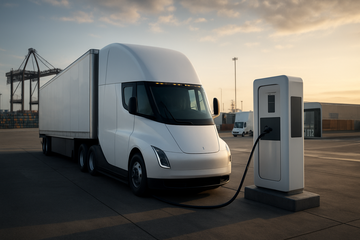
Forum Mobility began installing Tesla's Megawatt Charging System (MCS) Megacharger units at FM Harbor, its flagship Port of Long Beach depot, EVwire reported on Aug. 28, 2026 — the first time a third-party truck-fleet operator has put Tesla's commercial charger hardware inside its own site rather than at a Tesla-controlled location. The install anchors a 100-truck Tesla Semi commitment already locked in across four California drayage fleets (NICA 20, Big F Transport 40, QX Logistix 20, ATC Logistics 20), and lines up next to a 14-Megacharger Forum Mobility depot in Rancho Dominguez (FM Santa Fe) scheduled to open in Q1 2027.
Read past the truck order and the real shape of the deal emerges. Tesla is no longer pitching itself as a Class 8 OEM hoping fleets adopt the Semi; it is now selling fleets a one-stop commercial charging stack — Megacharger hardware, Basecharger overnight units, and a recurring $0.08/kWh fee on every kilowatt-hour that runs through the depot.
Stack economics
Tesla sells hardware, software, and a per-kWh fee in one bundle
On May 1, 2026, Tesla opened \"Semi Charging for Business\" and put a price tag on every piece of the stack. The headline number is a $188,000 starting price for one Megacharger cabinet plus two pull-through posts, scaling to roughly $940,000 for a fully built 8-stall V4 site — at an effective cost of under $40,000 per stall, well below the typical DC fast-charger site build. A new lower-power Basecharger (125 kW,60% range in four hours, deliveries early 2027) starts at $40,000, and every kilowatt that flows through a Tesla-controlled site carries an all-inclusive $0.08/kWh fee to Tesla.
| Product | Spec | Starting price | Recurring fee |
|---|---|---|---|
| Megacharger (1 cabinet + 2 posts) | 1.2 MW per stall, 60% range in ~30 min | $188,000 | $0.08/kWh |
| 8-stall V4 Megacharger site | Pull-through, depot scale | $940,000 | $0.08/kWh |
| Basecharger | 125 kW, 60% range in ~4 hrs, deliveries early 2027 | $40,000 | $0.08/kWh |
Demand
Tesla Semi bookings now run ahead of 2026 output — and90% of the market wants one
Through the first14 months of California's Clean Truck & Bus Voucher Incentive Project (January 2025 – February 2026), Tesla Semi accounted for 965 of 1,067 fleet applications — a 90.4% share. Daimler, PACCAR (parent of Peterbilt and Kenworth), and Volvo split the remaining 102 between them. The application gap is wider than the eventual delivery gap, but it is the cleanest demand-side reading available, and it predates the volume Semi program ramp.
Tesla Semi share of CA drayage voucher apps (Jan 2025 – Feb 2026)
90.4%
965 of 1,067 applications, per ICCT analysis
Combined Daimler / PACCAR / Volvo share
9.6%
102 of 1,067, three incumbents combined
Tesla Semi 2026 delivery estimate
5,000 – 15,000 units
Analyst range vs. 50,000-unit Giga Nevada capacity
Public Megacharger locations mapped
66 sites
Across 15 states, per Tesla's rolling map
Order flow is now stacking faster than the Nevada factory can fill it. Forum Mobility's 100-unit commitment plus WattEV's 370-truck order (~$100M, announced May 5, 2026) and Einride's 500-truck, third-party-financed commitment (Aug. 18, 2026) push announced Semi volumes above1,000 units since volume production began on April 29, 2026 — against an analyst projection of 5,000 to 15,000 trucks in2026. With three of the four buyers (Forum, WattEV, Einride) explicitly tying their orders to Tesla Megacharger or depot rollouts, the truck and the charger are now being sold as a single product.
Tesla Semi booked vs. addressable 2026 output
Announced orders since volume production began, against the upper end of analyst 2026 estimates
Unit: units
Forum Mobility
NICA 20 + Big F 40 + QX 20 + ATC 20
100
WattEV
~$100M, first 50 in 2026
370
Einride
24-month phased rollout from Sep 2026
500
Segment data
The fee is already showing up in Tesla's Services & Other line
Tesla's Q2 2026 10-Q, filed Jul. 23, 2026, separates the story cleanly. Services and other revenue hit $4,581M in the quarter, up roughly 50% year over year on company-reported figures, with record gross profit of $648M and a 14% gross margin. Energy generation and storage delivered another $3,139M (up 13% YoY), driven by Megapack deployments (22.3 GWh of storage products deployed year-to-date through Q2). Total automotive & services gross margin improved to 16.4%, but consolidated operating margin compressed to just 1.4% as regulatory credit revenue rolled off.
| Segment | Q2 2026 | Q2 2025 | YoY change |
|---|---|---|---|
| Automotive (incl. regulatory credits) | ~$20.5B (implied) | ~$16.7B (implied) | +~22% |
| Services and other | $4,581M | ~$3,054M | +~50% |
| Energy generation and storage | $3,139M | $2,789M | +13% |
| Total revenue | $28,236M | $22,496M | +26% |
Supply chain
Upstream — Tesla builds the stack in-house; the third-party MCS field is led by ABB
The Megacharger and Basecharger hardware is built by Tesla in-house on its V4 cabinet platform — the same cabinet family that powers Supercharger for Business at ~$40K per stall, the company's cheapest DC fast-charger build to date. Battery cells are sourced through a multi-supplier strategy for4680-format cells: Panasonic Holdings is the legacy partner, LG Energy Solution is set to mass-produce 4680s at its Arizona plant under a multi-billion-dollar supply arrangement disclosed March 2026, and CATL supplies prismatic LFP cells for the standard-range passenger cars and is a credible second source for commercial cells if Semi volumes scale beyond the 4680 design.
- Tesla — in-house V4 cabinet, Basecharger/Megacharger hardware, charging software, recurring kWh fee.
- Panasonic Holdings — long-standing 4680 cell partner; primary NCA cell supplier for the Semi program.
- LG Energy Solution — Arizona4680 line ramping under the $4.3B disclosed March 2026; named as a Tesla cell customer.
- PACCAR — incumbent US Class 8 leader (Kenworth, Peterbilt); trailing the Semi on drayage applications with a 9.6% combined Daimler/PACCAR/Volvo share.
On the third-party MCS side, the technology is not Tesla-exclusive. ABB Ltd E-mobility (a subsidiary of ABB, listed in Zurich and therefore outside this article's link scope) demonstrated a working MCS prototype with MAN in March 2024 and launched its M-Series 1.2-MW distributed system in April 2026, while Stäubli makes the MCS connector specified by the CharIN task force. The strategic question for Tesla is therefore not whether MCS exists — it does — but whether its proprietary V4 cabinet, its software stack, and its $0.08/kWh fee keep Forum Mobility and other depot operators inside its ecosystem when standards-compliant third-party hardware is available.
Downstream
Downstream — California ports, drayage, and Berkshire Hathaway's Pilot network
Forum Mobility, WattEV, Voltera, and TeraWatt Infrastructure are the four private depot operators actively building commercial charging capacity in California; Forum, WattEV, and now Voltera all hold explicit Tesla Semi fleet commitments or Megacharger relationships. California policy is the demand engine: the state's drayage fleet must transition to zero-emission under the Advanced Clean Fleets rule, the EPA awarded the Port of Oakland a $322M Clean Ports grant in December 2024 (with a $40M subgrant to Forum Mobility to lease-purchase226 electric trucks), and a stackable $165,000-per-truck federal incentive package under Forum's Market Acceleration Program pulls the per-truck effective cost down sharply for any drayage operator servicing the port 100+ times a year.
Outside the private depots, Tesla is layering a parallel public-network strategy. On Apr. 20, 2026, Tesla and Pilot Travel Centers (now a100% Berkshire Hathaway subsidiary since January 2024) announced Megacharger builds at four-to-eight-stall Pilot sites along I-5, I-10, and other corridors across California, Georgia, Nevada, New Mexico, and Texas, with the first stalls expected to open in summer 2026. That gives Tesla two distinct commercial charging footprints at once — proprietary depot installs like FM Harbor and FM Santa Fe, and public corridor sites on Berkshire Hathaway's truck-stop real estate.
California commercial charging footprint, anchored by Tesla
Tesla Semi and Megacharger commitments touching California freight corridors
Unit: units
Tesla Semi trucks committed (Forum + WattEV + Einride CA-bound)
Forum 100 + WattEV 370 + ~500 Einride phased
970
Megacharger locations nationwide
Tesla-mapped, 15 states
66
FM Harbor charging ports
Operational since Jan 2025
44
FM Santa Fe MCS lanes (Q1 2027)
Pull-through, Rancho Dominguez
14
What could break it
Risks — production, price, and a competitor that does not need a Tesla
The stack only works if three things hold: Tesla can produce the Semi on time, the $0.08/kWh fee survives competitive pressure from CCS-based depot operators, and the regulatory tailwind in California is not rolled back. The production track record is the most fragile. Tesla has now missed every Semi volume target it set since 2020; analyst 2026 deliveries sit at 10–30% of nameplate Giga Nevada capacity (5,000–15,000 units vs. 50,000). Forum Mobility's own100-truck order is staged off the Q1 2027 FM Santa Fe opening — if that date slips, Forum's fleet ramps slip with it.
- Production: Giga Nevada was officially rated at 50,000 units/year capacity, but no quarter has shipped even15,000 to date.
- Pricing: WattEV paid ~$270,000 per Semi (~$100M / 370 trucks) and Forum's buyers reference the $260K–$290K price ladder — pricing power depends on continued regulatory credit monetization.
- Competition: Volvo quietly hit its 5,000th electric truck sale and is winning Coca-Cola and DHL orders on a CCS/MCS dual-stack strategy.
- Capital: Einride's 500-truck order is \"fully financed with third-party funding,\" not by Tesla; any tightening of project-finance markets delays the rollout.
Horizons
Short-term and long-term — what moves first, what compounds
Short-term (days to quarters): three catalysts can move the print. First, the Pilot-Tesla Megacharger sites are expected to open in summer 2026 — every additional corridor stall is a per-kWh fee attached to a truck that already exists on the road. Second, the Einride rollout starting September 2026 is the first test of third-party-financed Semi volumes; any quarterly disclosure of trucks actually delivered (vs. ordered) will reset the bull-bear debate. Third, FM Santa Fe's Q1 2027 opening is the date Forum's full100-truck fleet goes operational; pre-opening delays or any miss there will be the cleanest read on Tesla's commercial execution.
Long-term (1–3 years): the structural argument is that Tesla becomes the platform vendor for commercial freight charging — the same moat Supercharger built in passenger EVs, but at higher per-site economics (1.2 MW per stall vs. 250 kW) and with a captive fleet (every Tesla Semi on the road must use a Megacharger or Basecharger for fast turnaround). The base case:50,000 trucks/year at Giga Nevada by2028, each running ~150 kWh/day through a Tesla-controlled site at $0.08/kWh, would generate a high-margin recurring revenue layer on top of the truck itself. The risk case: third-party MCS hardware from ABB E-mobility and others commoditizes the connector, a CCS-standard competitor like Volvo's network scales faster than Tesla's proprietary depots, and the $0.08/kWh fee compresses.
We are working with Forum Mobility to drive Semi adoption and improve Total Cost of Ownership — California, Washington, Oregon, and Canada.
Where the deal actually shows up
- Q2 202610-Q explicitly flags 'public Megacharger' deployment as a program line — converts the truck story to a network story on the SEC record.
- Short-term (days–quarters): Pilot Megacharger stalls open summer 2026, FM Santa Fe Q1 2027; upside if Forum hits 100 units by mid-2027, downside if Giga Nevada slips.
- Long-term (1–3 years): at nameplate 50,000 trucks/year by2028, a $0.08/kWh fee on Tesla-controlled depot charging could add a high-margin recurring layer atop auto revenue.
- Long-term (1–3 years): if Einride's 500-truck rollout sticks, it is the first fleet operator with a working Tesla-MCS commercial network at scale — a template other drayage operators can copy.
- Kenworth and Peterbilt are the established US Class 8 incumbents; the Tesla-Forum / Tesla-WattEV / Tesla-Einride depot partnerships shift the OEM-depot relationship toward Tesla as the platform layer.
- Short-term (days–quarters): every new Tesla Semi announcement compresses PACCAR's pricing power on its own electric Class 8 program; long-term (1–3 years) the zero-emission mandate turns into a 'do you have a Tesla-compatible depot?' question.
- Long-term (1–3 years): Pilot is the only public-corridor partner named in the Tesla network so far — the question is whether Berkshire can capture a meaningful share of the per-kWh economics or whether Tesla keeps the bulk of the margin.
- At 50,000 trucks/year of Semi volume, Panasonic's 4680 demand expands by an order of magnitude versus current4680 use in Cybertruck.
- Short-term (days–quarters): Tesla Semi delivery disclosures drive Panasonic cell volumes; long-term (1–3 years), the Semi program is the volume catalyst for the 4680 line.
- Short-term (days–quarters): any Forum/WattEV/Einride Semi delivery shortfall is a near-term volume risk for LGES; long-term (1–3 years), Tesla Semi is the largest single commercial-vehicle cell order in the US market.
- Short-term (days–quarters): Semi is currently 4680, so CATL exposure is limited until the design diversifies; long-term (1–3 years), any46xx or prismatic Semi variant opens a new TAM for CATL.