
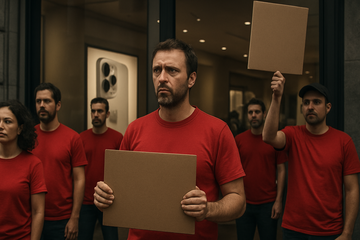
Striking workers
1,600+
Across 17 Apple Retail Italia stores, Sept 18, 2026
Unions on strike
3
Filcams CGIL, Fisascat CISL, Uiltucs
iPhone 18 Pro starting price
$1,199
$100 bump over iPhone 17 Pro, launched Sept 18, 2026
Apple Q3 FY2026 revenue
$109.4B
Quarter ended June 27, 2026; up 16% YoY
Apple Europe revenue, Q3 FY2026
$29.4B
26.9% of total;9-month YTD Europe at $95.6B
The strike broke at 9 a.m. local time on Apple's biggest retail day of the year. Workers picketed outside the glass-cube Apple Piazza Liberty store in Milan while customers queued inside to buy the new device. By the end of the day, none of Italy's 17 Apple Retail stores had closed, per the company's statement, but the unions representing 1,600 retail employees had made their point on the only day the press would care.
That point is not about the iPhone 18 Pro. It is about who staffs the stores that sell it, and on what terms.
The event
Three unions chose the one day Apple could not ignore
Filcams CGIL, Fisascat CISL and Uiltucs called the all-day action for September 18, the global launch day for the iPhone 18 Pro at a starting price of $1,199. The unions represent roughly 1,600 retail employees across all 17 Apple Retail Italia locations, including the flagship Piazza Liberty store in Milan and the Via del Corso store in Rome. Pickets went up outside multiple sites; inside, Apple said stores would \"operate normally.\"
- Unions want a jointly agreed hiring plan; Apple offered only additional fixed-term contracts
- Unions want fixed-term roles converted to permanent; Apple offered contracts approaching seven months
- Unions want part-time staff able to opt into more hours; Apple declined to formalize it
- Trigger: staff meetings on September 7 showed workloads rising while staffing stayed flat, unions said
This is not the first Italian labor flare-up at Apple. In 2011, Rome retail staff walked out ahead of the iPhone 4S launch under the slogan \"Strike Different.\" In 2013, the same three unions signed Italy's first Apple collective agreement, covering 1,300 workers across 14 stores. The current workforce has grown to roughly 1,600 across 17 stores — meaning today's workers have been negotiating under a framework that is now both out of date and, in the unions' reading, ignored.
Fundamentals
Behind the picket line sits a $30.7B services machine
Retail is the cheapest customer acquisition channel Apple has. In the quarter ended June 27, 2026, Apple generated $109.4B in revenue, of which $30.7B came from Services — the App Store, iCloud, AppleCare, Apple Music, advertising, payments — and the remainder from products including $54.3B from the iPhone line alone. Services gross margins run near 70%; product gross margins run in the mid-30s. Every customer who walks into a store and buys an iPhone is a future Services subscriber, and the conversion runs much higher after an in-store touch than after a click.
Services revenue, Q3 FY2026
$30.7B
Up12% YoY; ~70% gross margin segment
iPhone revenue, Q3 FY2026
$54.3B
Half of total revenue; launch-day halo effect
Apple gross margin, Q3 FY2026
50.1%
Including ~2 pts of tariff refunds
That is the moat the picket line is leaning against. Europe alone delivered $29.4B in the June quarter — roughly 27% of Apple's revenue — and $95.6B over the first nine months of fiscal 2026. Italy is a small slice of that, but the iPhone 18 Pro launch is a synchronized global event, and the labor story attached to it spreads to every European Apple employee who has been watching.
The comparison
Why the Tesla-Sweden buyout playbook cannot translate
In August 2026, IF Metall ended a 1,021-day strike against Tesla in Sweden after Tesla bought out the roughly 80 remaining striking workers with severance packages. No collective agreement was signed. The model looked like a win for union-busting by attrition: starve the strike of bodies, let collective-bargaining law do the rest.
| Variable | Tesla in Sweden (resolved Aug 2026) | Apple in Italy (Sept 18, 2026) |
|---|---|---|
| Strike duration | 1,021 days | Day 1 (Sept 18, 2026) |
| Striking workers | ~80 | 1,600+ |
| Stores affected | ~10 service/showroom sites | 17 retail stores |
| Revenue dependency on strike day | Low — direct sales minimal | High — iPhone 18 Pro launch day |
| Outcome so far | No collective agreement; union concedes | Negotiations ongoing; second strike possible |
| Buyout cost per worker | Not disclosed | N/A — no buyout offered |
| Collective agreement signed | No | No (last was 2013; expired) |
The math flips. Tesla's Sweden operation sold cars and serviced them, but launch-day volume in a single retail channel was never the swing factor for revenue. Apple's Italian retail operation is the channel through which roughly a fifth of iPhone 18 Pro units in the country move in the first weekend — and it is also the on-ramp to Services revenue that runs at Apple's highest margin. Buying out 1,600 retail specialists in a country where Apple only has 17 stores is not attrition; it is replacing the store with nobody.
Apple has already shown what its non-buyout version of the same playbook looks like. In April 2026 the company announced the closure of its Towson, Maryland store — the first Apple store in the U.S. to unionize, in 2022, with the IAM. The store shut in June 2026. The union accused Apple of union-busting; Apple cited \"declining conditions\" at the surrounding mall. The strategy of removing the venue rather than negotiating the contract is portable to Italy — but harder to repeat17 times over, and harder still to hide inside a launch-day press cycle.
Labor structure
The seven-month contract sits five months under an EU ceiling
Italian law caps fixed-term employment contracts at 12 months without a stated cause, and 24 months with one. Apple Retail Italia's response to the unions was to offer more fixed-term contracts, with some approaching seven months. That is legal, but it is also the precise instrument the unions say they want abolished: a treadmill of short contracts that cycles staff through the door before any conversion obligation can attach.
- 7-month fixed-term contracts approach the 12-month no-cause ceiling under Italian Legislative Decree 81/2015
- Unions want the conversion to be automatic, not at management discretion
- Allowing part-time staff to opt into more hours targets the largest cost variable: hourly scheduling, not base wages
- A new collective agreement would replace the 2013 deal and lock in conversion terms for the next cycle
None of this is unfamiliar in European retail. French Apple workers struck on the iPhone 15 launch in September 2023 — a few hundred of Apple's roughly 2,300 French retail staff walked out, demanding a 7% pay rise. In Germany, works councils have existed at Apple stores since 2012. In Japan, the UA Zensen-affiliated union represents staff at three of Apple's ten stores. The pattern across Apple's footprint is that organized labor gains traction exactly where the retail format tries to operate without one.
Apple's European retail labor scorecard,2011–2026
Number of Apple retail employees covered by a union or works council at the time of each action
Unit: employees covered
Italy 2011 (iPhone 4S)
0
Italy 2013 (first deal)
1,300
France2012 (iPhone 5)
1,000
France 2023 (iPhone 15)
2,300
Towson MD, 2022
110
Italy 2026 (iPhone 18 Pro)
1,600
Horizons
Short-term: a single day of picket lines. Long-term: a European contest.
The strike does not threaten Apple's launch day in any mechanical sense. Pre-orders opened September 12, and the bulk of Italian iPhone 18 Pro demand has already been routed to online fulfillment and carrier partners — Vodafone's Italian operation and Telecom Italia's TIM retail network absorb significant volume. Apple's Q4 FY2026 iPhone cycle, with Apple at a $4.95T market cap and trailing P/E of 38.2, is driven by global Pro demand, not by the 17 Italian stores' one-day walkout. The strike cost the union leverage, not Apple revenue.
The longer game is the precedent. Italy's three unions have signaled further action if talks do not move. If Apple signs a deal that includes automatic conversion clauses, French and German unions — both with prior track records of Apple disruption — gain a template. The cost is not the Apple line item, but the operating model. Apple stores are designed to be a flexible labor environment wrapped in a premium experience; the Italian unions are arguing the flexibility is no longer compatible with the experience. That argument, if it wins in Rome, travels.
- Next union meeting expected within two weeks; further strikes possible if no movement
- Italian labor courts may compel back-pay awards if fixed-term contracts are later ruled disguised permanent roles
- Foxconn and Luxshare Precision Industry assemble the iPhone 18 Pro upstream and are unaffected by Italian retail labor
- Taiwan Semiconductor Manufacturing fabricates the A20 Pro chip and faces its own labor dynamics in Arizona and Hsinchu, separate from this strike
Synthesis
Premium pricing meets the cost of its own labor model
The framing of the strike as a test of Apple's premium retail playbook is correct, but the test is not whether Apple can sell an iPhone through a picket line — it can, and did. The test is whether the playbook that ties premium pricing to a premium in-store experience can survive organized labor demands for permanence, when every Apple retail employee is a high-touch node in the $30.7B-quarter Services revenue stream.
What to watch: any settlement language from Rome; whether French unions invoke the Italian deal in their own next negotiation; whether Apple announces further European store closures (a re-run of the Towson pattern); and the Q4 FY2026 iPhone gross margin print in late October, which will be the first quarterly read on whether launch-day disruptions or labor cost creep have any measurable margin impact. A clean print would let Apple bury the story. A soft one would bring it back to the front page before the December quarter.
Stocks to watch
- 1,600 Italian strikers are 0.96% of Apple's 166,000 global employees — one-day impact on iPhone 18 Pro revenue is mechanical noise.
- Long-term risk: a permanent-conversion settlement in Italy becomes a template for French and German unions, raising fixed-cost share of European retail.
- $30.7B Q3 Services revenue runs at ~70% gross margin; the moat that the picket line leans against is the Services flywheel, not the iPhone itself.
- Sweden ended Aug 19, 2026 after Tesla bought out the last ~80 strikers — playbook wins on paper, but no collective agreement was signed.
- Playbook does not scale: Apple's 17 Italian stores and 1,600 workers make buyout attrition mathematically impossible.
- Watch the next Nordic union response to Tesla's Swedish posture; a second market fight would expose the buyout tactic as one-off, not template.
- Primary iPhone 18 Pro assembly partner alongside Foxconn; unaffected by Italian retail labor but exposed to parallel Apple supply-chain decisions.
- Italian strike pattern, if replicated in Europe, doesn't touch Luxshare's Zhengzhou/Shenzhen capacity but does touch Apple's willingness to invest in retail-tier labor across regions.
- Watch Q4 FY2026 iPhone shipment guidance from Luxshare — the real demand read on Pro uptake, independent of retail labor dynamics.
- Fabless supplier of the A20 Pro chip in iPhone 18 Pro; the Italy strike has zero direct impact on TSMC's wafer throughput.
- Indirect exposure: if Apple re-prices or re-launches in Europe to absorb labor-cost creep, chip volume orders to TSMC could shift in 2027.
- Long-term horizon (1–3 years): any Apple retail margin compression could feed back into A-series chip budget and node-mix decisions.
- Sells iPhone 18 Pro at U.S. launch with carrier subsidies; iPhone launch-day revenue split with retail carriers is a real channel for AT&T, T-Mobile, Verizon.
- Apple retail labor is a separate workstream from carrier sell-through — T-Mobile Q4 FY2026 results won't see an Italy strike line item.
- Watch the iPhone 18 Pro attach rate in T-Mobile's Q4 results for the real U.S. demand signal, independent of European retail noise.