
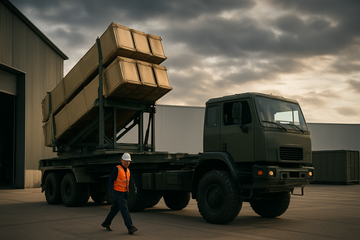
First-batch delivery
August 28, 2026
22 days after the August 6, 2026 contract signing, per Lockheed Martin statement to Reuters
Patriot framework value
$58.6B / 7 years
U.S. Army contract to Lockheed Martin for PAC-3 MSE interceptors, FY2026–FY2032
PAC-3 MSE production target
2,000 / year by end-2030
Up from ~600 units today, a 233% increase
Lockheed Martin backlog
$230.4B
Record, as of Q2 FY2026 earnings release (July 23, 2026)
Lockheed MFC segment growth (Q2 FY2026)
+19% YoY to $4.1B
Driven by PAC-3 and THAAD ramps, per Lockheed Q2 FY2026 release
GM Defense 2026 revenue target
~$700M
Positive EBIT, with multi-year revenue CAGR above 30% — CEO Mary Barra, Q2 2026 letter
The proof point
Twenty-Two Days From Contract to Casting — A Production Curve the Aerospace Tier Hasn't Matched
On August 6, 2026, Lockheed Martin and General Motors Defense signed a formal manufacturing agreement for PAC-3 MSE interceptor housing components. On August 28 — twenty-two days later — the first batch arrived at Lockheed's door. Tim Cahill, president of Lockheed Martin Missiles and Fire Control, framed the turnaround in the September 17 Reuters report: the 22-day cycle \"underscores Lockheed Martin's relentless focus on execution — delivering for our troops faster, with greater capacity.\"
The components are precision castings that form the missile housing — exactly the kind of high-tolerance, high-volume metal forming that an automotive stamping and casting line is built to do at scale. Stephen duMont, president of GM Defense, told Reuters the automaker's \"precision-fabrication expertise would support production of this country's critical defense capabilities.\" That phrasing matters: GM is not assembling a complete missile. It is taking a sub-tier bottleneck — cast airframe housings — and running it through a manufacturing system engineered for multi-million-unit annual volumes of similar components.
Demand backdrop
The $58.6 Billion Patriot Framework Sets the Volume the Auto Tier Has to Hit
The parts ramp sits on top of an unusually large and unusually long demand envelope. The U.S. Army awarded Lockheed Martin a contract worth up to $58.6 billion on July 30, 2026 — a seven-year, multiyear procurement framework running from FY2026 through FY2032. The Army's pre-deal inventory disclosure was stark: fewer than 1,000 Patriot interceptors on hand and fewer than 250 THAAD interceptors, against a stockpile draw rate that accelerated through the Iran conflict.
PAC-3 MSE production ramp — units per year
Targets set by the Pentagon-Lockheed seven-year framework signed January 2026.
Unit: interceptors / yr
2025 (actual)
600
2027 (target)
1,100
2028 (target)
1,500
2030 (target)
2,000
Lockheed Martin is committing $8 billion to $9 billion of its own capital through 2030 across more than 20 U.S. facilities, and Camden, Arkansas — the primary PAC-3 assembly site — is already expanding headcount from 1,200 to roughly 1,850 jobs, a 50% increase. Full-year 2026 sales guidance was raised to $79.75–$81.75 billion with free-cash-flow guidance of $7.0–$7.2 billion at the Q2 FY2026 print.
Supply chain
Who Else Lives Inside the 13,000-Supplier PAC-3 Network — and Where the Auto Capacity Sits
The PAC-3 MSE ecosystem runs through 13,000 suppliers across 15 U.S. locations and 11 states. GM's housing castings enter the network at a specific choke point: high-tolerance metal forming, where every additional unit of capacity is currently the rate-limiting step on the way from 600 interceptors to 2,000. The rest of the system is already being re-plumbed for the same ramp.
| Company | Role on PAC-3 MSE | Capacity / investment signal |
|---|---|---|
| Boeing | Seeker manufacturing at Huntsville, AL | $200M+ invested since 2024; 35,000 sq ft expansion; 850 seekers in 2026 → 2,000/yr target |
| L3Harris | Dual-pulse solid rocket motor, attitude control motors, lethality enhancer (via Aerojet Rocketdyne) | $4.7B, seven-year propulsion contract, May 2026 |
| Howmet Aerospace | Precision castings — incumbent in the airframe-housing category GM is now entering | Q2 FY2026 revenue $2.55B, +24% YoY; LTM EBIT margin 28.5% |
| Lockheed Martin — Camden, AR | Final assembly of PAC-3 MSE | Headcount 1,200 → 1,850 (+50%); $8–9B facility investment through 2030 |
Two of the four are direct peers to GM Defense — Howmet Aerospace on castings and L3Harris on propulsion sub-systems — and both are running their facilities hard. Howmet just posted Q2 FY2026 revenue of $2.55 billion, up 24% year-over-year with organic growth of 21%, with engine-products and engineered-structures (the segments that touch defense castings) doing most of the lifting. L3Harris bagged the landmark $4.7 billion propulsion contract in May 2026 — separate from the GM-Lockheed deal — covering the dual-pulse solid rocket motor, attitude control motors, and lethality enhancer that sit downstream of the housing.
Margin economics
Defense Earnings Are Becoming a Margin Floor for GM, Not a Spare-Time Side Hustle
GM Defense is still small relative to the parent's $185.5 billion in trailing-twelve-month revenue — but the trajectory CEO Mary Barra laid out in the Q2 2026 shareholder letter is materially different from a one-off contract. 2026 revenue approaches $700 million, the segment targets positive EBIT this year, and management has guided to a multi-year revenue CAGR above 30%. Internal forecasts discussed with the Army describe a path toward $1 billion in vehicle work alone as the ISV-Heavy competition resolves.
The structural argument isn't that GM Defense will move the group P&L — it won't, even at a $1 billion run-rate. It is that defense work is paid on long-cycle, cost-plus or fixed-price-incentive contracts with milestone-based cash collection, in a counter-cyclical end market to light-vehicle demand. Every interceptor housing GM ships is a unit of EBIT-margin exposure that does not correlate with North American light-truck SAAR or with EV price compression. With North American EBIT-adjusted margin already running at 8.6% — up 250 basis points year-over-year — defense adds a separate, slower-moving margin rail.
Policy backdrop
The Pentagon Is Buying the Entire Industrial Base, Not Just the Primes
The August delivery is the operational expression of a policy shift that began with President Trump's June 11, 2026 invocation of the Defense Production Act. The Pentagon's FY2027 budget request followed with roughly $30 billion in DPA-purchase authority — a nearly 100-fold increase over prior-year levels — earmarked specifically for munitions, missiles, and the industrial base that supplies them. DPA Title III funding is the mechanism the Department of War is using to sign seven-year subcontracts with key suppliers like L3Harris and Boeing, neutralizing negative cash impact during capacity build-outs.
For an auto OEM like GM, the DPA framework changes the entry math. The federal government is now willing to pre-fund supplier tooling, absorb nonrecurring engineering, and provide inflation protection — in exchange for capacity commitments that defense primes cannot meet from their traditional tier base alone. That is why the Lockheed GM Defense contract moved from MOU on June 16 to signed agreement on August 6 to first delivery on August 28: the policy backdrop already had the bureaucratic and financial rails laid in advance.
Horizons
What Moves First vs. What Compounds Over Three Years
- Short term (days to quarters): Watch the FY2027 defense budget markups in October–December 2026 and the next Lockheed earnings print for explicit disclosure of how much of the $58.6B framework has been definitized into funded backlog — that number drives Lockheed's near-term revenue conversion more than any single supplier headline.
- Short term: Howmet Aerospace and L3Harris are the most direct read-throughs to incremental PAC-3 volumes; both should see follow-on order flow as the 600-to-2,000-unit ramp progresses through 2027.
- Medium term (12–24 months): The first auto-OEM-to-missile milestone that proves the model scales is GM Defense booking incremental casting capacity for a second interceptor program — THAAD is the obvious candidate, given the shared supplier constraint — rather than a one-off Patriot contract.
- Long term (1–3 years): Structural margin impact at GM hinges on whether defense revenue reaches the $1.5–$2 billion run-rate implied by the >30% CAGR guidance; below that, the segment is margin-accretive but immaterial; above that, it becomes a credible argument for a re-rating of the parent multiple toward defense peers like LMT and NOC.
- Long term risk: The single biggest threat to the thesis is auto-OEM unit economics failing at sub-scale — if GM Defense needs $2B of revenue to clear corporate overheads and sits at $700M, defense becomes an EBIT drag, not a margin floor.
- Cross-industry spillover: Peer auto OEMs — Ford Motor Company has held Pentagon-adjacent vehicle work for years — face a strategic decision by mid-2027 on whether to follow GM into precision munitions sub-tier or cede that margin to Detroit's No. 1.
Investable takeaways
- First-batch delivery lands directly inside the $58.6B / 7-year Patriot framework, reducing execution risk on the 600-to-2,000 PAC-3 ramp by proving non-traditional supplier onboarding works in 22 days.
- Q2 FY2026 MFC segment grew +19% YoY to $4.1B on PAC-3/THAAD ramps — and the GM supply line is the marginal capacity lever for converting the $230.4B backlog into revenue.
- Risk: GM tooling scale-up could pull forward cost commitments faster than the multi-year definitization cadence, pressuring 2027 free cash flow even as revenue accelerates.
- The 22-day delivery validates GM Defense's manufacturing thesis and supports the guided >30% multi-year revenue CAGR toward ~$1.5–$2B by 2029, layering defense margin onto the 8.6% North American EBIT-adjusted base.
- GM Defense targeting positive EBIT in 2026 on ~$700M revenue means the segment needs scale beyond Patriot alone to clear corporate overhead — a second interceptor program (THAAD is the candidate) is the binary 2027 catalyst.
- Bullish thesis hinges on the segment compounding past $1.5B; bearish case is that defense revenue stalls at <$1B and becomes a margin drag during the EV investment cycle through 2027.
- Pure-play precision-castings incumbent on the exact category GM is entering — Q2 FY2026 revenue $2.55B, +24% YoY, with 28.5% LTM EBIT margin reflecting defense pricing power.
- Howmet Engineered Structures and Engine Products segments are direct read-throughs to the 600-to-2,000 PAC-3 ramp; order momentum should compound through FY2027 as missile castings demand scales.
- Risk: GM's lower-cost automotive-tier entry could pressure Howmet margins on the next round of supplier-of-record awards for missile housings post-2027.
- Anchored $4.7B, seven-year PAC-3 propulsion contract (May 2026) covers dual-pulse SRM, attitude control motors, lethality enhancer — sits downstream of GM castings in the bill of materials.
- DPA-backed seven-year subcontract structure provides demand certainty through FY2033; LTM backlog conversion supports the company's $79.75–$81.75B-equivalent sales trajectory.
- Risk: production lead time on the SRM is 30 months — L3Harris capacity, not GM castings, is the actual near-term binding constraint on Patriot output.
- Boeing PAC-3 seeker manufacturing in Huntsville, AL is on its own tripling path: $200M+ invested since 2024, 850 seekers in 2026 ramping to 2,000/yr — a parallel capacity build to GM's housing line.
- Seeker production is the highest-precision, highest-margin node on the PAC-3 bill of materials and a direct beneficiary of the $58.6B Patriot framework volume.
- Risk: Boeing's commercial aerospace FCF drag caps how much of the defense ramp can be reinvested; the 2027 free-cash-flow print will show whether defense backlog is funding or subsidizing the commercial recovery.