
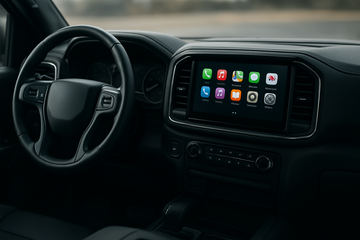
General Motors on Tuesday, September 15, 2026 unveiled a new pickup-truck user interface that integrates — rather than blocks — Apple CarPlay and Android Auto. The debut vehicles are the 2027 Chevrolet Silverado and 2027 GMC Sierra, GM's two highest-volume nameplates, with the system described as a \"single scalable foundation\" that will \"expand across the broader portfolio\" of electric, gas, and diesel vehicles. Phone content now sits in a card window alongside native apps like trailering status and climate, instead of replacing them. The new truck UI spans roughly 60 inches of display across the cabin.
The reversal lands after three years of attempted pivot. In 2023, General Motors said it would phase CarPlay out of EVs; by late 2025 the policy had been extended to the entire lineup under CEO Mary Barra. Within twelve months of that October 2025 escalation, GM is now publicly performing the opposite: bringing the iPhone back to the center screen, first on its two most important trucks.
What GM actually said on Sept. 15, and what it didn't
General Motors framed the announcement as a deeper integration, not a retreat. In a Q&A published the same day, GM infotainment executive Mike Wahlstrom said GM was \"one of the first automakers to bring [Apple] CarPlay and Android Auto into our gas-powered vehicles\" and that the new pickup system integrates them \"more deeply than ever before\" — a single experience rather than the walled-off \"rooms\" of past implementations.
- Debut: 2027 Chevrolet Silverado and 2027 GMC Sierra light-duty pickups — GM's two highest-volume nameplates by a wide margin
- Architecture: split-card layout with native vehicle data (trailering, range, climate) persistent alongside CarPlay/Android Auto content; designed for over-the-air updates
- Scale: 60 inches of combined display across the cabin with local backlight dimming, signaling the UI is built for premium-truck content not just phone projection
- Rollout language: GM said the system \"can extend across electric, gas and diesel-powered vehicles,\" with a spokesperson clarifying that gas trucks were always going to support CarPlay/Android Auto — only the depth of integration has changed
- What GM did not say: no mention of Ultifi or any owned-software platform, no timeline for removing CarPlay from future EV programs, no comment on the related $7.1B Q4 2025 special charges tied to EV realignment
Buyer sovereignty: the math that forced the pivot
Apple-using buyers calling no-CarPlay a dealbreaker
55%
CarPlay-skeptic survey cited in GM materials and Jalopnik, Sept. 15, 2026
Android Auto users calling its absence a dealbreaker
36%
Same survey; 19-point gap suggests Apple-fleet buyers skew more loyal to the phone-mirror experience
GM owners (any phone) calling CarPlay loss a no-go
42%
Same survey; population GM had the most direct exposure to
Apple's 2022 buyer-preference claim
79%
Apple at WWDC 2022: 79% of U.S. buyers would only consider a CarPlay-equipped car
The inflection points read in order. When General Motors first announced the CarPlay phase-out in 2023, Apple's WWDC data (79% of U.S. buyers want CarPlay) was public, but no automaker had measured what its own owners would do. By August 2026, an industry survey was producing single-segment dealbreaker rates north of 40% for GM owners and 55% for iPhone users — the same population the EV-only phase-out was supposed to target first. Cadillac quietly kept CarPlay as standard on the 2027 Lyriq configurator, and a General Motors spokesperson framed the choice as \"evolving based on customer feedback.\"
Infotainment now ranks among the top three purchase drivers for new-car buyers, per the 2025 U.S. Ipsos NVCS study (Oct. 2024 to Jun. 2025) cited in GM's own Sept. 15 materials. The competitive cost of being wrong on the dashboard moved from a footnote to a Silverado/Sierra conquest-rate variable. With light-duty pickups running roughly 800,000-900,000 U.S. units annually and transaction prices north of $55,000, even a 1-2 point defection is a billion-dollar revenue problem.
What the pivot costs GM's software thesis
The original software thesis was not small. In October 2021, General Motors projected $20-25B in annual software-and-services revenue from a target of 30 million connected vehicles by 2030 — explicitly modeled on the Tesla-style owned-stack economics. Through2025 the build advanced on OnStar and Super Cruise, not on the dashboard: realized subscription revenue grew from $1.7B in 2020 to $2.7B in 2025, with the company guiding to more than $3B for 2026 and deferred software revenue rising to $5.4B at year-end 2025.
| Metric | FY2020 | FY2025 | Q2 2026 | FY2026E |
|---|---|---|---|---|
| Realized subscription revenue | $1.7B | $2.7B | $800M OnStar (+20% YoY) | >$3.0B |
| Deferred software/services revenue | n/d | $5.4B (+65% YoY) | $6.3B (+~50% YoY) | $7.5B (+~40%) |
| OnStar subscribers (millions) | ~20 | ~12 (after plan redesign) | n/d | growing double-digit |
| Q4 2025 special charges (EV realignment) | — | $7.1B ($1.8B EV write-down + $4.2B EV costs + $1.1B China) | — | — |
The privacy overhang also matters here. In January 2026, the FTC finalized a consent order banning General Motors and OnStar for five years from selling driver geolocation and behavior data to consumer reporting agencies, after the agency alleged GM collected and sold driver data without informed consent. General Motors also settled a related California Attorney General action for $12.75M in May 2026. The data-monetization pillar of the2021 software thesis — using CarPlay replacement as a forcing function for first-party data capture — just became substantially harder to execute.
Apple just got its dashboard back — and the next leg is already queued
Apple's Services segment posted $30.74B in the June 2026 quarter (fiscal Q3 2026), up double digits year over year but short of the $31.22B Street consensus. Services gross margin ran 75.6%, and management called out double-digit growth in cloud, video, payment services, and advertising. Automotive-specific revenue is not disclosed, but the connected-car wedge is the surface area Apple is rebuilding on three fronts at once: classic CarPlay (now restored at General Motors), CarPlay Ultra (next-gen, instrument-cluster level), and MapKit for Automotive SDK (the underlying maps engine Apple now licenses to OEMs).
- CarPlay: ~800 vehicle models currently supported; restored by General Motors on the 2027 Silverado and Sierra, then to extend across GM's gas, diesel, and EV portfolio
- CarPlay Ultra: debuted on Aston Martin in May 2025; Hyundai Motor and Kia confirmed for at least one model each in the second half of 2026 per Bloomberg reporting
- Apple Maps via MapKit for Automotive SDK: Ford announced July 23, 2026 that Apple Maps will power navigation on the 2027 Ford Universal Electric Vehicle (UEV) platform, including BlueCruise hands-free integration — a direct endorsement of Apple infrastructure inside a competitor's truck-adjacent EV
The Ford deal is the under-reported piece. Ford is not dropping its own BlueCruise ADAS; it is layering Apple Maps on top. That hybrid template — owned ADAS, Apple navigation, Google-or-native point-of-interest data — is now the playbook two of the three Detroit incumbents have converged on. Only General Motors tried to own the whole stack, and it has now publicly conceded the screen.
Rivian stands alone — and the data is starting to bite
Rivian remains the most aggressive anti-CarPlay holdout. CEO RJ Scaringe has publicly defended the decision, and the company's software chief said in May 2026 that CarPlay and Android Auto are \"redundant in the world of AI.\" Rivian OS 2 began rolling out across the R1 lineup on September 4, 2026, unifying the software platform across vehicles including the upcoming R2.
Rivian Q2 2026 software & services revenue
$515M
Up 37% YoY; ~60% ($308M) from VW joint venture, per Q2 2026 release
Rivian software/services gross margin
42%
Q2 2026; well above the 11% automotive gross margin
Rivian 2026 software revenue target
$2.5B
Company-stated, heavily dependent on VW joint venture milestone payments
Rivian has the most to lose from a buyer-sovereignty reset because it sells to the demographic that reads every CarPlay forum thread. The bull case is that Rivian's $2.5B 2026 software target and the VW joint venture (total deal size up to $5.8B) prove the owned-stack economics can work even without CarPlay. The bear case is that the R2 — the mass-market model that has to scale to keep the company alive — is launching into a buyer pool that GM has just been forced to accommodate, and Rivian has not.
Ford, Stellantis and the new template
Ford is the cleanest expression of the hybrid playbook. Q2 2026 delivered $48.3B in revenue and a net loss of $1.3B, but paid subscriptions grew 20% and BlueCruise now accounts for roughly half of Ford's retail Integrated Services revenue, with 840 million cumulative hands-free miles logged. Critically, Ford is also the first major OEM to embed Apple Maps into a next-gen EV via the MapKit for Automotive SDK — a deliberate split: own the ADAS, rent the maps.
Stellantis has the opposite exposure. On May 28, 2025, the company confirmed it was winding down its Amazon-anchored STLA SmartCockpit project — the in-car software stack meant to compete with native Alphabet/Apple experiences. Reuters framed it as \"the latest software effort to stall out at a Stellantis partner.\" The implication: Stellantis is no longer building a CarPlay alternative, and has not announced a phase-out either — which leaves it functionally closest to the pre-2023 status quo, supported by STLA Brain and the STLA AutoDrive stack.
| OEM | CarPlay today | Dashboard strategy | Key software metric |
|---|---|---|---|
| General Motors | Restored (2027 trucks first) | Hybrid: Android Automotive OS underneath, CarPlay/AA integrated in card UI | $6.3B deferred software revenue, Q2 2026 |
| Ford | Retained | Hybrid: SYNC + BlueCruise + Apple Maps via MapKit SDK on UEV | Paid subscriptions +20% YoY, Q2 2026 |
| Stellantis | Retained | STLA Brain in-house; SmartCockpit/Amazon partnership wound down May 2025 | No disclosed software-services line |
| Rivian | Never offered; explicitly rejected | Pure owned stack (Rivian OS 2); VW joint venture for licensing | $515M software/services, 42% GM, Q2 2026 |
Short term: who moves first, and on what
Days to quarters. General Motors's Sept. 15 announcement will be tested against Q3 2026 results due in October — the first full quarter with the public reversal baked into the General Motors narrative. Watch for (1) any restated commentary on the $20-25B 2030 software TAM, (2) any explicit Ultifi/VIP write-down language (the brand was retired in 2024 but the underlying spend continued), and (3) OnStar subscriber growth versus Q2's double-digit pace. The most market-moving number is the 2026E deferred software revenue line: General Motors is guiding to $7.5B, a 40% step-up that will be harder to defend if CarPlay return meaningfully compresses dashboard-attached ARPU assumptions.
Apple's next dashboard datapoint is the Hyundai/Kia CarPlay Ultra launch in the second half of 2026 — Bloomberg reported at least one model in H2, and the install base matters because CarPlay Ultra is the deeper-instrument-cluster experience that competes head-on with Android Automotive. If Hyundai/Kia lights up CarPlay Ultra cleanly, the playbook shifts from \"GM capitulated\" to \"GM led a stampede,\" with read-through pressure on every remaining Android Automotive-only OEM.
- Q3 2026 earnings (October 2026): General Motors's first post-reversal quarter; key metric is the bridge between deferred software revenue and a now-lower dashboard-attached TAM ceiling
- H2 2026: First Hyundai/Kia CarPlay Ultra launch; sets the template for whether the deeper-instrument experience scales beyond Aston Martin
- Late 2026 / early 2027: 2027 Silverado and Sierra production begins; dealer order books will show whether CarPlay restoration actually moves conquest mix
- Q1 2027: First Rivian R2 deliveries scale into consumer hands; software/services revenue mix and any CarPlay pressure campaign will surface in the Q2 2027 print
- FY2027: MapKit for Automotive SDK launches on Ford UEV — first volume proof point that Apple maps can sit alongside owned ADAS at scale
Long term: the 1-3 year structural read
The Sept. 15 reset does not kill OEM software ambitions — it relocates them. The General Motors thesis still holds for ADAS (Super Cruise), emergency services (OnStar), and the second-generation software-defined vehicle architecture that anchors GM's $185B 2030 revenue target. What changes is the rent extraction on the center screen: that surface area belongs to Apple and Alphabet for the foreseeable future, and OEMs are now choosing between owning the data layer underneath (Alphabet's Android Automotive) or the convenience layer above (Apple CarPlay Ultra). Most will end up with both.
For Rivian, the long-term question is whether R2 buyer demographics tolerate the no-CarPlay stance at scale. R1 buyers skew enthusiast, R2 buyers are family-and-fleet — and 55% of new-car Apple users say no-CarPlay is a dealbreaker. The $2.5B 2026 software revenue target and the VW joint venture give Rivian a non-automotive-monetization path, but R2 unit economics are the variable that determines whether the no-CarPlay stance becomes a moat or a coffin.
For Alphabet, the read-through is asymmetrically positive. Android Automotive still sits underneath General Motors's native UI, Ford's SYNC, and most new EV programs; AAOS integration services revenue is forecast to grow from $4.8B in 2025 to $18.6B by 2034 per industry sizing. CarPlay's return does not displace Android Automotive — it coexists with it. The bigger risk for Alphabet is Apple CarPlay Ultra: if Apple Maps can sit on instrument clusters without conceding data, Alphabet's bundled-services model loses negotiating leverage with OEMs.
Investable read-throughs
- CarPlay restoration protects Silverado/Sierra conquest mix — GM's $48B Q2 2026 revenue and $3.9B EBIT-adjusted hinge on defending light-duty pickup share, where42% of GM owners called CarPlay loss a dealbreaker
- Caps the upper bound of the $20-25B 2030 software-services TAM: deferred software revenue is already guiding40% higher to $7.5B in 2026, and any restatement of the owned-stack TAM is a 2027 narrative risk
- OnStar and Super Cruise growth (Q2 2026 OnStar +20% YoY to $800M, BlueCruise 840M miles) is independent of CarPlay, so the core subscription engine is intact even as the dashboard-rent layer thins
- Apple reclaims the dashboard on GM's two highest-volume vehicles while CarPlay Ultra rolls out at Hyundai/Kia in H2 2026, expanding the addressable automotive footprint from ~800 models upward
- Services revenue hit $30.74B in fiscal Q3 2026 (75.6% gross margin); the Ford MapKit-for-Automotive deal July 23, 2026 proves Apple can monetize maps inside competitor EV platforms without conceding the dashboard
- CarPlay restoration short-circuits any antitrust framing of CarPlay as anticompetitive — the OEM vote of confidence is now on the record from the largest U.S. automaker, with read-through pressure on every remaining holdout
- Alphabet's Android Automotive still sits underneath GM's native UI and most new EV programs; AAOS integration services forecast to grow from $4.8B in 2025 to $18.6B by 2034, largely unaffected by CarPlay restoration
- The real risk is CarPlay Ultra, not classic CarPlay: if Apple's instrument-cluster-level Maps can run without conceding data, Alphabet's bundled ad/services cut with OEMs loses leverage
- Google Automotive Services revenue-share economics remain intact as long as OEMs refrain from pre-installing competing voice assistants — GM's split-screen UI preserves that constraint
- Paid subscriptions +20% YoY in Q2 2026 with BlueCruise accounting for ~50% of Integrated Services revenue and 840M cumulative hands-free miles validates the hybrid owned-ADAS-plus-rent-the-maps playbook
- The July 23, 2026 MapKit for Automotive SDK deal on the 2027 Ford UEV platform makes Ford the first OEM to embed Apple Maps at instrument-cluster level — a template that now looks prescient after GM's pivot
- Q2 2026 revenue of $48.3B and adjusted EBIT of $2.5B (+17% YoY) show the model is funding the software pivot while tariff-related noise ($1.3B net loss) washes out
- Ended its Amazon-anchored STLA SmartCockpit project May 28, 2025; SmartCockpit's collapse saved Stellantis from owning a depreciating asset and forced the in-house STLA Brain + STLA AutoDrive approach instead
- Has not committed to dropping CarPlay and is now functionally aligned with the new General Motors template — a defensive win, but no upside without disclosed software-services revenue
- Watch the H1 2027 investor day for any explicit software-services revenue line; if STLA Brain starts to be disclosed, the multi-year underperformance narrative shifts
- Still the lone major OEM rejecting CarPlay and Android Auto; Q2 2026 software/services revenue of $515M is 60% reliant on the Volkswagen JV ($308M), not on dashboard monetization
- R2 deliveries begin in 2027 into a buyer pool where 55% of Apple users call no-CarPlay a dealbreaker — a demographic mismatch that could compress conquest mix versus the R1 enthusiast base
- Software/services gross margin of 42% is the proof point for the thesis, but $14.99 share price (Sep. 19, 2026) versus a $22.69 52-week high shows the market is not yet crediting the no-CarPlay stance