
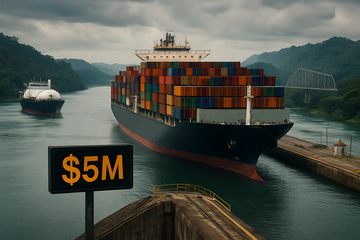
Single Panama Canal slot auction record
>$5M
Paid for an LPG carrier for South Korea's SK Gas; surpassed prior ~$4M bids, Reuters commentary, Sept 17, 2026
Neopanamax maximum draft
48.0 ft
Effective Aug 26, 2026; deeper 47.5 ft cut scheduled Oct 1, ACP notice, Reuters Aug 5, 2026
Daily Panama Canal transits cap
32
Down from 36 normal; cuts to 34 on Sept 3 then 32 on Sept 15, 2026, ACP advisory
CMA CGM Panama Canal surcharge
$500/TEU
Effective Sept 10, 2026 on Far East → US East/Gulf, CMA CGM notice
Drewry Shanghai→New York rate
$10,394/FEU
World Container Index, Sept 17, 2026, up 7% week-over-week
TSMC share of revenue from U.S. customers
75.6%
H1 2026 consolidated revenue, per TSMC disclosures, July 2026
The trigger event
A $5 Million Transit Slot, and the Container Board Is Next
Hapag-Lloyd, ZIM and their rivals just watched a single Panama Canal reservation sell for more than $5 million — an auction premium paid by South Korea's SK Gas for an LPG carrier, on top of the canal toll itself. Reuters' Gavin Maguire flagged it Sept. 17 as the headline event of an \"historic surge in shipping costs,\" but Maguire's real point sits in the next section: the container lane is the one that follows. Energy shipping feels the auction shock first; chips, electronics and AI hardware feel it next, because that is the lane Panama still controls end-to-end from Asia to the U.S. East Coast.
Transmission mechanism
From the Lock Gates to the Loading Dock: Each Foot of Draft Costs ~450 TEU
The Panama Canal Authority (ACP) has cut the maximum authorized Neopanamax draft in half-foot steps — 49.5 ft on July 1, 49.0 ft on July 24, 48.5 ft on Aug. 15, 48.0 ft on Aug. 26, and a deeper 47.5 ft cut now scheduled for Oct. 1. The rule of thumb quoted by carriers and freight analysts: a 10,000-TEU Neopanamax loses roughly 450 TEU of cargo capacity for every one-foot reduction in draft. The math turns a \"water level\" story into a fleet utilization story — carriers can't add ships, so they lighten loads, slow schedules, and bill shippers for the difference.
| Effective date | Max Neopanamax draft | Daily transits cap |
|---|---|---|
| July 1, 2026 | 49.5 ft | 36 (unchanged) |
| July 24, 2026 | 49.0 ft | 36 (unchanged) |
| Aug. 15, 2026 | 48.5 ft | 36 (unchanged) |
| Aug. 26, 2026 | 48.0 ft | 36 (unchanged) |
| Sept. 3, 2026 | 48.0 ft (47.5 postponed) | 34 |
| Sept. 15, 2026 | 48.0 ft | 32 |
| Oct. 1, 2026 (scheduled) | 47.5 ft | 32 |
The capacity cut lands on the busiest chip-import corridor in the world. Of the 291 Neopanamax vessels that called U.S. East and Gulf Coast ports since May, 162 transited the Panama Canal — an average capacity near 12,000 TEU each. Every percentage point of effective slot loss on that lane is multiplied across the fleet that serves Taiwan Semiconductor Manufacturing Company, Samsung Electronics, SK Hynix and the contract manufacturers that package NVIDIA and Advanced Micro Devices silicon.
Carrier economics
Surcharges Now Land Before the Container Leaves Kaohsiung
Carriers wasted no time pricing the new regime. Hapag-Lloyd launched a $130/TEU Panama Canal Surcharge on Far East → North America cargo on August 15. ZIM, Cosco and Yang Ming followed with their own canal-related fees; CMA CGM stepped up to $500/TEU on September 10 for Far East cargo routed via the canal to the U.S. East and Gulf coasts; MSC's revised Panama Canal Surcharge went to $149/TEU (20-ft), $297/FEU (40-ft) and $376 per 45-ft container on September 12; Ocean Network Express charges $150/TEU on transpacific services routed through the canal. Add the underlying spot rate — Shanghai-to-New York at $10,394/FEU on Sept. 17 — and the Panama Canal line item is now a percentage of the total freight bill, not a footnote.
- Drewry's World Container Index (Sept 17, 2026): Shanghai → New York at $10,394/FEU, up 7% week-over-week and the steepest transpacific climb since 2022
- Freight from China to the U.S. East Coast is up roughly 325% since the end of February 2026, leaving rates within ~11% of the COVID-era all-time high of $11,900/FEU
- Asia-to-U.S. East Coast capacity fell ~9% month-over-month in August; carriers announced twelve blank sailings for the U.S. East Coast and Gulf in September alone
- ZIM trades on this volatility — its Q2 2026 revenue of $6.4B and178% YoY net-income growth on Aug. 12 came directly from the post-Hormuz reroute and Panama Canal draft cut
The AI stack
Why AI Compute Feels the Bite Before Anyone Else
The Asia-to-U.S. East Coast container lane is not just one trade route among many — it is the artery that moves the chips that build the data centers that train the models that justify the capex. Taiwan Semiconductor Manufacturing Company generated $40.2B in Q2 2026 revenue, up 33.7% YoY, with U.S.-headquartered customers accounting for 75.6% of consolidated revenue in H1 2026. SK Hynix posted ₩79.3 trillion ($58B) in Q2 2026 revenue with operating profit up 557% YoY on HBM demand. Samsung Electronics reported a 250-fold jump in quarterly profit, with its memory business the dominant contributor. None of those fabs sit inside the U.S. — the chips still have to cross an ocean.
The second leg is the data-center buyer. NVIDIA reported trailing-twelve-month revenue near $303B and quarterly revenue growth above 105% YoY, Advanced Micro Devices is racing to fill GPU demand, and Dell is the assembler converting wafers into rack-scale systems that ship into Ashburn, Quincy and Loudoun County. Most of the inbound silicon arrives at U.S. East Coast ports reached through the Panama Canal — the same lane whose slot just sold for $5M and whose daily transits just dropped to 32.
Asia → U.S. East Coast container rates versus all-time record
Indexed to COVID-era peak of $11,900/FEU set in Jan 2022; data via Drewry WCI and Xeneta/ASRWE as of Sept 18, 2026
Unit: % of Jan 2022 peak ($11,900/FEU)
COVID-era peak (Jan 2022)
100
End of Feb 2026 (pre-Hormuz)
23.6
Drewry Shanghai → NY, Sept 17
87.3
China → USEC spot, Sept 18
92
Shanghai → LA, Sept 17 (comparison)
64.8
The policy layer
Washington Reads the Lane as Strategic, Not Just Commercial
The same month ACP tightened the draft, the U.S. State Department opened a $50 million tender for a chip-tracking \"digital passport\" platform that Panama will pilot — Pax Silica's first concrete financial commitment. The pilot will certify the origin and route of each shipment crossing the canal and accelerate customs clearance for vetted cargo, with the State Department signaling it wants to extend the model to other partner countries. By August 2026, 25 countries had signed the Pax Silica Declaration (up from seven at launch in December 2025), with a separate $250M Pax Silica Fund supporting allied silicon supply chains. The fact that Washington chose the Panama Canal — not the Taiwan Strait — as the launch site for the tracker tells the market which chokepoint the policy community considers the binding constraint.
Horizons
Short-Term: Surcharges Linger; Long-Term: Capacity Must Move
- Days–quarters: ACP's47.5 ft draft cut is set for Oct 1 unless rainfall relief arrives; carriers' Panama surcharges of $130–$500/TEU are now embedded in Asia-US East Coast transpacific contracts through peak season, with Golden Week (final week of September / first days of October) expected to test capacity further
- Days–quarters: Hapag-Lloyd and Maersk's full-year EBITDA guidance was already lifted twice — Hapag-Lloyd's H1 2026 Group EBITDA reached $829M (+68% QoQ), and Maersk raised FY2026 EBITDA to $10.5–12.5B; the canal surcharges are a direct contributor
- 1–3 years: the structural answer is fleet capacity (more Neopanamax ships) and route diversification (U.S. Gulf Coast via the Suez-all-water lane for East-bound Asia cargo; air-freight premium for high-value AI silicon) — but new container tonnage ordered in 2024–2025 only fully delivers from 2027
- 1–3 years: the deeper risk is structural climate. NOAA's 81% probability of a \"very strong\" El Niño by late 2026 means ACP's 32-transit baseline could itself become the ceiling rather than the floor; carriers and AI hardware buyers must plan for a structurally tighter canal through 2027
What to watch
Five Catalysts That Will Move the Story
Five data points will tell investors whether this is a Q4 story or a multi-year regime change. First, ACP's next draft announcement — the 47.5 ft cut is currently scheduled for Oct. 1, and any further delay or acceleration resets the entire rate curve. Second, the next Drewry WCI print for Shanghai → New York, with the all-time high at $11,900/FEU the line in the sand. Third, Taiwan Semiconductor Manufacturing Company's monthly revenue releases — August2026 already hit a record NT$514.81 billion, and any sequential slip from supply-chain drag would be the first concrete chip-side evidence. Fourth, Hapag-Lloyd and ZIM Q3 2026 results in November, which will separate the rate-driven windfall from the cost-driven squeeze. Fifth, the next slot-auction record — if a container carrier rather than an LPG operator pays nine figures for a reservation, the AI compute lane has officially repriced.
Stocks exposed to the Panama Canal → AI supply chain channel
- Gains pricing power from any AI silicon that arrives late, with trailing-twelve-month revenue near $303B and quarterly growth above 105% YoY
- Pax Silica's $50M Panama chip-tracking pilot reduces customs friction on NVIDIA-bound shipments from Taiwan
- Reroute optionality is limited — most Ashburn-bound NVIDIA racks still move through East Coast ports reached via the canal
- 75.6% of H1 2026 revenue came from U.S.-headquartered customers, most of it routed through Asia-to-U.S. East Coast lanes
- Moat protects margins — Q2 2026 gross margin held at 64.2% even as freight and packaging costs climbed
- Watch TSMC monthly revenue prints: a sequential slip would be the first chip-side evidence of canal drag
- HBM demand insulates SK Hynix from most shipping friction — Q2 2026 operating profit jumped 557% YoY on ₩79.3T revenue
- HBM3E and HBM4 qualification timelines remain the dominant driver; canal friction is a secondary margin headwind
- Specialty cargo with low Panama exposure relative to container freight — HBM ships by air-freight for premium customers
- Direct beneficiary of $130/TEU Panama Canal Surcharge effective Aug 15 on Far East → North America cargo
- Q2 2026 Group EBITDA reached $829M, up 68% QoQ, and full-year outlook was raised in July
- Captures the freight premium on 162 of 291 Neopanamax vessels that called U.S. East and Gulf Coast ports via the canal since May
- Higher beta to spot — Q2 2026 net income jumped 178% YoY as Panama and Hormuz reroutes lifted rates
- Smaller fleet means each Neopanamax sailing reroute delivers outsized margin lift, with $1.99/share trailing dividend yield
- Most exposed to continued rate strength among the publicly traded pure-play container carriers
- Same shipping lane as NVIDIA — any supply friction on Asia-to-U.S. East Coast lanes reinforces AMD's MI-series GPU pricing
- TSMC foundry partnership puts AMD on the same Pax Silica watchlist as NVIDIA
- Demand backdrop from hyperscaler capex keeps absorption strong even if freight bills climb
- Memory and foundry both exposed to Asia-to-U.S. East Coast container capacity, with Q2 2026 revenue of ₩171.5T
- Galaxy smartphone weakness offsets some memory strength — operating margin profile still stronger than peers
- Broader end-market mix dilutes the Panama impact compared with pure-play memory or AI-silicon names
- Final-mile assembler for much of the NVIDIA Blackwell and AMD MI rack-scale volume shipping into U.S. East Coast data centers
- Server backlog and AI factory deals mean Dell captures price if freight bills climb faster than component costs
- Higher absolute logistics spend than chip designers, but pass-through to hyperscaler buyers is largely intact