
What Petrobras's board actually approved
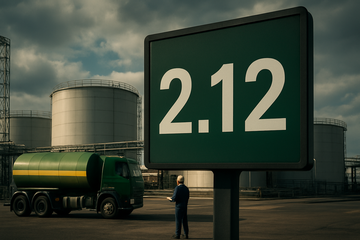
Petrobras's board of directors, meeting on Friday Sept 18, 2026, approved the company's adherence to the new federal diesel economic subvention created by Provisional Measure 1,389, signed by President Lula on Sept 9. The program pays R$1.00 (US$0.19) per liter to producers and importers of road-use diesel for an initial 30 days, extendable for another 30 days, and is cumulative with the R$1.12/liter subvention already in force since June 1 under MP 1,363 — bringing combined diesel compensation to R$2.12 per liter. Petrobras had already announced the operational consequence a day earlier, on Sept 17: a R$1.00/liter hike in the diesel price charged to distributors, paired with an equivalent R$1.00/liter discount funded by the new subsidy, leaving the net price to distributors unchanged while monetizing the government payment.
New diesel subsidy
R$1.00/L
MP 1,389, signed Sep 9, 2026
Existing diesel subsidy
R$1.12/L
MP 1,363, in force since Jun 1, 2026
Combined diesel compensation
R$2.12/L
Initial 30 days, extendable 30 more
Cumulative fuel-program receipts
R$9.9B
Diesel + gasoline + LPG through mid-Sep 2026
Sept fuel-relief package
R$13B
R$5.6B earmarked for diesel subsidies
Why Petrobras needed the shield: a record pricing gap and a R$2.12/liter margin hole
The board approval is not a policy choice but a survival arithmetic. Brazil's importers' association Abicom reported on Sept 16 that Petrobras was selling road diesel at R$3.89/liter (about US$0.79) below international import parity, even after the existing R$1.12/liter subvention. With Brazil still importing roughly a quarter of its diesel consumption — EPE projects total 2026 diesel demand at 73 billion liters — that gap had become politically untenable: distributors could not arbitrage imports profitably, private refiners were being squeezed, and the cost of absorbing Brent's climb above US$88/bbl sat entirely on Petrobras's realized diesel price.
The R$2.12/liter combined compensation does not just close that gap — it over-corrects. At Petrobras's stated diesel capacity of roughly 700,000 barrels per day, the new R$1.00/liter federal payment alone covers about R$2.7 billion per month of additional revenue if fully drawn, on top of the existing subvention. Translated into the company's reporting currency at Q2 2026 results, the diesel sales line of R$38.2 billion (+9.3% year-on-year) is now structurally insulated against the next leg of oil-price volatility for at least 60 days.
Brazil diesel pricing gap, mid-September 2026
Petrobras posted diesel price vs. import parity, reais per liter
Unit: R$/L
Petrobras posted price
3.3
Import parity (Abicom)
7.2
Subsidy (MP 1,389)
1
Existing subvention (MP 1,363)
1.1
The state-oil trade: posted price up R$1.00, realized price flat, Treasury pays the difference
The mechanism Petrobras used on Sept 17 is what turns this from a subsidy story into a margin story. The company raised the headline diesel price by R$1.00/liter — a number that, in a normal market, would lift realized revenue and trigger consumer and inflation backlash — and simultaneously granted distributors a R$1.00/liter discount funded by the new federal payment. The price at the pump does not move; the price on Petrobras's invoice to distributors does not move; the Treasury absorbs the R$1.00/liter delta and pays it back to Petrobras as a subvention. Politically, the government owns the inflation shield; financially, Petrobras owns the margin.
| Metric | Q2 2026 | Q2 2025 | YoY change |
|---|---|---|---|
| Revenue | $33.6B | $21.0B | +59.8% |
| EBITDA | $19.3B | $11.1B | +73.2% |
| Net income | $10.4B | $4.7B | +120.4% |
| Refinery utilization | 101.2% | 96% | +5.2 pp |
| Oil products output | 1,918 kbpd | 1,728 kbpd | +11.0% |
| Diesel sales (BRL) | R$38.2B | R$35.0B | +9.3% |
What the US refiners are seeing at the same time
Across the Atlantic, the US refining complex is printing the opposite signal. On Sept 1, 2026, the US Gulf Coast 3:2:1 diesel crack spread against WTI closed at US$103.29/bbl — the highest close on record — and reached an intraday record of US$108.02/bbl on Sept 2, before settling near US$107.72/bbl on Sept 10. That is roughly three times the five-year average crack spread. Marathon Petroleum, Valero and Phillips 66 captured this directly in Q2 2026: MPC printed EPS of US$17.68 on US$52.0B of revenue, VLO printed US$12.62 on US$36.6B, PSX US$9.59 on US$51.0B.
The mechanism here is structural rather than policy-driven. Russian refining capacity has been struck offline by ongoing Ukrainian strikes on more than 1 million bpd of diesel-heavy refining, Middle East tensions have lifted crude into the high US$80s, and US Gulf Coast distillate inventories sit at multiyear lows entering fall — the seasonal window when cracks typically widen further. Brazil's R$2.12/liter diesel shield does not feed this US refining bull case directly, but it removes a potential counter-pressure: a Petrobras struggling with sub-parity pricing might otherwise turn to the international market as a marginal buyer, tightening US export economics.
| Company | TTM revenue | TTM EBITDA | EBITDA margin | EV/EBITDA | P/E (TTM) |
|---|---|---|---|---|---|
| Petrobras | $104.2B | $57.9B | 55.5% | 3.99x | 5.29x |
| Marathon Petroleum | $153.9B | $17.4B | 11.3% | 8.63x | 14.64x |
| Valero | $132.9B | $13.3B | 10.0% | 9.24x | 17.21x |
| Phillips 66 | $153.6B | $12.8B | 8.4% | 9.80x | 15.65x |
The supply chain above and below Petrobras
Upstream of Petrobras's refining segment, the biodiesel feedstock complex — soybean oil and animal fat suppliers — absorbs the demand signal that any diesel price stabilization sends through the mandatory biodiesel blend (currently 14%, on track to 15%). The Sept subsidy package extends the gasoline subsidy at a higher 0.63 real/liter tax cut and increases gasoline compensation 43% over the previous month, which indirectly supports ethanol mill margins. Downstream, Brazilian fuel distribution is dominated by Ultrapar (Ipiranga, Ultragaz) and Vibra Energia (BR Distribuidora), both of which buy from Petrobras at posted prices. Because Petrobras's distributor net price is unchanged in this scheme, the distributors capture neither upside nor downside — but they are insulated from the volume-rationing risk that has surfaced in past defasagem episodes when Petrobras held prices too far below import parity.
Private Brazilian refiners — Replan, Reduc, Repar and others operated by firms including PRIO and others — face the opposite dynamic. With Petrobras now selling at import parity-plus-subsidy, the arbitrage window for private imports narrows from R$3.89/liter toward zero, and Petrobras regains the volume share that had been slipping to imports. Petrobras has already cut diesel imports 85% year-on-year in Q2 2026 on the back of 101.2% refinery utilization; the new subsidy extends that volume defense.
Inflation: a R$2.12/liter shield against the diesel line item in IPCA
Diesel is a top-weighted item in Brazil's IPCA consumer basket. In March 2026, when Petrobras last raised diesel by only R$0.38/liter, the line item still rose 13.90% month-on-month and contributed materially to IPCA's climb to 4.14% year-on-year — above the 3% target. By holding the pump price flat while the subsidy absorbs the R$2.12/liter gross cost increase, the government is buying a 60-day window of zero pass-through into transport, logistics and food categories that ride on trucking. That is the political prize of the scheme; the fiscal cost — annualized at full draw, roughly R$32 billion — is the price tag Lula's government is willing to carry ahead of the 2026 election cycle.
Short-term and long-term horizons
- Short-term (30–60 days): the September 30 expiry of MP 1,389's initial 30-day window is the next catalyst — extension is administrative, not legislative, but a non-extension would re-open the R$3.89/liter gap overnight and force Petrobras to cut realized diesel prices
- Short-term (Q3 2026 reporting): Petrobras's Sept 30 quarter-end subsidy accrual will determine whether the R$2.12/liter combined payment is recognized in Q3 realized refining margin or deferred — Q4 diesel volumes and the Sept 17 price action should already be reflected in the segment
- Medium-term (1–3 years): Petrobras's stated 2030–2031 diesel self-sufficiency plan (capacity rising from ~700,000 bpd today to 950,000–970,000 bpd by 2030 and ~1.25 MM bpd by 2031) is the structural answer to the import-parity squeeze — every additional barrel of domestic diesel production reduces the need for the federal subvention
- Long-term risk: a Brazilian Treasury unable to fund the subsidy past the 30+30-day extension would re-open the R$3.89/liter pricing gap and force Petrobras back into sub-parity realized prices, erasing the structural margin defense the board just confirmed
- Cross-border risk: US Gulf Coast cracks at record highs depend on continued Russian refining outage and Middle East tension — a normalization of those flows would compress MPC/VLO/PSX EBITDA even as Petrobras remains domestically insulated
Investable names
- R$2.12/L combined diesel subsidy shields Q4 2026 realized refining margin from Brent's move above US$88/bbl, supporting the record R$52.4B Q2 earnings trajectory
- PBR trades at 5.3x TTM P/E and 4.0x EV/EBITDA with a 17.5% dividend yield — a structural discount to integrated peers that narrows if the federal subsidy extends past the initial 60-day window
- Self-sufficiency plan to 2030–2031 (capacity rising from ~700k bpd to 1.25 MM bpd) reduces import dependence and structurally limits future subvention size — multi-year margin defense
- US Gulf Coast 3:2:1 diesel cracks at record US$103.29/bbl close (Sept 1) and US$108.02/bbl intraday (Sept 2) flow directly into MPC's Q3 2026 refining segment
- Q2 2026 already delivered US$17.68 EPS at 11.3% EBITDA margin — record cracks suggest Q3 prints materially higher
- Russian refining strikes (>1 MM bpd diesel-heavy capacity offline) and Middle East tensions are the structural drivers; Brazil's R$2.12/L shield removes a potential counter-pressure on global diesel demand
- Record diesel cracks hit VLO's Gulf Coast and PADD 5 systems hardest — 15 refineries, ~3.2 MM bpd capacity concentrated on diesel yield
- Q2 2026 EBITDA of US$6.05B on US$36.6B revenue already up sharply from Q2 2025; Q3 cracks imply another step up
- Renewable diesel and ethanol segments provide earnings diversification if the distillate cycle rolls over in 2027
- 12-refinery system with ~46% distillate yield captures the diesel crack rally alongside MPC and VLO
- Q2 2026 EBITDA US$5.87B on US$51.0B revenue — the lowest EBITDA margin of the three, meaning the most operating leverage to crack expansion
- Midstream and Chemicals segments are slower-moving but reduce cyclical earnings volatility if distillate cracks normalize in 2027
- Ipiranga and Ultragaz volumes are insulated from upstream price volatility because Petrobras's distributor net price is unchanged in the Sept 17 scheme — earnings stability over 30+30 days
- Distribution margins do not expand on this deal — the catalyst is volume retention if past defasagem-style shortages had been thinning the network
- Next 6-K from Petrobras on whether MP 1,389 extends past Sept 30 is the binary catalyst for the Brazil distribution complex
- Brazil's largest fuel distributor (BR network) similarly insulated from price moves but exposed to volume risk if Petrobras's posted price hike is unwound
- Q2 2026 results will be the first quarter to reflect any volume signal from Petrobras's expanded refining footprint
- Watch for Petrobras Q3 production data (Oct–Nov 2026) for confirmation that domestic diesel supply is structurally stabilizing