
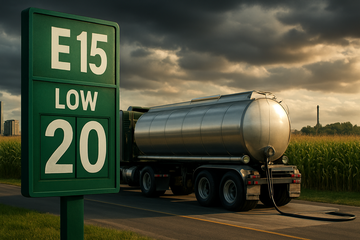
New California ethanol demand
600–650M gal/yr
Aemetis estimate; ~10× its in-state Keyes plant capacity
Annual pump savings
$2.7B
UC Berkeley / U.S. Naval Academy study cited by Renewable Fuels Association
E15 vs. E10 retail discount
~$0.20/gal
Cal Berkeley and AB 30 backgrounder; Aemetis quotes up to $0.25/gal in some markets
California regular gasoline
$6.14/gal
GasBuddy, week of Sept 21, 2026; vs. U.S. national average $4.44
Blended ethanol under E15
15%
Up from current 10% (E10) cap that California has run since CaRFG3
The final hurdle is gone — and the bill is older than most think
California legalized E15 almost a year ago. Governor Newsom signed Assembly Bill 30 on October 2, 2025, authorizing gasoline blends of 10.5% to 15% ethanol for the first time in the nation's largest automotive fuel market. What changed on September 19, 2026 was the E15 Clean-Up Act — Senate Bill 795 — which directs the State Fire Marshal to write the labeling, dispenser, and safety rules that station owners must follow before they can actually sell the higher blend. Reuters reported the signing the same week, framing it as the \"final regulatory hurdle.\"
The path was contested at every step. The Renewable Fuels Association and Growth Energy pressed the bill; Marathon Petroleum and PBF Energy opposed it on emissions-permitting and refining-margin grounds. California is still the only U.S. state that runs its fuel market around a Low Carbon Fuel Standard, which is why a federal E15 waiver — EPA renewed the nationwide summer E15 waiver on August 27, 2026 — was never sufficient on its own.
The math breaks in three places at once
Aemetis CEO Eric McAfee frames the demand shock as 600–650 million additional gallons per year — enough to lift California's annual ethanol draw by roughly a third, since the state already blends close to 1.4 billion gallons at the current 10% cap. At wholesale ethanol prices near $2.30 per gallon, that is roughly $1.4–1.5B of new ethanol revenue sitting somewhere between California terminals and Midwest plants.
Who can actually fill 600M new California gallons?
Annual ethanol production by California-relevant producers; Aemetis's Keyes plant alone covers ~11% of the new demand surge.
Unit: Million gallons per year
California new E15 demand
650
Valero (12 ethanol plants)
1,600
Green Plains total system
1,100
Aemetis Keyes plant, CA
65
Three structural frictions decide who actually books that revenue. First, the refiner gate: every California gallon still ships through a small set of pipelines and terminals owned by refiners, who set the wholesale markup between the ethanol producer's price and the station owner's cost. Second, the station gate: SB 795 requires new labeling, underground tank compatibility checks, and dispenser upgrades estimated by the Renewable Fuels Association at $10,000–$20,000 per site, paid by the operator. Third, the carbon gate: California's LCFS prices ethanol based on carbon intensity, which is why low-carbon producers with on-site renewable heat — like Aemetis's Keyes plant after its $30M MVR upgrade — collect extra LCFS credits that commodity ethanol from the Midwest does not.
Ethanol side: who collects the dollar
Aemetis is the only pure-play ethanol producer inside California, and the only one with the LCFS advantage baked into its plant design. Keyes produces 65 million gallons per year and runs at a negative carbon intensity pathway once its new mechanical vapor recompression system is commissioned — a feature worth roughly $0.50 per gallon in extra LCFS credits versus standard Midwest corn ethanol. Aemetis posted Q2 FY2026 revenue of $62.7M and an operating loss of $5.8M, so 600M new California gallons represent a step-function in revenue mix even before factoring in LCFS-credit uplift.
Valero Energy is the most consequential single counterparty because it is both a refiner and the operator of 12 ethanol plants capable of 1.6 billion gallons per year — the largest U.S. ethanol footprint by capacity. Valero can self-source ethanol into its California wholesale rack, capturing the refiner markup on its own gallons, and earn LCFS credits on top. The integrated structure turns E15 into a margin-extending event rather than a competitive threat, which is why Valero has not opposed the bill. Q2 FY2026 revenue was $132.4B on a trailing basis with EBITDA of $13.4B.
Green Plains and Archer Daniels Midland are the next tier of suppliers without California refining assets. Green Plains ran 1.83B in trailing revenue through Q2 FY2026 with $204M in EBITDA, and operates roughly 1B gallons of ethanol capacity across the Midwest — meaningful capacity to ship west, but dependent on third-party terminals for the last mile into California. Bunge has a smaller direct U.S. ethanol position but is the most exposed to the corn-upstream math; its $91.8B trailing revenue dwarfs pure-play ethanol producers, meaning even a meaningful acreage-and-yield response in Iowa and Illinois is a rounding error on its P&L.
Refiner side: who absorbs the loss
The California refining margin is unusually fat — and E15 is engineered to compress it. Drivers in California paid an average of $6.14 per gallon the week the bill was signed, against $4.44 nationally; the gap reflects a market where refiners have lost 17% of capacity in 12 months and roughly 575,000 barrels per day over five years (EIA; RBN Energy). Every 5% of ethanol blended into the pool replaces 5% of refined gasoline volume, which on a 14-billion-gallon California market is roughly 700 million gallons of refined product that no longer needs to be made.
| Company | California presence | E15 stance | Direct impact |
|---|---|---|---|
| PBF Energy (PBF) | Torrance (160K b/d, ~12% of CA capacity); Martinez restart pending | Opposed, joined refiner coalition | Volume displacement hits West Coast margins hardest |
| Marathon Petroleum (MPC) | Carson/Wilmington and (post-2020) former Martinez site | Opposed; cited emissions-permitting cost | Refining & Marketing segment is core earnings |
| Phillips 66 (PSX) | Rodeo Renewable Energy Complex (50K b/d renewable diesel) | Quietly defensive; competing low-carbon strategy | Renewable diesel competes with ethanol for LCFS dollars |
| Valero Energy (VLO) | Wilmington, Benicia, plus 12 ethanol plants | Not opposed; integrated | Captures ethanol margin, loses refining share |
PBF Energy is the most direct casualty. Its Torrance refinery alone is 160,000 barrels per day and accounts for roughly 12% of California's refining capacity; even a partial E15 ramp takes refined gasoline volume out of its highest-margin market. PBF traded near $73.74 with trailing revenue of $34.4B and EBITDA of $969M as of the September 21 print, and its earnings declined sharply in the most recent quarter (quarterly EPS down 69.9% sequentially). Marathon Petroleum runs the Carson/Wilmington complex and the former Martinez site, and explicitly warned that California's emissions and fee regime is already eroding refining economics independent of E15. Phillips 66 is in a different but related position — its Rodeo Renewable Energy Complex produces up to 50,000 barrels per day of renewable diesel and renewable gasoline from waste feedstocks, directly competing with ethanol for the same LCFS carbon-intensity credits.
Retail side: the upgrade bill decides how fast E15 actually arrives
AB 30 legalized E15; SB 795 imposes the conditions. The State Fire Marshal must adopt labeling and dispenser rules by December 31, 2026, and California stations must comply before they can sell E15 as an alternative fuel. Per-site costs run $10,000–$20,000 depending on tank count, according to Stillwater Associates — small for a major brand, but a real hurdle for the independent operators who still account for the majority of California's roughly 10,000 retail fuel sites.
The retailers with the strongest direct exposure to California E15 are not the chains that show up first in retail-fuel headlines. Casey's and Murphy USA are mostly Midwest and Southeast plays; their average gallons per store and merchandise margins would benefit from any ethanol-led fuel-cost decline, but their store footprint is geographically insulated. The companies that move first are the California-specific operators — GPM Investments (a subsidiary of ARKO Corp), the independent dealer networks under Marathon Petroleum's ARCO brand, and branded stations affiliated with Valero Energy. These are the operators whose upgrade decisions will set the actual E15 availability curve over the next 12–24 months.
Short-term and long-term: what moves first, what the milestones look like
In the next 1–2 quarters, the State Fire Marshal's rulemaking (deadline Dec 31, 2026) is the binary catalyst. Until those rules drop, station owners cannot legally dispense E15 regardless of state-level authorization. Watch for Aemetis and Valero to disclose new California shipping agreements tied to the rule, and for refiner management teams (PBF on its Q3 FY2026 call; MPC, PSX on theirs) to quantify how much volume they expect to migrate to ethanol over 2027.
Over 2027–2028, the ramp depends on station economics. Each California station converts at a $10,000–$20,000 capex, with payback depending on the spread between E10 and E15 wholesale prices and on how quickly branded networks (ARCO, Valero, Shell, Chevron) mandate the upgrade. A 50% station-conversion rate would absorb ~700M ethanol gallons; a 25% rate would absorb ~350M. CARB's MME evaluation is the long-tail variable — adverse LCFS scoring or particulate findings could compress the carbon-intensity premium that makes in-state ethanol economic.
- Dec 31, 2026 — California State Fire Marshal rule deadline for E15 labeling and dispenser standards
- Q1–Q2 2027 — expected first wave of California station upgrades; first E15 gallons sold under SB 795 rules
- 2027–2028 — adoption ramp; key swing variable is the E10/E15 wholesale spread after LCFS pricing
- 2028+ — structural question: whether ethanol captures incremental demand vs. renewable diesel (PSX Rodeo) and EV adoption curve
The thesis, in one chain
California's SB 795 does not change the price of ethanol or the price of corn. It changes the legal blend ceiling, and in doing so pulls roughly 600–650M gallons of new ethanol demand into a market with only one in-state producer (Aemetis at 65M gallons) and a thin wholesale channel still owned by the refiners who opposed the bill. The first beneficiaries are the producers and integrated players with the cheapest path to the California rack — Valero Energy, Aemetis, and Midwest pure-plays like Green Plains. The first losers are the refiners whose California crude exposure makes E15 a direct volume displacement — PBF Energy and Marathon Petroleum. Phillips 66's renewable diesel platform is a slower-burn threat because it competes for the same carbon-intensity dollars, not the same gallons. Corn processors (Archer Daniels Midland, Bunge) and station retailers (Casey's, Murphy USA) only see the windfall after it has passed through the refiner gate and the upgrade gate — which is why the upside looks much smaller at their scale than the headlines suggest.
Investable names tied to the California E15 chain
- Keyes plant (65M gal/yr) covers ~11% of California's 600–650M gallon new demand on its own, per Aemetis guidance
- Low-carbon ethanol pathway plus LCFS credits adds ~$0.50/gal of extra margin that commodity Midwest producers cannot match
- Q2 FY2026 revenue of $62.7M is a rounding error versus the new California opportunity, so adoption ramp directly shifts the revenue mix through 2027
- Short-term: track the State Fire Marshal rule (deadline Dec 31, 2026); long-term: 2–3x revenue uplift plausible if Aemetis captures 15–25% of new CA gallons
- Operates 12 ethanol plants at 1.6B gal/yr — the largest U.S. ethanol capacity base, with direct access to California racks
- Integrated refiner + ethanol structure means E15 captures both the producer margin and the wholesale markup on self-sourced gallons
- Q2 FY2026 trailing revenue $132.4B / EBITDA $13.4B; California E15 is incremental, not transformational, to scale
- Near-term (1–2 quarters): California wholesale pricing for E15 vs. E10 will be the first valuation signal; long-term: defends refining share by leaning into ethanol integration
- ~1B gallons of Midwest ethanol capacity that could ship into California terminals if the E10/E15 spread widens
- Q2 FY2026 trailing revenue $1.83B / EBITDA $204M; trades at 9.1x trailing P/E, leaving room for multiple expansion if margins hold
- Last-mile disadvantage vs. Valero: depends on third-party terminals, which compresses the per-gallon margin capture
- Watch: first California shipping agreements and LCFS-carbon-intensity filings once State Fire Marshal rules are published
- Carbohydrate Solutions segment includes ethanol; +600M CA gallons is supportive but small versus ADM's $82.1B revenue base
- Corn origination (the actual upstream of the ethanol chain) is a slow-burn beneficiary — corn prices tend to follow ethanol-plant margins with a lag
- Q2 FY2026 trailing EBITDA $3.0B / margin 3.2%; diversified agribusiness dilutes the pure ethanol upside
- Long-term: stronger-than-expected U.S. ethanol demand stabilizes corn basis in Iowa/Illinois — a margin tailwind for ADM's origination franchise
- Torrance refinery at 160,000 b/d represents ~12% of California refining capacity — the most exposed balance sheet to E15 volume displacement
- Already trades at 6.8x trailing P/E, reflecting investor concern about refining-margin compression; E15 accelerates that path
- Q2 FY2026 quarterly EPS down 69.9% sequentially — pre-E15, on weak crack spreads; E15 ramp adds a structural rather than cyclical headwind
- Martinez restart is upside optionality, but the same site is exposed to the California fuel mix shift
- Carson/Wilmington complex is the largest West Coast refining position outside PBF; explicit opponent of SB 795
- Q2 FY2026 trailing revenue $154.1B / EBITDA $15.4B; California is a meaningful but not majority share of segment earnings
- Already warned that California's emissions and fee regime is eroding refining economics — E15 layers on top of an existing margin problem
- Short-term: California wholesale rack prices on Q3 FY2026 earnings call will be the first signal; long-term: refining asset retirements accelerate
- Rodeo Renewable Energy Complex produces 50,000 b/d of renewable diesel from waste feedstocks — competes with ethanol for LCFS dollars
- Q2 FY2026 trailing revenue $152.2B / EBITDA $9.9B; refining plus renewable fuels is a coordinated strategy, not pure opposition
- Binary catalyst: whether CARB treats ethanol and renewable diesel as complements (LCFS credits stack) or substitutes (one displaces the other)
- Long-term: Phillips 66's renewable-diesel scale gives it more optionality than PBF/MPC if the policy framing favors feedstocks over fuel type