
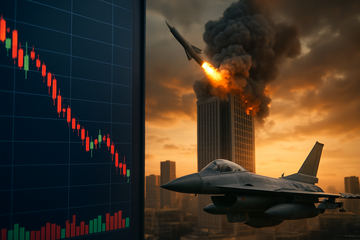
On Saturday, September 19, Yemen's Houthis fired missiles and drones at Riyadh — not at the kingdom's eastern oil fields, but at the Saudi capital itself. A Saudi-led coalition spokesperson confirmed a ballistic missile was 'successfully intercepted and destroyed', but a drone wave hit fuel storage at King Khalid International Airport, sending a plume of black smoke across central Riyadh and forcing flight delays. The attack drew the first air-raid alert over the capital in the renewed Yemen war and triggered an immediate US Embassy security advisory warning Americans of 'potential for unforeseen escalation' and possible flight cancellations. Twenty-four hours later, the Tadawul's TASI benchmark closed the first post-strike session down just 0.3% at 10,750, Saudi Aramco swung from an early loss to close up 1.3%, and Brent crude rose 0.78% to $104.68 —a reaction that says less about resilience than about where capital is actually pricing the new political-risk premium.
Saudi TASI close (Sep 20)
10,750
-0.3% on day, after opening sharply lower
Saudi Aramco close (Sep 20)
+1.3%
Reversed an intraday drop after Brent pushed past $104
ACWA Power (2082.SR) close
-2.8%
Worst hit among Tadawul heavyweights on Sep 20
Qatar QSI (Sep 20)
-3.2%
Sharpest Gulf drop on Riyadh strike and Iran warning
Brent crude (Sep 20)
$104.68/bbl
+0.78% intraday, +13.4% over the past month
First strike on Riyadh capital
Sep 19
Ballistic missile + drones; airport fuel-storage fire
The first missile at the capital itself
The September 19 attack was different in kind, not just degree. Earlier Houthi operations in the renewed Yemen war had hit the Aramco Jazan refinery on September 8 — wounding 73+ — and a separate drone wave struck the East-West pipeline on September 13, blamed on Iran-aligned militias in Iraq. On September 16 the Houthis claimed an attack on Mecca and downed a Saudi F-15. Each of those strikes moved oil and Saudi equities. The Riyadh attack moved the political-risk premium because it hit the capital, not the country's energy perimeter.
What happened on the ground: a Houthi-launched ballistic missile was intercepted before impact, but a wave of drones reached a fuel-storage area at King Khalid International Airport, sending a thick plume of black smoke visible across central Riyadh. The Saudi-led coalition confirmed the missile was 'successfully intercepted and destroyed' on social media; the airport's fuel depot, not the runway, was the actual damage site. The US Embassy issued a security alert on September 19 warning Americans of 'potential for unforeseen escalation' and cautioning about flight cancellations and airspace closures, and the State Department told US citizens that 'conflict has potential to escalate rapidly'. Some flights at King Khalid were delayed. Civilian injuries since the September 8 wave have reached at least 73, with no fatalities reported immediately.
Iran's warning pulls the GCC into direct retaliation risk
Twenty-four hours later, Iran's military central command issued a statement that markets had to absorb alongside the Saudi selloff. State media carried the warning that any 'big new attack' by the United States or its allies would trigger 'sustained retaliation' against 'US bases and interests'. The market-moving line was the next clause: that 'Washington's regional allies would be considered parties to the conflict'. Iranian Parliament Speaker Mohammad Baqer Qalibaf added that Iran would continue both fighting and negotiating to consolidate recent gains. The US Embassy alert ran in parallel, urging vigilance across the Middle East and warning that US diplomatic facilities — including outside the region — have been targeted.
| Date | Event | Market read |
|---|---|---|
| Sep 8 | Houthi strikes on Aramco Jazan; 73+ injured | Brent +0.9% to $97.92; first re-pricing of supply risk |
| Sep 13 | Drone strike on East-West pipeline (Iraq militias blamed) | Saudi shares lead Gulf decline; pipeline shut |
| Sep 16 | Mecca drone claim; Saudi F-15 downed | UAE markets reported closed; political-risk layer added |
| Sep 19 | Missile + drones on Riyadh; airport fuel-storage fire | First capital strike; US Embassy security alert |
| Sep 20 | Iran: 'regional allies are parties to the conflict' | TASI -0.3% close; ACWA -2.8%; Brent +0.78%; channel switch |
A muted selloff hides a re-rate, not a collapse
Tadawul opened sharply lower on Sunday, September 20 — the first session after the Riyadh strike — but reversed through the day. The TASI benchmark pared early losses to close just 0.3% down at 10,750. Inside the index, Saudi Aramco Power dropped 2.8% (the heaviest hit among Tadawul heavyweights), Saudi Aramco swung from an early loss to close 1.3% higher at 25.90 SAR, and Saudi National Bank — the kingdom's largest lender — drifted around 40.20 SAR, near flat on the day. Qatar's QSI led the Gulf losses at -3.2%. The reaction reads as institutional buying of the dip rather than panic selling, with the premium shifted to specific names rather than dumped across the index.
Sep 20, 2026 — who fell and who held
Reaction to the Riyadh strike and Iran's escalation warning (single-day % moves)
Unit: %
Qatar QSI
Sharpest Gulf drop on Riyadh strike
-3.2
ACWA Power (2082.SR)
Saudi utility — biggest Tadawul heavyweight hit
-2.8
Saudi TASI
Closed lower; opened much weaker
-0.3
Saudi National Bank (1180.SR)
Largest Saudi bank, flat on day
-0.1
Saudi Aramco (2222.SR)
Reversed intraday loss on Brent push past $104
1.3
Brent crude
Largest single-day move in weeks
0.8
Defense — the cleanest re-rate window is still open
US defense primes have already re-rated hard since the US–Iran war started on February 28, 2026. RTX has gained roughly 110% since the war began, Northrop Grumman about 60%, General Dynamics 57%, and Lockheed Martin around 37% with shares near $533 on a 19.7x trailing P/E and a 2.54% dividend yield. Boeing, by contrast, has lagged — closed September 18 at $198.20 with a 71x trailing P/E and no dividend, roughly mid-range in its 52-week band of $176.77 to $254.35. That dispersion is the setup: the most exposed names already trade the war, but Boeing still hasn't, leaving an asymmetric re-rate window if the Iran warning crystallizes into new US strikes.
- Lockheed Martin at ~$533 and a 19.7x trailing P/E is the most obvious proxy for the Patriot/PAC-3 and THAAD air-defense systems now intercepting Houthi missiles over Riyadh — every successful intercept validates incremental Saudi and Gulf air-defense orders.
- RTX is the rally's heavyweight at +110% YTD since the Iran war began, with Raytheon's Patriot franchise and Pratt & Whitney's F-35 engines already priced in — the company has more upside from cruise-missile defense (NASAMS) than the primes with narrower Saudi exposure.
- Northrop Grumman at +60% YTD is the pure-play on the B-21 and Sentinel strategic systems that any deeper US–Iran confrontation would activate, trading at a smaller absolute scale than Lockheed Martin.
- Boeing is the laggard — its defense backlog is real (F-15EX, KC-46, AH-64) but its commercial-aviation recovery story (negative TTM EBITDA, no dividend since 2020) is what is holding the multiple, and the Riyadh attack barely moved the Sept 18 close.
Aramco and Brent — supply tightness buys time, but risk has a cap
Saudi Aramco is the cleanest single-name expression of the new political-risk premium: its fundamentals already justify the multiple on supply-tight oil, and any escalation ratchets that tighter. Q2 2026 adjusted net income came in at $33.4 billion (up 33% year-over-year), the board declared a $21.9 billion base dividend for Q2 (SAR 0.3393 per share), and downstream adjusted EBIT doubled to $6.2 billion — all reported on August 4, 2026 against a backdrop of the Iran war already compressing global supply. Brent's run from $97.92 on September 8 to $104.68 on September 20 is the same dynamic playing in real time. The bull case is that Aramco's production base just keeps shrinking while prices keep rising.
GCC spillover — banks, utilities, hospitality, airlines take the side hits
If the Iran–Gulf standoff crystallizes, the listed spillover won't sit in the defense primes — it will sit in the names with concentrated Gulf exposure. Saudi National Bank, ACWA Power, the UAE-listed Air Arabia, and US-listed hospitality chains like Marriott International all carry direct revenue exposure to Riyadh and Gulf travel, and the September 19 strike hit the airport infrastructure that connects them all. This is the second-derivative trade: the names that drop on the strike but don't recover on a Brent bid are the ones with the most political-risk beta to a US–Iran escalation.
- Saudi National Bank is the kingdom's largest lender by assets, with SAR60 billion of capital — a sustained pullback in Saudi equity wealth, M&A, and corporate borrowing would hit fee income more than net interest.
- ACWA Power — the renewables and desalination developer — fell 2.8% on Sep 20, the heaviest hit among Tadawul heavyweights, on the read that any sustained GCC conflict stalls its project pipeline.
- Air Arabia (DFM-listed, AED 4.90) carries the most direct travel-disruption risk as the leading low-cost carrier across the Middle East and North Africa from its Sharjah hub.
- Marriott International runs the Riyadh Airport Marriott and dozens of properties across Saudi Arabia — a Riyadh-attack premium is the risk to the brand's mid-2026 Saudi growth story.
Horizons — three catalysts that move the trade
Short-term (days to weeks), the catalyst is whether the US State Department's security advisory hardens into an evacuation order, which would convert the political-risk premium into an actual capital flight out of Saudi equities. The September 19 advisory warned of 'possible flight cancellations and airspace closures' but did not call for departure. If that line shifts, TASI -0.3% becomes TASI -3% in a session, and the regional airlines and Saudi banks reprice to where the Iranian warning says they should.
Medium-term (one to three months), the watch is whether the Houthi campaign keeps climbing the escalation ladder — from oil infrastructure on September 8, to the pipeline on September 13, to the capital on September 19 — and whether Saudi air-defense performance, which intercepted the ballistic missile but missed the drone swarm that hit the fuel depot, generates a Saudi request for additional US or allied interceptor stockpiles. Lockheed Martin's PAC-3 and Raytheon's NASAMS are the two systems most likely to see incremental orders; Boeing's Patriot co-production would benefit if Saudi Arabia moves to in-country manufacture.
Long-term (one to three years), the structural question is whether the US–Iran war that started February 28, 2026 ends with a diplomatic settlement that pulls the Houthis back from the Saudi border — in which case the entire defense-prime re-rate partially fades — or whether Iran settles into a 'managed escalation' pattern where Riyadh and the Gulf sit in a permanent risk-premium state. The September 20 Iran statement, with its explicit framing of regional allies as 'parties to the conflict', points to the second scenario. That keeps the defense re-rate alive but caps the multiple on Brent.
Stocks that price the Riyadh–Iran escalation
- catches a fresh defense re-rate window as the Riyadh strike and Iran warning pull the US Gulf-ally threat back into focus
- Closed Sep 18 at $198.20 — mid-range in a $176.77 to $254.35 52-week band — leaving the most asymmetric upside if Boeing's defense backlog (F-15EX, KC-46, AH-64) gets repriced
- Cited by IBD as the lagging defense prime since the February 2026 Iran war began, with Lockheed Martin, RTX, and Northrop Grumman all having already moved
- Monday Sep 21 open is the first test of whether the market re-rates Boeing alongside the rest of the primes
- Patriot/PAC-3 and THAAD interceptors are the air-defense systems now actively intercepting Houthi missiles over Riyadh — every successful intercept validates incremental Saudi and Gulf air-defense orders
- Already up ~37% since the February 2026 Iran war, but each new Iranian escalation tightens the order book on a defense book that includes Saudi Arabia's existing PAC-3 inventory
- Shares at ~$533 on a 19.7x trailing P/E (per company-reported metrics through Jun 30, 2026) — cheap relative to a defense book that now has live combat validation
- Monday Sep 21 open is the test — Lockheed Martin is the most direct read on whether the Saudi request for additional interceptor stockpiles crystallizes
- Raytheon's Patriot franchise and Pratt & Whitney's F-35 engines are the two biggest Saudi and Gulf-related revenue lines — already priced into a 110% gain since the Iran war began
- Less upside from incremental re-rating given the run already in the stock, but the most downside-protected in a deal-driven scenario
- Direct exposure to NASAMS cruise-missile defense, relevant for protecting the airport fuel-storage infrastructure that the Houthis hit on Sep 19
- Watch the Sep 21 open — RTX has been the bellwether for the sector since March 2026
- gains a clear strategic-systems bid as the +60% YTD pure-play on B-21 and Sentinel that any deeper US–Iran confrontation activates
- Smaller absolute scale than Lockheed Martin but more concentrated strategic exposure, with no civil-aviation drag on the multiple
- Watch for new B-21 production orders if the Iran–Gulf standoff persists through Q4 2026
- Sep 21 open: any continuation of the move from the Q2 earnings season into a fresh geopolitical catalyst is the cleanest signal
- captures the direct Brent beta as the US-listed oil major with the most Gulf-region operational footprint among the US majors
- Brent at $104.68 on Sep 20 (+0.78% on the day, +13.4% past month) — every Saudi infrastructure hit tightens supply further
- Operates alongside Saudi Aramco in joint ventures, particularly in the Partitioned Zone between Saudi Arabia and Kuwait
- Sep 21 open: Brent futures are the catalyst — if $104.68 holds, Chevron's Gulf-related revenue base re-rates higher
- re-rates on the same Brent beta as Chevron but with more US shale exposure that dampens the upside on a sustained conflict
- Brent at $104.68 supports Permian economics at any strip — Exxon is the largest US producer by volume
- Q3 2026 earnings in October will be the first quarter to fully reflect the September price moves
- Sep 21 open: less upside than Chevron if the conflict stays Gulf-region specific, but more downside protection if Brent rolls back
- Operates the Riyadh Airport Marriott and dozens of properties across Saudi Arabia — the brand sits on the wrong side of any sustained Gulf travel pause
- Mid-2026 Saudi pipeline (announced Sep 18, 2026 promotions) is now exposed to a slower opening if corporate events and travel insurance pause
- Saudi Arabia was a top growth market for Marriott's Middle East pipeline — a Riyadh-attack premium is the risk to that growth story
- Sep 21 open: look for any Saudi-specific promotion or guidance pull from Marriott's Q3 2026 earnings call expected in late October