
Market event • policy_trade
The venue choice was the message: US–China diplomacy is moving into the Wall Street workflow
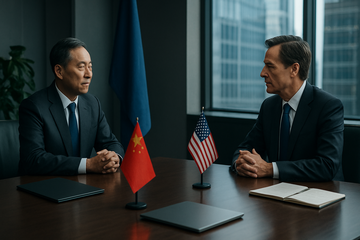
A US–China bilateral between U.S. Treasury Secretary [Scott Bessent] and China’s Vice Premier [He Lifeng] took place at JPMorgan Chase & Co.’s New York headquarters. Reuters reported the meeting began at 10:30 a.m. ET and was set for topics including AI security and trade (plus other economic issues).
Importantly, the coverage also frames the choice as a venue/logistics decision: JPMorgan “agreed to provide its headquarters building as the meeting venue,” with the rationale tied to heightened Manhattan security during the UN General Assembly period.
Facts on the agenda
The agenda reads like a supply-chain blueprint: AI safety + trade + critical minerals
After the talks, Reuters (republished by U.S. News) reported the U.S. side proposed a new AI safety notification mechanism for leaders at the summit, alongside discussion of an AI dialogue emphasizing national-security concerns around “common goals and common threats,” including AI-related incidents. Other reporting around the same event also pointed to trade as a core track, with critical minerals appearing as part of the broader deliverables discussion.
- The AI-notification concept is a procedure layer: it targets how quickly both sides can share alerts on AI-related incidents that could trigger economic or security responses.
- Trade talks at this level imply policy-to-market translation—rules that directly affect cross-border shipments, licensing, and compliance-heavy contracting.
- Critical-minerals framing matters because it links diplomacy to upstream inputs that constrain chip and advanced-manufacturing capacity.
Why JPMorgan matters beyond symbolism
JPM is not the diplomat—but it is the plumbing for execution
JPMorgan Chase & Co. describes its Commercial & Investment Bank as spanning investment banking, payments, market-making, financing, custody and securities services, plus securities-services capabilities tied to global fund and liquidity/trading services. It also positions Asset & Wealth Management as a global platform with client assets disclosed at $7.1 trillion.
Asset base disclosed by JPMorgan
$7.1T
Client assets in Asset & Wealth Management described in JPMorgan’s 2025 10-K
JPMorgan’s 2025 total net revenue (managed basis)
$185.6B
For fiscal year 2025, reported in JPMorgan’s 2025 10-K
Causal chain
Venue → workflow → measurable downstream winners (and losers)
The causal pathway isn’t “diplomacy fixes chips.” Instead, the venue choice signals that leaders are using a place designed for high-assurance logistics and complex deal execution. That can lower the time-to-draft for AI-security notification protocols, trade adjustments, and critical-minerals coordination—changes that then filter into industrial planning and financing.
| Agenda thread | Execution mechanism | Most likely supply-chain linkage |
|---|---|---|
| AI security & incident notification | Creates a cross-border “alert-and-response” procedure for AI-related incidents | Encourages continuity for AI hardware build plans and reduces policy uncertainty for downstream capacity |
| Trade negotiations | Clarifies compliance posture for restricted goods/services and licensing expectations | Affects export/migration timelines for advanced compute supply chains |
| Critical minerals | Touches upstream input availability and processing capacity bottlenecks | Impacts supply risk premiums for advanced-manufacturing inputs tied to magnets, optics, and semiconductors |
What could go wrong: if the notification/trade outcomes remain abstract, markets can still price the risk premium of future restrictions—especially for financing and trading activity that’s sensitive to sudden rule changes.
Investor map: where markets will look first
Short-term: headlines can reprice risk; medium-term: policy clarity can reprice capacity
- In days-to-weeks, watch for whether markets price a “lower probability of disruption” versus “no new mechanism, same friction.”
- In quarters to 1–3 years, the more durable lever is whether diplomacy reduces timeline uncertainty for AI hardware and for upstream critical-minerals procurement.
For operating businesses, the key is that even incremental policy alignment can shift ordering patterns: buyers tend to lock in capex and sourcing when rule uncertainty drops.
Fundamental support: why the cited businesses are plausible linkages
Why chips, memory and rare-earths are the most sensitive transmitters
Advanced compute requires tight supply chains across leading-edge foundry and memory, while advanced applications also rely on rare-earth-dependent components and magnet materials. If trade and critical-minerals coordination improves predictability, it tends to show up first as improved forecast confidence for input-linked sectors.
Taiwan Semiconductor’s fiscal 2025 revenue
$121.4B
FY2025 revenue disclosed in TSMC’s filing for the year ended Dec. 31, 2025
Micron fiscal 2025 revenue
$37.4B
Fiscal 2025 revenue disclosed in Micron Technology’s 10-K for the year ended Aug. 28, 2025
MP Materials fiscal 2025 revenue
$224.4M
Fiscal 2025 total revenue disclosed in MP Materials’s 10-K for the year ended Dec. 31, 2025
What to watch in listed markets that sit closest to the event’s transmission channels
- The venue role supports more recurring cross-border execution that aligns with JPM’s payments/securities and capital-markets platform, aiding fee stability into 2027.
- In the next few weeks, market narrative can lift sentiment around Wall Street’s “policy-to-trade” function, even without direct revenue from the meeting.
- In 1–3 years, JPM benefits if diplomacy reduces compliance whiplash for global clients, stabilizing deal volumes and financing activity.
- If AI security/trade clarity reduces disruption risk, TSMC can convert policy stability into steadier leading-edge demand expectations into 2027.
- In quarters ahead, improved predictability can support utilization-rate confidence, which markets typically price quickly.
- If trade outcomes disappoint, TSMC faces renewed export/compliance uncertainty, pressuring multiples despite strong FY2025 scale.
- AI-notification and trade mechanisms can reduce ordering timing risk for DRAM/NAND-linked platforms into the next 1–2 quarters.
- Revenue is sensitive to memory cycle swings; even with diplomacy progress, Micron Technology can still see margin volatility when supply/demand tightness changes.
- If critical-minerals coordination improves, upstream uncertainty can lower one layer of input volatility, but it won’t cancel DRAM price-cycle risk.
- A credible AI-security protocol can stabilize capex planning among AI hardware customers into 2027, benefiting high-bandwidth memory demand expectations.
- In the short term, SK Hynix can trade on headlines, but memory pricing still dominates near-term fundamentals.
- If trade restrictions tighten, SK Hynix could face shipment and compliance friction even with improved diplomatic procedure.
- Critical-minerals coordination can reduce procurement risk premiums for rare-earth-linked supply chains, supporting demand visibility for 2026–2027.
- In the next few quarters, a clearer policy pathway can pull forward contract negotiations for downstream magnet and materials users.
- If agreements stay vague, MP Materials still faces input-price and customer-cycle swings, limiting sustained upside.