
Date of first deployment
Sep 18, 2026
Prysmian press release, Highland Heights, KY
Aluminum source
Alma smelter, Quebec (hydropower)
Rio Tinto, ELYSIS process
Cable plant
Sedalia, Missouri
Prysmian North America
Distributor
Wesco International
EES segment supply chain partner
End use
Amazon AWS data center, Ohio
First inert-anode aluminum in a hyperscaler facility
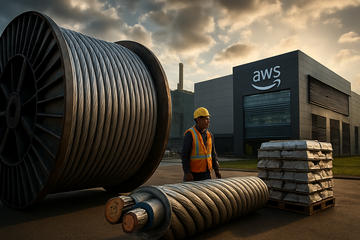
The Sep 18 announcement marks the first time aluminum produced with ELYSIS inert-anode technology has been specified into a hyperscaler data-center electrical system, Prysmian said. Cables were drawn at Prysmian's Sedalia, Missouri facility from a blend of hydropower-fed aluminum from Rio Tinto's Alma smelter in Quebec and a portion of metal smelted with ELYSIS, which replaces the carbon anodes of the conventional Hall-Héroult process with proprietary inert anodes that release pure oxygen instead of CO₂ and perfluorocarbons. Rio Tinto and Alcoa jointly own ELYSIS.
Scope 3 just became a procurement spec, not a press release
Amazon has committed to net-zero across operations by 2040, and the company's Scope 3 footprint — emissions embedded in the materials it buys — is the largest bucket it cannot decarbonize unilaterally. Aluminum is a leading candidate: smelting is electricity-intensive, and the anode reaction in conventional smelting releases both CO₂ and powerful perfluorocarbons. By specifying ELYSIS aluminum at the cable stage, AWS shifts the emissions reduction upstream and locks in auditable Scope 3 credits without touching the data-center building itself.
The mechanism matters because Prysmian targets net-zero across Scopes 1, 2, and 3 by 2035 — among the most aggressive in the cable industry — and aims for 55% of revenues from sustainability-linked solutions by 2028. The Ohio deal is the first proof point that ELYSIS-grade cable can be specified into hyperscaler RFPs at scale. If a single hyperscaler signs, others follow: AWS, Microsoft Azure, Google Cloud, and Meta all compete on Scope 3 narratives, and the loser is whichever one is still buying commodity aluminum while peers buy carbon-traced metal.
The carbon math is what makes the deal non-trivial
Conventional aluminum smelting carries roughly 1.5 tonnes of CO₂-equivalent emissions per tonne of metal from anode consumption alone, before any electricity is counted. The C2ES pegs the smelting step at about 17% of all aluminum-industry greenhouse-gas emissions. Rio Tinto's Quebec operation runs on hydropower, so the electricity component is already near zero — ELYSIS collapses the residual anode-emissions tail to near zero as well, leaving only embedded process and ancillary loads.
| Process route | Direct anode CO₂e | Indirect electricity CO₂e | Total cradle-to-gate |
|---|---|---|---|
| Hall-Héroult + coal-heavy grid | ~1.5 t CO₂e | ~10–13 t CO₂e | ~12–15 t CO₂e/t |
| Hall-Héroult + hydropower | ~1.5 t CO₂e | <0.5 t CO₂e | ~1.6–2.0 t CO₂e/t |
| ELYSIS + hydropower (Rio Tinto Quebec) | ~0 t CO₂e | <0.5 t CO₂e | <1 t CO₂e/t |
Constellium, the recycled-content specialist, posted 4.55 metric tons of Scope 1+2+3 CO₂ intensity per metric ton shipped in 2025 — better than industry-average primary aluminum, but still an order of magnitude above ELYSIS-at-hydroelectric on the smelting step alone. Recycled-content aluminum does not neutralize the same Scope 3 line because AWS's aluminum in cable is new primary metal, not closed-loop recycling from a can.
The supply chain that won, and where the moat actually sits
Four tiers cleared the AWS spec. Upstream, the only U.S.-accessible source of inert-anode aluminum today is Rio Tinto's Quebec operation; ELYSIS remains a controlled-technology JV with Alcoa. Midstream, Prysmian's Sedalia plant drew the rod and extruded it into building-wire and data-center cable products. Distribution runs through Wesco's EES segment, which already handles 39-plus data-center builds for a major cloud provider. The end customer is AWS Ohio, where the cable is being installed as part of the active build-out cycle.
- Upstream aluminum: Rio Tinto (ELYSIS patent holder + Quebec hydropower) and Alcoa (ELYSIS JV partner) — only two suppliers can produce ELYSIS-grade metal commercially today
- Midstream cable: Prysmian — Sedalia plant qualified for ELYSIS rod; existing five-year aluminum supply agreement with Rio Tinto signed in 2023
- Distribution: Wesco — bundled procurement for hyperscaler data-center builds; acts as the bankable intermediary in low-carbon cable certification
- End customer: Amazon AWS — first hyperscaler to accept inert-anode aluminum into a live data-center spec
- Indirect beneficiaries: existing ELYSIS customer Apple has shipped the metal in iPhone SE enclosures since 2022; second-order suppliers like Nexans face pressure to source ELYSIS-blend rod or lose premium hyperscaler RFPs
The market is doubling — which is why the spec race starts now
CRU estimates the data-center sector represented ~7% of total North American cable demand in 2025 and is forecasting ~17% CAGR through 2030, with aluminum taking an increasing share of the cable product mix. Combined copper and aluminum cable and non-cable metallic demand for data centers is expected to hit 850–900 kt in 2026 and exceed 1,500 kt by 2030. Aluminum overhead cable demand has already risen at about a 9% CAGR from 2020–2026. In short, the addressable market for ELYSIS-grade cable is roughly doubling within five years, and the share that will be specified as low-carbon is set by the largest buyers.
Data center cable demand — combined copper + aluminum
CRU, Aug 2026 forecast; aluminum share of cable product mix rising
Unit: kt/year
2026E
kt Cu + Al combined
875
2028E
kt Cu + Al combined
1,100
2030E
kt Cu + Al combined
1,500
Who pays the carbon premium — and who loses the contract
Prysmian gave investors the clearest signal in July2026: a 10-year agreement with Molex (a Koch company) worth up to €5.5 billion, supported by a €550 million upfront payment, and a stated target of €10 billion in cumulative hyperscaler and data-center revenues through 2035, with up to €1.1 billion in incremental revenue from 2031 alone. Q2 2026 group revenue hit €6,021 million (+9.4% organic) with adjusted EBITDA of €730 million — Prysmian's strongest-ever quarter, driven by data-center demand.
| Company | Ticker | Latest revenue | Data center / cable angle |
|---|---|---|---|
| Prysmian | PRYMF | €6.0B Q2 2026 (+9.4% organic) | €10B cumulative hyperscaler target by 2035 |
| Rio Tinto | RIO | Aluminum $9.4B H1 2026 (+24% YoY) | Only commercial ELYSIS-grade primary aluminum |
| Alcoa | AA | $4.0B Q2 2026 (+24% sequential) | ELYSIS JV partner; aluminum segment exposed |
| Constellium | CSTM | TTM ~$9.6B | Scope 1+2+3 intensity 4.55 t CO₂/t; low-carbon portfolio, no ELYSIS |
| Nexans | NEX.PAR | — | Prysmian's main rival; pressure to match low-carbon offering |
| Wesco | WCC | $25.0B TTM | Distribution + bundled procurement for hyperscaler builds |
| Century Aluminum | CENX | — | Conventional U.S. smelter; no low-carbon capacity; high-grid-cost exposure |
On the upstream side, Rio Tinto's Aluminum business posted $9.4 billion of revenue and $3.1 billion of EBITDA in H1 2026 (+38% YoY), with average realized prices up 39% to $4,343 per tonne. The segment is carrying the highest realized-price gains in Rio Tinto's portfolio — and the only primary aluminum producer that can supply ELYSIS-grade metal is the only one positioned to lock in a premium to LME for the lowest-carbon molecules. Alcoa, the ELYSIS co-pilfer, posted Q2 2026 revenue of $4.0 billion (+24% sequential) and is acquiring South32's bauxite, alumina and aluminum assets for $4.1 billion — adding primary metal to its portfolio as the cable-grade aluminum spec tightens.
Short-term catalysts and long-term thesis
Near-term (days to quarters), three triggers could rerate the value chain. First, any follow-on hyperscaler order — Microsoft Azure or Google Cloud — converting from ELYSIS building-wire trials to data-center cable spec. Third, the start of commercial-scale ELYSIS production at Rio Tinto's Alma smelter (announced in June 2024 with first production targeted by 2027); if the 2,500-tonne-per-year commercial cells ramp on schedule, the supply constraint binding hyperscaler adoption loosens. Fourth, Wesco signing additional bundled procurement arrangements with hyperscalers — the model that monetizes the distribution layer's relationship to the spec.
Long-term (1–3 years), the structural thesis is straightforward: as data-center power demand doubles and Scope 3 emissions accounting tightens, low-carbon aluminum stops being a marketing line and becomes a bill-of-materials specification. Rio Tinto and Alcoa own the only commercial-scale primary aluminum process that eliminates direct anode emissions; Prysmian has converted that into a hyperscaler contract clause; Wesco sits in the distribution lane where the spec is enforced. The losers are conventional smelters — Century Aluminum and Russian or Chinese primary producers — without low-carbon capacity or hydropowered grids.
The main risks to the thesis: ELYSIS commercial-scale production delays beyond2027 keep supply tight and prevent broad adoption; aluminum prices fall and the low-carbon premium evaporates; hyperscalers pivot to lower-carbon copper substitutes for some applications; and trade policy — including the U.S. Section 232 tariffs on aluminum and Canadian retaliation — re-prices the geography of supply. None of these undercut the directional case, but each can push the timeline.
Stocks that move on this event
- Only commercial ELYSIS-grade aluminum producer locks in a carbon premium to LME in hyperscaler cable contracts; H1 2026 aluminum EBITDA already +38% YoY to $3.1B at $4,343/t average.
- First-mover scale at Alma smelter (commercial-scale cells targeted 2027) keeps the production moat in place through the 1–3-year window when competitors will be lining up.
- Cross-cycle exposure: Rio Tinto's Aluminum & Lithium segment now derives a structural premium from Scope 3 demand, not just LME prices — a different earnings mix than iron ore or copper.
- Q2 2026 record EBITDA of €730M (+20.7% YoY) on data-center pull; ELYSIS-grade cable specification is the wedge into the stated €1.1B/yr incremental hyperscaler revenue target from 2031.
- 10-year Molex agreement worth up to €5.5B (announced Jul 20, 2026) plus the AWS Ohio ELYSIS spec stack the order book with sustainability-linked cable;55% sustainability-linked revenue target by 2028 is now within reach.
- Net-zero Scope 1+2+3 by 2035 target is the most aggressive in cable; competitors like Nexans without comparable low-carbon rod supply face a narrowing buyer pool at hyperscaler RFPs.
- ELYSIS JV partner captures licensing and metal-premium economics as the technology scales; Q2 2026 revenue of $4.0B (+24% sequential) and $4.1B South32 acquisition add primary aluminum mass at the right moment.
- Constellium is the recycled-content specialist — but cable-grade aluminum at hyperscalers is new primary metal, so ELYSIS access matters more than recycled content for AWS-grade material.
- Operating leverage to aluminum prices remains intact (TTM operating margin 18.4% on Q2 2026 print), with a structural tailwind from the carbon premium that lifts margins above pure-LME exposure.
- Distribution role on the AWS Ohio spec monetizes the relationship: Wesco already bundles procurement for 39+ hyperscaler data-center builds, so capturing the ELYSIS cable line is incremental revenue at high incremental margin.
- Net-debt-to-EBITDA of 3.7x is the highest in the comp set; data-center tailwind helps EBITDA growth (TTM EBITDA $1.59B) but rising rates or a demand correction would compress the leverage cushion.
- Hyperscaler order flow remains binary — the stock rerates if additional ELYSIS-grade cable contracts flow through Wesco's EES segment, but the distribution layer captures less of the carbon premium than the upstream players.
- Best-in-class Scope 1+2+3 intensity at 4.55 t CO₂/t shipped in 2025 keeps Constellium in low-carbon aluminum conversations, but the cable market is new primary metal — not recycled content — so the recycled-content advantage is partial.
- Aerospace and automotive rolled products dominate Constellium's mix (no cable exposure today), so the immediate hyperscaler tailwind is indirect via customer perception of low-carbon aluminum producers.
- Net-debt-to-EBITDA of 1.65x and P/E of 6.6x screen as a value setup if Constellium pursues a low-carbon primary aluminum JV or licensing deal to enter cable-grade supply.
- Direct rival to Prysmian in data-center cable; Prysmian's ELYSIS spec gives it a structural advantage in hyperscaler RFPs that Nexans cannot match until it secures its own ELYSIS-grade rod supply.
- Cable-only exposure (no aluminum production) leaves Nexans dependent on third-party rod supply; the only two producers are Rio Tinto and Alcoa, both aligned with Prysmian's five-year agreement.
- Pricing pressure as Prysmian secures multi-year hyperscaler deals (€10B cumulative target) could compress Nexans's data-center cable margins into 2027–2028.
- Conventional smelting with no ELYSIS access or hydropowered grid; rising U.S. power prices tied to data-center demand (per S&P Global commentary) compress smelter margins.
- Hyperscaler cable spec increasingly excludes high-carbon metal; Century's addressable buyer pool narrows as AWS-grade cable specifications propagate to other customers.
- DOE-backed low-carbon smelter project (announced March 2024) is the only counter-play, but commercial-scale low-carbon primary aluminum is years away and capital-intensive.