
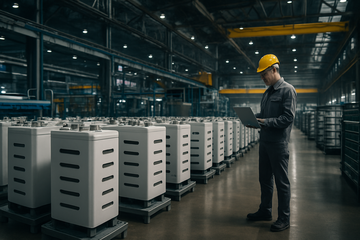
On Sept. 22, 2026, EnerVenue began mass-producing nickel-hydrogen batteries in Changzhou, Jiangsu — the same week President Trump meets Xi Jinping in Washington. Two years earlier, the same Fremont, California-founded company had announced a $264M, 450-job factory in Shelby County, Kentucky, with a full state welcome. That plant was finished, never turned on, then handed to a competitor. The move to Changzhou is not an aberration; it is the cleanest single piece of evidence yet of where the cost curve in clean-energy hardware manufacturing actually lives, and what US industrial policy has, and has not, been able to bend.
The Move: A Novel US Battery Chemistry Built in China
EnerVenue's technology is the outlier variable in this story. The company makes nickel-hydrogen batteries adapted from chemistry NASA flew on the Hubble Space Telescope and the International Space Station — 30,000-cycle design life, zero thermal-runaway risk, water-based electrochemistry. Founder Yi Cui is a Stanford materials-science professor. The technology is American; the factory is now Chinese. Reuters reported on Sept. 22 that CEO Henning Rath, who joined in April 2026, made building in China a precondition for taking the job, and that the Changzhou plant is around 95% automated with about 400 workers by year-end.
Series B extension
$300M
Closed March 2026; led by Full Vision Capital, joined by Saudi Aramco and SLB
Capacity target — 2026
250 MWh
~300 cells/day on the first Changzhou line, ramping from Q3 2026
Capacity target — Q3 2027
1 GWh
Per EnerVenue guidance reported in June 2026
Workers at full ramp
~400
At the 95%-automated Changzhou facility
Why Changzhou Beats Kentucky on the Math
In the Reuters piece, Rath named three structural reasons China won: skills, supply-chain depth, and the willingness of local vendors to develop equipment without payment until EnerVenue adopts the design. Changzhou hosts a 97%-complete power-battery supply chain — 3,000 companies, 180,000 workers and ¥200B ($28B) of output concentrated in one city. Graduate engineers there earn roughly 12,000 yuan ($1,792) a month; a US counterpart on an equivalent career track costs a company roughly $7,000–$9,000 fully loaded.
| Driver | Changzhou, China | Kentucky, US (illustrative) |
|---|---|---|
| Supply-chain completeness | ~97% within city limits (3,000 suppliers) | Dispersed; many parts shipped in from Asia |
| Graduate engineer comp. | ~$1,792/month | $7,000–$9,000/month fully loaded |
| Equipment financing | Vendors wait for design adoption | Upfront payment standard |
| Automation / headcount | ~95% automated, ~400 workers | Lower automation,1,000+ typical |
| State support on offer | Permits, certification, site selection | Cash, tax credits, loans |
- Cost of iteration: when an automation line has to be redesigned on the fly, paying $1,792/month for an engineer instead of $8,000/month shrinks a rebuild budget by roughly 80%.
- Vendor financing: Chinese equipment makers absorb development cost and recover it only on adoption — capital that would otherwise sit in inventory or pre-production CAPEX.
- Cluster density: hydraulics, pneumatics and automation specialists live within a 30-minute drive of the plant, enabling same-day iteration on what Rath calls a 'first-of-its-kind' line.
- Government role is narrow: permits, certification and site selection — not the demand-side subsidies Kentucky was prepared to write.
Kentucky's Industrial-Policy Scorecard
Kentucky spent the last three years trying to build a battery manufacturing cluster through state and federal subsidies. Three of the four largest bets have failed or stalled; the fourth only survived by switching to a different product. The EnerVenue decision is the latest data point — and arguably the least surprising.
| Project | Headline commitment | Current status |
|---|---|---|
| EnerVenue (nickel-hydrogen) | $264M Phase 1, 450 jobs (2023) | Built, never operated; site leased to Canadian Solar subsidiary e-STORAGE, Nov 2024 |
| Ford–SK On BlueOval SK (Glendale, KY) | $5.8B JV plant, 1,600 jobs | Closed Feb. 14, 2026; Ford converting to energy storage; Kentucky renegotiating $250M upfront loan |
| Ascend Elements (Hopkinsville) | Multi-billion EV materials plan | Trump administration cut ~$100M in federal grants, Oct 2025 |
| e-STORAGE / Canadian Solar (Shelbyville) | $712M, 1,572 jobs, 3 GWh scaling to 6 GWh | Operating on former EnerVenue site; production since late 2025 / early 2026 |
The pattern is consistent: state cash can finance a building, but it cannot manufacture the suppliers, the engineers, or the iteration speed that a 'first-of-its-kind' production line requires. The e-STORAGE plant that took EnerVenue's Kentucky site is itself a Canadian-headquartered, China-supply-chain-integrated LFP operation — not a domestic chemistry startup. It works because it rides existing Chinese cell supply; EnerVenue did not, and walked.
Upstream: Where the Advantage Compounds
EnerVenue's bet also exposes a deeper supply-chain reality: even novel chemistries inherit the cost curve of the surrounding ecosystem. China's battery-storage cell shipments accounted for roughly 90% of the global total in 2025, according to Solarplaza's mapping of the Chinese BESS supply chain. That dominance is reinforced upstream in raw materials and midstream in cells — and downstream in deployment. CATL, the world's largest battery maker, posted Q2 2026 revenue of ¥147.8 billion, up 56.9% year-on-year, with net profit of ¥22.5 billion; its energy-storage battery segment grew 87.54% in the first half of 2026 to ¥53.26 billion.
CATL revenue by quarter — energy storage has become the marginal growth engine
Quarterly revenue (¥B), based on the company's interim and annual disclosures
Unit: ¥B
Q2 2025
Reported Jul 2025
94.2
Q3 2025
Reported Oct 2025
104.2
Q4 2025
FY2025 result, Mar 2026
140.6
Q1 2026
Reported Apr 2026
129.1
Q2 2026
Reported Jul 2026; +56.9% YoY
147.8
- Nickel supply: China refines roughly 70% of global nickel; nickel-hydroxide cathode active material costs are tightly coupled to Chinese midstream.
- Cell manufacturing: 90% of global BESS cell shipments in 2025 came from Chinese suppliers, per Solarplaza's 2026 BESS supply-chain map.
- Equipment vendors: the same Changzhou cluster that built EnerVenue's line also serves every Chinese LFP/NMC cell maker — shared learning that compounds across customers.
- R&D density: Chinese power-battery R&D headcount is concentrated in Ningde, Changzhou and Yibin — a research network the US cannot replicate at state-level subsidy scale.
Downstream: Who Actually Buys These Batteries
The demand side tells the same story. EnerVenue's first paying deployment is with Hong Kong and China Gas Company (Towngas) at a 150 kWh pilot in Jintan, Changzhou, commissioned May 14, 2026 — paired with an electric-bus charging station. RWE is separately testing the chemistry at its Milwaukee facility on the way to a 6 GW storage target by 2030. The US opportunity is real (US battery storage installations hit 20.2 GWh in Q2 2026 alone), but Reuters noted that it is 'unclear whether China-made cells will qualify for US clean energy tax credits' after Trump's 2025 tax law tightened restrictions on Chinese content and ownership. Rath called EnerVenue 'an American company with a Chinese footprint' — exactly the phrasing US tax-credit auditors will scrutinize.
Global LDES deployment2025
15 GWh
+49% YoY; China accounted for 93% of cumulative deployment
LDES market 2026 (est.)
$3.9B
Tracking to $9.5B by 2035 at a 10.5% CAGR
US BESS installs Q2 2026
20.2 GWh
On pace for ~71 GWh across2026
EnerVenue Jintan pilot
150 kWh
50 cells, outdoor Energy Rack, commissioned May 14, 2026
What to Watch Over the Next 12–36 Months
Three catalysts will determine whether EnerVenue's bet pays off — and what it means for US industrial policy. First, the 1 GWh target by Q3 2027 at the Changzhou line will test whether nickel-hydrogen can scale at LFP-comparable cost. Second, the Trump–Xi summit on Sept. 24, 2026 will set the tariff and tax-credit tone for China-made storage; a thaw loosens the financing path, a hardening tightens it. Third, EnerVenue says it will choose sites for North American, Middle Eastern and European factories in 2027 — the first real test of whether the company will (or can) come back to the US at all.
- Near-term (days–quarters): Trump–Xi deliverables on Chinese-content rules for storage tax credits; EnerVenue's 1 GWh Q3 2027 milestone; any Chinese-domestic energy-storage price compression that crowds out novel chemistries.
- Long-term (1–3 years): whether LG Energy Solution and SK Innovation — both scarred by Kentucky write-downs — pivot their US CAPEX away from EV cells toward LFP storage; whether BYD and EVE Energy export cell lines abroad or stay domestic.
- Watch: EnerVenue's 2027 North America / Middle East / Europe site selection — the signal of whether 'Made in Changzhou' becomes a feature or a bug for US utility customers.
- Risk to the China-skeptics thesis: US grid operators are still the world's most demanding storage buyers; nickel-hydrogen's 30-year cycle life is genuinely differentiated if it ships at scale from Changzhou.
Stocks exposed to EnerVenue's China move
- Energy-storage segment revenue jumped 87.54% YoY in H1 2026 to ¥53.3B — the same Chinese demand pull EnerVenue is chasing.
- Q2 2026 net profit of ¥22.5B (+36.5% YoY) confirms pricing power even as cell makers crowd in; CATL compounds the cost-curve advantage that brought EnerVenue to Changzhou.
- Long-term: if EnerVenue picks a non-China site by 2028, CATL's overseas capacity (Hungary, Spain under construction) is the default second source.
- Vertically integrated LFP+storage producer; benefits whenever novel chemistries validate the Chinese supply-chain flywheel that EnerVenue just joined.
- If US tax-credit restrictions harden after the Sept. 24 Trump–Xi summit, BYD's existing Brazilian and Thai plants become the workaround — and BYD's overseas CAPEX widens.
- Watch for storage-segment disclosure in H2 2026 earnings to gauge share gains against CATL and EVE Energy.
- Pure-play Chinese battery/storage challenger; Changzhou cluster gives it the same supplier-financing advantage that lured EnerVenue.
- Energy-storage cell shipments grew sharply through 2025–26; further share gains directly pressure US storage startups on price.
- Long-term: as LDES market scales toward $9.5B by 2035, EVE is best-positioned to bundle cells with system integration.
- Trina Storage claims 25 GWh of integrated in-house BESS manufacturing capacity — the Chinese scale advantage that EnerVenue could not replicate in Kentucky.
- Vertical integration (modules + cells + storage) locks in customer contracts ahead of standalone cell startups.
- Long-term: the same Trump–Xi tariff outcome that affects EnerVenue's US utility customers will determine Trina Storage's North American addressable market.
- Korean LFP + NMC player with US plants in Kentucky and Ohio; the BlueOval SK closure signals the EV-cell US strategy is broken — but storage demand at 20.2 GWh/quarter in Q2 2026 is a real offset.
- If Trump–Xi loosen Chinese-content rules, LG's US-made LFP loses pricing advantage against imports from CATL and EVE Energy.
- Long-term: storage pivot could neutralize China-import risk if LG ramps LFP capacity in Michigan and Arizona.
- Parent of SK On, now absorbing the $5.8B BlueOval SK Kentucky JV dissolution and a $250M Kentucky loan renegotiation after the Feb 14, 2026 closure.
- The EnerVenue walk is the same playbook that played out on BigBlueOval SK — state subsidies were not enough — and SK's US CAPEX story is now structurally weaker.
- Near-term catalyst: any disclosure of additional Kentucky-style write-downs in Q3 2026 earnings.
- EnerVenue's first paying commercial deployment is Towngas's 150 kWh Jintan pilot, commissioned May 14, 2026 — a beachhead into Asia-Pacific utility storage.
- Towngas's distribution footprint across Hong Kong and mainland China makes it a credible scale-up partner if nickel-hydrogen proves out, pulling US-style30-year storage assets into Asia.
- Watch for follow-on Towngas orders that convert the Jintan pilot into a multi-MWh deployment.
- Took over EnerVenue's Shelbyville, Kentucky shell with a $712M, 1,572-job, 3 GWh LFP plant — proof that the site only works with Chinese-supplied LFP, not US novel chemistries.
- Storage pivotrescued the subsidy package that EnerVenue could not, but ties CSIQ's US economics to Chinese cell imports.
- Near-term: any tariff tightening after Sept. 24 Trump–Xi hurts CSIQ's Kentucky LFP cost position.