
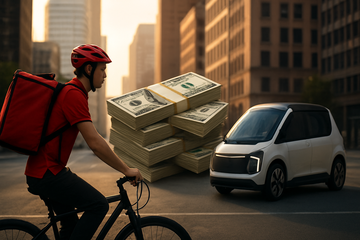
NYC settlement (DoorDash)
$131.5M
with NYC DCWP, announced Sep 22, 2026; 264,000 workers affected, $12.3M in direct payments
DoorDash Q2 2026 revenue
$4.5B
up 36% YoY; adjusted EBITDA $914M (+40%); GOV $33.1B
Uber Q2 2026 revenue
$14.2B
up 12% YoY; Delivery Gross Bookings $27.5B (+26%); layoffs 3,300 same week
NYC Dasher effective floor
$29.93/hr
DoorDash-published active-time rate, vs. $22.13 city minimum pay rate (April 1, 2026)
Tesla Q2 2026 revenue
$28.2B
up 26% YoY; deliveries 480,126 (+25%); 2026 capex plan $25B
NYC tip recovery since Jan 2026
$104M
additional tips pulled back to ~70,000 workers after DCWP enforcement
The Settlement
DoorDash's $131.5M Tab Is the Visible Half — the Real Cost Is the Pay Floor Behind It
New York City's Department of Consumer and Worker Protection (DCWP) spent nine months building a case, and on September 22, 2026 it closed the loop with a $131.5 million agreement that DoorDash signed by admitting — in the company's own words — \"we screwed up.\" The probe covered roughly 264,000 delivery workers the city said were underpaid or paid late, and the package includes $12.3 million in direct payments to drivers plus ongoing city monitoring of DoorDash's payment methods. The deal piggybacks on a separate city finding that DoorDash and Uber Eats together stripped more than $550 million in tips from couriers with hidden post-checkout tip screens after minimum pay rules first took effect in December 2023.
The Pay Floor
NYC's Enforcement Run Already Doubled Couriers' Tips — and Set the Template for Other Cities
The settlement is the second shoe dropping on enforcement that began January 26, 2026, when NYC's Minimum Pay Rate (MPR) for app delivery workers rose to $21.44 per hour and then stepped up to $22.13 on April 1, 2026 — nearly double the city's $15 general minimum wage. Tipping rules forced platforms to surface a default 10% tip option at checkout. Per the city's July 29, 2026 report, the immediate impact was that average tips per delivery nearly doubled from $1.18 to $2.29, total hourly earnings jumped from $10.48 to $27.32 (a 161% gain), and consumers kept ordering: weekly volume climbed to 3.3 million orders, 700,000 more per week than the December 2023 baseline. The city says the new rules have already returned roughly $104 million in additional tips and projects $184 million annually going forward.
| Metric | Pre-enforcement | Post-enforcement | Change |
|---|---|---|---|
| Minimum pay rate (excl. tips) | $17.96/hr | $22.13/hr | +23% |
| Average tip per delivery | $1.18 | $2.29 | +94% |
| Total hourly earnings | $10.48 | $27.32 | +161% |
| Weekly NYC delivery orders | 2.6M | 3.3M | +27% |
| DoorDash NYC Dasher effective rate | — | $29.93/hr | n/a |
DoorDash's P&L
A $4.5B Quarter Eats the Fine — but the Margin Story Already Includes the Higher Wage Bill
DoorDash's Q2 2026 (quarter ended June 30, 2026) is its best-looking quarter on file: revenue of $4.5 billion up 36% year-over-year, marketplace gross order value of $33.1 billion also up 36%, and adjusted EBITDA of $914 million up 40% with free cash flow of $742 million. The company is guiding Q3 2026 EBITDA to a range of $950 million to $1.10 billion — meaning the $131.5 million settlement is essentially one quarter's worth of Q2-level profit stripped out in cash. The structural hit, however, is in the cost of revenue line: DoorDash's own blog states Dashers in NYC earn at least $29.93 per active hour, on top of tips, well above the city-mandated floor.
DoorDash's Q2 2026 scale vs. the settlement
Quarter ended June 30, 2026 — the settlement equals roughly one week of marketplace GOV or about 18% of Q2 free cash flow
Unit: USD billions
Marketplace GOV
USD billions
33.1
Revenue
USD billions
4.5
Adjusted EBITDA
USD billions
0.9
Free cash flow
USD billions
0.7
NYC settlement
USD billions
0.1
Uber's Squeeze
Uber Cuts 10% of Staff on the Same Day NYC Settles — and Pivots the Savings to Robotaxis
On September 2, 2026, three weeks before the DoorDash settlement, Uber announced roughly 3,300 layoffs — about 10% of its 34,000-person workforce, the deepest cuts since the pandemic. CEO Dara Khosrowshahi framed the move as flattening management and freeing capital for the robotaxi push, explicitly citing encroachment from autonomous rivals. The company has signaled more than $10 billion of robotaxi investment \"in the coming years,\" with the goal of reshaping Uber into the marketplace layer between vehicles and riders even as it owns fewer of those vehicles outright.
- Uber Q2 2026 revenue hit $14.2B (+12% YoY) on $58.0B of Gross Bookings (+24%); Delivery alone produced $27.5B of GB (+26%) — the segment most exposed to the same DCWP template DoorDash just settled.
- Adjusted EBITDA reached $2.8B (+33%), non-GAAP operating income $2.1B (+40%), and GAAP diluted EPS $1.17 — meaning Uber's earnings power is large enough to absorb the equivalent of multiple DoorDash-style fines without flinching.
- The 3,300-position cut implies annual savings that, on a rough loaded-comp basis of $300K, run $1.0B+ — only a fraction of the $10B+ robotaxi capital plan, suggesting equity-funded AV spending.
- Uber is already on the hook from the November 2023 NY Attorney General settlement ($290M fund), so the September 2026 NYC environment is not new liability exposure — but each DCWP enforcement cycle raises the platform cost base.
- Lyft, with TTM revenue of just $6.77B, thin TTM EBITDA of $46.6M, and roughly 3,900 employees, lacks the cushion to absorb both labor-cost escalation and a parallel $10B-class AV capex program.
The AV Substitution
Tesla's Cybercab Launch Lands the Next Day — but Robotaxi Scale Is Still Years Away
Hours after the Uber layoff announcement, Tesla flipped the switch on paid Cybercab rides in Austin on September 3, 2026, with the public booking tier opening September 4. The two-seat vehicle has no steering wheel or pedals, runs through Tesla's existing Robotaxi app, and immediately drew an audit from the National Highway Traffic Safety Administration covering roughly 1,000 Cybercabs. Tesla appears to be self-certifying compliance rather than applying for NHTSA's exemption, a posture that could land in court. Through the end of June 2026 Tesla had logged only about 2.4 million cumulative paid Robotaxi miles — a rounding error next to Uber's 3.9 billion Q2 trips and Lyft's US-Canada base.
- Tesla Q2 2026 revenue of $28.2B (+26%) and 480,126 deliveries (+25%) came with operating income down 57% YoY, and the company reiterated a $25B 2026 capex plan funded primarily for robotaxis and Optimus.
- Cybercab unit economics depend on removing the driver — currently $20-30/hour of Uber/Lyft cost — but Tesla has not disclosed per-ride economics or fleet utilization, leaving the AV substitution thesis as a multi-year capex bet.
- For delivery specifically, robotaxis solve rideshare costs but not the human courier problem on a bike or in a stairwell, so the gig delivery pay floor compounds with no near-term AV offset.
- Alphabet's Waymo remains the operational benchmark — commercially running paid rides across multiple US metros — and any expansion onto Uber's marketplace would compete for rider share before it competes for delivery share.
The Supply Chain
Restaurants Pay Twice — Once in Commissions, Again if Platforms Pass Through Higher Labor Costs
The pay floor hits restaurants on two sides: DoorDash and Uber already deduct commissions of 15-30% from their order values, and the new minimum-pay and tip rules raise the variable cost per delivery. DoorDash's own data says its NYC Dasher rate is $29.93 per active hour, which is more than double the $13 restaurant back-of-house starting wage in many NYC kitchens. The platform's response so far — sustaining order volume growth of 700,000 weekly orders above the December 2023 baseline — suggests price elasticity is lower than feared, but commission renegotiations with chains are likely the next negotiation surface.
- McDonald's, Starbucks, and Chipotle Mexican Grill are the three chains most exposed to delivery-platform economics — Chipotle's digital sales mix exceeds 35% and McDonald's has run dedicated \"McDelivery\" promotions for years, so any platform commission hike flows through P&L almost immediately.
- If DoorDash raises consumer fees or restaurant commissions to recover the ~$184M annual tip-equivalent, the spillover demand effect hits dine-in traffic — historically 60-70% of US restaurant visits — and pressures unit-level economics at chains with the highest delivery dependency.
- On the autonomy side, restaurant supply chains are exposed through Mobileye's ADAS volumes and Alphabet's Waymo fleet expansion, but neither supplies a delivery robot in commercial scale yet.
- Lyft, as a US-Canada rideshare pure-play with no delivery segment, has no offsetting growth lever — every DCWP-style city rule that sticks to Uber Eats applies equal pressure to Lyft-equivalent wage-theft cases (the $38M Lyft NY AG settlement in 2023 already set that template).
Synthesis
Two Sides, Two Speeds — Pay Floors Compound Now, Robotaxi Substitution Later
The settlement, the layoff, and the Cybercab launch together define a setup where the cost of platform labor moves on a known rule-based trajectory while the cost-reducing AV substitution stays on a speculative capex curve. DoorDash's $131.5M is the visible bill for nine months under the new regime; the invisible bill is the structural lift in the cost of revenue that flows from paying Dashers ~$30/hour before tips. Uber is pre-empting the same shock on the rideshare side with layoffs and a $10B robotaxi war chest, while Tesla is still in the public-relations phase of commercial robotaxi — 2.4 million paid Robotaxi miles through June 2026 versus 3.9 billion Uber rides in a single quarter. The markets are pricing both sides: DoorDash at ~5.2x EV/Sales and 38.8x forward P/E, Uber at 2.8x and 16.2x, Tesla at 14.2x and 151x — labor-intensive delivery platforms trade below their growth multiples, the AV aspirant trades at a multiple of its future.
- Short term (days to quarters): the $131.5M cash hit is absorbable for DoorDash but the monitoring overhang and the 264,000-worker class creates recurring legal expense — watch for parallel DCWP notices to Uber Eats and Grubhub within 60-120 days.
- Short term: Uber's $10B+ robotaxi capex plan is the more important operating story than the $131.5M-equivalent labor backdrop — the layoffs finance the autonomous transition and signal that the company is hedging the labor floor with its own substitution.
- Long term (1-3 years): the $184M annual pace in recovered tips is the benchmark for other US cities; if DCWP's enforcement model templates into Chicago, Seattle, or California, the same arithmetic applies to ~$2B+ of delivery-worker pay that DoorDash, Uber, and Lyft all absorb.
- Long term: the AV substitution still needs to clear NHTSA's exemption cap (2,500 vehicles/year) and prove unit economics before it materially offsets human-driver costs — a 2027-2028 milestone, not a 2026 one.
- The cleanest read: labor costs compound by rule, AV substitution compounds by capex — and the platform that hedges the slowest carries the most wage-inflation risk.
Stocks exposed to the pay-floor and robotaxi setup
- $131.5M NYC settlement runs ~9% of TTM EBITDA and ~18% of Q2 2026 free cash flow — manageable but recurring legal and monitoring overhead now structurally embedded.
- Q2 2026 delivery volume growth of 36% YoY at $4.5B revenue and $914M adjusted EBITDA proves the platform can absorb the $29.93/hr Dasher floor without compressing unit economics, at least in the near term.
- Watch the next two DCWP enforcement cycles — a parallel settlement with Uber Eats would re-rate the labor overhang and force a renegotiation of restaurant commissions.
- Q2 2026 Delivery Gross Bookings of $27.5B (+26%) sit on top of the same DCWP enforcement that just hit DoorDash — Uber Eats faces a near-identical settlement template within 1-2 quarters.
- The 3,300-position layoff on September 2, 2026 funds a $10B+ robotaxi war chest that hedges Uber against the labor floor by replacing drivers, not by paying them more.
- Forward P/E of 16.2x and EV/Sales of 2.8x already price in significant labor cost compression — the upside comes from AV marketplace economics, not delivery growth.
- TTM EBITDA of just $46.6M on $6.77B revenue leaves no cushion if the DCWP template extends into other metro minimum-wage rules or a settlement on the 2023 NY AG $38M framework.
- Lyft has no Delivery segment to offset labor cost pressure and no disclosed robotaxi capex of its own — both hedges that Uber is actively deploying.
- Trailing P/E of 2.2x signals market expectations of further earnings compression; the next leg down is policy-driven, not competition-driven.
- Cybercab paid rides launched September 3-4, 2026 in Austin with NHTSA audit already open — the operational risk is binary, but the AV timeline just moved forward by 6-12 months for the broader market.
- Q2 2026 revenue of $28.2B and 480,126 deliveries masked a 57% drop in operating income as the $25B 2026 capex plan front-loads robotaxi and Optimus investment.
- Cumulative paid Robotaxi miles of ~2.4M through June 2026 versus Uber's 3.9B quarterly rides shows the gap is years wide — Tesla wins on the substitution optionality, not near-term unit economics.
- McDelivery volumes flow through the same platform commission structure that just absorbed a $131.5M NYC labor settlement — the chain has limited ability to renegotiate commission rates mid-cycle.
- Watching for DoorDash or Uber Eats to pass through higher labor costs via commission increases or service fee markups within the next 1-2 quarters.
- Q3 2026 earnings (late October) will be the first clean read on whether US delivery demand absorbed the pay floor without menu price hikes.
- Digital sales mix above 35% makes Chipotle the most delivery-exposed US chain — any platform commission hike or labor pass-through hits gross margin before competitors feel it.
- Higher Dasher base pay of ~$30/hour in NYC raises the variable cost of every digital order, but the offset is that consumer tipping has roughly doubled — neutral for the demand curve.
- Watch for Q3 2026 delivery mix commentary in late October earnings — a guide-down on delivery growth or margins would validate the commission-pressure thesis.
- Waymo is the operational benchmark in commercial robotaxi; an expansion of Waymo's fleet or geographic coverage pulls forward the AV substitution that Uber and Lyft are paying for in capex.
- Alphabet's Q2 2026 results were not the focus of this setup, but Waymo's commercial milestones are a leading indicator for the platform AV economics in the article.
- Key catalyst to watch: NHTSA's resolution of Tesla's Cybercab self-certification — a Tesla win accelerates competitive pressure on Waymo's exclusive markets.