
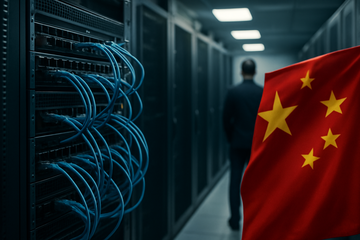
Broadcom switch penetration at state-owned data centers
Up to 90%
Per Financial Times/Reuters, Sept 23, 2026, citing people familiar with the SASAC survey
Broadcom AI semiconductor revenue, Q3 FY2026
$16.7B
+221% YoY, 56% of total revenue; company-reported Sept 2, 2026
Broadcom contracted AI backlog, Q3 FY2026
$73B+
To be shipped over the next 18 months; reaffirmed on Q3 FY2026 earnings call
Cisco Asia Pacific, Japan and China revenue, FY2026
$8.91B
14.08% of total, +9.05% YoY; FY ended July 25, 2026
What happened
SASAC Just Made State Procurement an AI-Decoupling Weapon
China's State-owned Assets Supervision and Administration Commission (SASAC) spent recent weeks surveying how extensively Broadcom switches are deployed inside state-controlled data centers, and preliminary findings put Broadcom's share of equipment in use at as much as 90%, the Financial Times reported on September 23, 2026, with Reuters confirming the story hours later. Based on those findings, SASAC may issue informal guidance directing state-run facilities to scale back Broadcom purchases under Beijing's 'domestic chips for domestic use' campaign.
- SASAC is also probing Broadcom's bundling practices, including deals of 'up to tens of thousands of units,' that may restrict access for H3C, Ruijie Networks, and Huawei in state tenders.
- The guidance covers only state-owned facilities; privately operated data centers run by ChinaByteDance, Alibaba, and other hyperscalers would not be directly affected.
- Huawei's high-end switches remain widely used inside China, though industry experts cited in the report say Huawei devices are less energy-efficient than Broadcom's Tomahawk silicon, raising power costs in dense AI builds.
Scale of exposure
Broadcom's China State Market Is Small, But It Sits on Top of the AI-Rack Stack
The durable read on Broadcom is that its $73B+ AI backlog is overwhelmingly booked by US hyperscalers — and Broadcom said on its Q3 FY2026 call that the contracted backlog, covering custom XPUs and networking, ships over the next 18 months. State-owned data centers in China represent a sliver of that. The qualitative damage is bigger than the revenue number, because the Tomahawk 6 (102.4 Tbps) and Tomahawk 7 (200 Tbps) silicon roadmaps are increasingly framed as the AI-fabric standard globally.
Broadcom Semiconductor Solutions revenue, Q3 FY2026
$20.8B
+127% YoY, 70% of total revenue; company-reported Sept 2, 2026
Broadcom non-AI semiconductor revenue, Q3 FY2026
$4.2B
+5% YoY, roughly flat sequentially; the slice most exposed to enterprise/state switching
Broadcom AI revenue guide, FY2027
$115B
Stated on Q3 FY2026 call; FY2028 guide of $230B
Supply-chain ripple
Marvell, Arista, and the OEM Channel Sit One Layer Below Broadcom — and Take the Whiplash
Broadcom ships its silicon to OEMs that brand and configure the boxes — Arista Networks, Cisco, H3C, and a long tail of white-box ODMs. SASAC's guidance targets the silicon layer, but enforcement will land on whoever ships finished switches into state-owned deployments. The exposure map:
| Company | Role in chain | China/state-owned exposure |
|---|---|---|
| Broadcom (Tomahawk 6/7) | Switch ASIC vendor | Up to 90% state penetration today; direct target of audit |
| Marvell (Alaska / DSP) | Pluggable optics DSP, custom silicon for switches | Sits in 800G/1.6T transceivers inside Tomahawk builds; China-state share undisclosed |
| Arista Networks | Branded switch OEM using Broadcom silicon | Limited direct state exposure; benefits if Chinese hyperscalers absorb share |
| Cisco | Branded switch OEM + Cisco Silicon One | APJC = $8.91B FY2026 (14.08% of total); restructuring already in motion |
| H3C (Unisplendour) | Domestic OEM, #1 China Ethernet switch | Preferred vendor on state procurement lists |
| Ruijie Networks | Domestic OEM, fast-growing DC switch line | H1 2026 net profit guided +32.7%–65.9% YoY; Gartner DC-switching guide vendor |
For Arista Networks, the spillover is mildly positive in the medium term: state-owned share that vacates Broadcom silicon stays inside the Ethernet ecosystem, and Arista Networks's 19%-ish share of high-speed Ethernet switching (per industry trackers) is well-positioned if private Chinese hyperscalers Alibaba and ByteDance pick up the freed capacity. Cisco's APJC line, with $8.91B in FY2026 (14% of revenue), looks incrementally exposed: Cisco sells its own Silicon One alongside Broadcom-based Nexus, so any procurement crackdown on US silicon ripples into both.
Marvell is the sleeper name. Its pluggable-optics DSPs and Alaska switch silicon sit one layer inside the Broadcom-branded chassis that ship into Chinese AI factories. With the data-center switch market pegged at roughly $19.2B globally in 2026 (Persistence Market Research) and growing toward ~$27.6B by 2033, even a single-digit market-share erosion in China state-owned demand can knock 100–200 bps off Marvell's optical/connectivity growth rate.
Mechanism
Procurement Audit Is the Quiet Decoupling Lever Washington Can't Replicate
The US side of the decoupling story runs on the Entity List, the Foreign Direct Product Rule, and the Department of Commerce. The Chinese side is learning to run its lever through procurement law and auditorial opinion, which can be implemented by SASAC without a public trade action and without provoking a WTO dispute. The November 2025 Nvidia directive — barring foreign AI accelerators from any data center backed by state money — was the template. The Broadcom audit extends that template to the switch fabric that physically wires AI clusters together.
For investors, the takeaway is structural rather than transactional. The audit will not show up as a quarterly revenue miss at Broadcom — its non-AI semiconductor segment is just $4.2B a quarter, and the China-state share of that is small. What it does is normalize procurement-law as a decoupling tool, which means every US networking, storage, and security vendor with China-state exposure now sits inside a parallel de-risking calendar that runs alongside Washington's export controls.
Horizons
What Moves First, and What Stays Risk for Years
- Days to weeks — informal SASAC guidance to state-owned data centers, framed as 'optimize procurement mix' rather than a formal ban; expect a5–15% reorder deferral on next-cycle Broadcom Tomahawk 6 purchases.
- 1–2 quarters — Ruijie Networks and H3C report outsized China-state order growth; Marvell optical-DSP mix shifts as Chinese alternatives (Innolight, Eoptolink) absorb share.
- 6–12 months — Huawei CloudEngine and Cloud Fabric gain formal preferred-vendor status; Arista Networks and Cisco renegotiate Chinese channel structures to keep non-state enterprise revenue.
- 1–3 years — If the audit framework stays in place and extends to other US networking/cybersecurity vendors, the cumulative lost revenue across US silicon vendors in China state infrastructure is plausibly $1–3B annually, with the marginal share landing on H3C and Ruijie Networks; a formal expansion to all state-funded (not just state-owned) data centers would double the addressable impact.
Investable read-throughs
- $73B+ AI backlog is overwhelmingly hyperscaler-driven and not directly at risk from a state-procurement squeeze; non-AI semiconductor ($4.2B Q3 FY26) is the slice most exposed, but small.
- China-state share falls inside the bundling investigation — a precedent that procurement law can shape US silicon sales in China without an export-control action.
- Near-term: shares likely pressured on news flow and State-Owned DC reorder deferral; long-term: AI-rack stack lock-in at hyperscalers remains intact through FY27 ($115B AI guide).
- Marvell's pluggable-optics DSP and Alaska switch silicon sit inside Broadcom-branded chassis shipped to China; Chinese alternatives (Innolight, Eoptolink) absorb share if procurement tilts to H3C/Ruijie/Huawei.
- Custom-silicon business (~18% of FY26 revenue, ~$1.5B) is largely US hyperscaler and unaffected — that floor supports the bullish thesis on AI ASIC design wins.
- Expect optical/connectivity segment growth rate to compress 100–200 bps if state procurement fully drops Broadcom silicon in2027; offsets any upside from NVIDIA's NVLink Fusion partnership announced March 2026.
- Q2 2026 revenue $3.04B (+37.7% YoY); FY2026 revenue guide raised 3x to ~$12.6B (+40%); 2026 AI revenue target $3.5B — driven by US hyperscalers, not Chinese state.
- Beneficiary if private Chinese hyperscalers (Alibaba, ByteDance) absorb the share freed by state-owned data centers curtailing Broadcom silicon.
- Watch Q3/Q4 2026 commentary for any mention of China procurement impacts; Arista has minimal state-owned DC exposure, so the impact is mostly through optics-and-DSP supply chain pricing.
- APJC revenue $8.91B in FY2026 (14.08% of $63.3B total, +9.05% YoY); any audit-driven extension to other US networking vendors would directly impact this segment.
- AI infrastructure orders surged to $9.3B in FY2026 (4x YoY) — $4B from hyperscalers in Q4 — so the US AI tailwind partially offsets China-state exposure risk.
- Cisco Silicon One alternative to Broadcom gives Cisco a domestic-switch angle to defend APJC enterprise revenue, but state-owned segment remains exposed if procurement guidance broadens.
- Direct beneficiary: state-owned data center procurement lists already prefer Ruijie alongside H3C; audit-driven displacement of Broadcom silicon directly expands its addressable market.
- H1 2026 net profit guided +32.7% to +65.9% YoY (RMB 600M–750M); data-center switch segment compound growth rate 55.8% per company disclosures.
- Recognized as Representative Vendor in Gartner's 2026 Market Guide for Data Center Switching; named alongside Arista, Celestica, and Nvidia as capturing the majority of Q1 2026 Ethernet switch revenue growth.
- H3C trades inside its parent Unisplendour (private equity — unverified listing); H1 2026 parent revenue +33.93% YoY to RMB 63.5B with H3C growing 37.28% — directionally aligned with state procurement tailwind.
- China Ethernet switch share leader at 34.5% (2023); 400GbE shipments doubled in Q2 2025 to surpass 1M ports, second-largest globally.
- Watch: whether parent moves toward a public listing that would unlock direct equity exposure; for now, investors access H3C only through private-equity channels.