
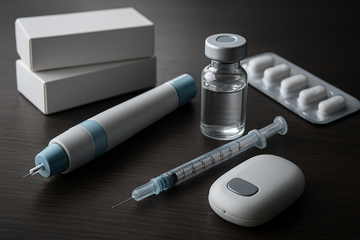
The once-weekly insulin moment arrived on March 26, 2026 — and it didn't come from the company most investors expected. Novo Nordisk's Awiqli (insulin icodec-abae) won FDA approval as the first once-weekly basal insulin for adults with Type 2 diabetes, based on a phase 3 program in roughly 2,680 patients that included a head-to-head win over daily glargine. The drug launched August 11, 2026 at a $99 list price with a $35 copay cap, and Visible Alpha estimates point to roughly $174M in 2026 sales. Eli Lilly's competing efsitora alfa, which posted non-inferior Phase 3 A1C reductions of its own, is still in FDA review with a Q3 2026 PDUFA expected. The race everyone was watching has a winner — and a much larger supply-chain ripple than the GLP-1 launches of the past two years.
FDA approval date
March 26, 2026
Novo Nordisk Awiqli (insulin icodec-abae), first once-weekly basal insulin for T2D
ONWARDS-1 A1C reduction (icodec)
-1.55%
vs -1.35% for daily glargine in 984 insulin-naïve adults — superior endpoint
Launch price
$99 / package
$35 copay program; nationwide US launch on Aug 11, 2026
Lilly efsitora PDUFA
Q3 2026
Still pending FDA decision as of Sep 24, 2026; QWINT-1 efsitora A1C reduction -1.31% vs -1.27% glargine
Basal insulin market (2026)
$7.7B
Mordor Intelligence, basal-only segment; broader insulin market $19.4B per Grand View
Sanofi Lantus glargine share
44.2%
Largest single-product share in the glargine subsegment in 2026
The verified event
Awiqli's approval was a head-to-head win, not just a label change
The ONWARDS-1 trial in 984 insulin-naïve adults with Type 2 diabetes showed Awiqli cut A1C by 1.55% from baseline versus 1.35% for daily insulin glargine — a statistically superior result, not the customary non-inferiority claim that has historically accompanied basal insulin launches. Four pivotal trials covered roughly 2,680 patients across both insulin-naïve and insulin-experienced populations. The clinical edge matters less than the commercial edge: Novo Nordisk enters the US Type 2 basal insulin market with a once-weekly dosing profile that collapses 365 daily injections a year down to 52, a pitch every primary-care prescriber is going to hear from a sales force that already calls on the same offices for GLP-1s.
The chase
Lilly is the clear second mover — and the framing matters
Coverage of this milestone has often been mis-attributed to Eli Lilly. It isn't — efsitora alfa is awaiting a Q3 2026 PDUFA decision after QWINT-1, QWINT-3, and QWINT-4 reported non-inferior A1C reductions versus daily comparators. The QWINT-1 efficacy-estimand result was -1.31% versus -1.27% for glargine at 52 weeks; QWINT-3 hit -0.86% versus -0.75% for degludec; QWINT-4 tied glargine at -1.07%. Strong data, but matched against Awiqli's superior ONWARDS-1 endpoint, Lilly enters the US market as the clear #2 in a two-player category rather than the breakthrough player the GLP-1 narrative has conditioned investors to expect from its diabetes pipeline.
| Program | Trial | A1C reduction | Comparator | Outcome | FDA status |
|---|---|---|---|---|---|
| Novo Nordisk Awiqli | ONWARDS-1 | -1.55% | Insulin glargine U-100 | Superior | Approved Mar 26, 2026 |
| Lilly efsitora alfa | QWINT-1 | -1.31% | Insulin glargine U-100 | Non-inferior | PDUFA Q3 2026 |
| Lilly efsitora alfa | QWINT-3 | -0.86% | Insulin degludec | Non-inferior | Same filing |
| Lilly efsitora alfa | QWINT-4 | -1.07% | Insulin glargine U-100 | Non-inferior | Same filing |
Direct incumbent impact
Sanofi's Lantus franchise is the most exposed daily-injection incumbent
Sanofi's Lantus and Toujeo together still hold roughly 45.7% of the insulin glargine subsegment — the single largest pool of daily basal users Awiqli will compete for. Lantus is a $7B-plus historical peak franchise now in steady decline; once-weekly dosing reframes a chronic-adherence story Sanofi has been losing for a decade to modern GLP-1 prescribing. The near-term substitution rate will be modest — basal insulin patients are notoriously sticky, prescribers switch slowly, and payor step edits will gate early uptake — but the trajectory is now clear: Sanofi is selling into a market where the primary differentiator of its franchise (once-daily over NPH) is itself being leapfrogged.
- Awiqli's $99 list price undercuts Lantus list economics while the $35 copay program is positioned for pharmacy benefit adoption
- Novo Nordisk reports Awiqli is already in more than 70,000 US pharmacies by launch
- Sanofi's counter — Toujeo U-300 — is a longer-acting daily injection, not a frequency challenger, and offers no structural defense
- Sanofi's diabetes division revenue (T2D + cardio + established portfolio) was reported inside a TTM revenue base of ~$48.9B in H1 2026
Supply chain — pumps
Insulet's Omnipod isn't directly substitutable — but MDI is its competitor, and that story just hardened
Insulet's Omnipod 5 is an automated insulin delivery (AID) system, not a basal insulin — it still requires the same rapid-acting insulin to dose through the pod. But the more interesting substitution story is multiple daily injections (MDI): the patient who currently takes one long-acting basal shot every night plus mealtime coverage. Awiqli doesn't replace the mealtime shots, but it removes the daily basal commitment, which is the largest single adherence friction. Insulet's Q2 2026 results showed total Omnipod revenue of $795.9M (24.6% YoY) with US Omnipod at $544.1M (+20.1%), but the company also cut its 2026 revenue-growth guide from 21–23% to 20–22% — a modest step that doesn't yet reflect weekly-insulin cannibalization, and a separate Omnipod pod manufacturing notice reached roughly 7 million pods. The pump franchise still grew faster than the lowered guide; the watch item is whether MDI-to-Omnipod conversions decelerate as some needle-averse T2D patients opt for once-weekly basal instead.
Tandem Diabetes Care, the smaller US pump player behind the t:slim X2, is more vulnerable to the same dynamic. Q2 2026 trailing-twelve-month revenue of roughly $1.04B and negative EBITDA leave less margin to absorb any deceleration in MDI-to-pump conversion. Medtronic's diabetes unit was carved out via the MiniMed IPO in March 2026, raising $560M at a $5.6B market value — a structural vote that Medtronic's diabetes business could not compound at the pace of its peers, partly because pump share of the T2D market is still under 10%. Weekly basal is a separate but parallel vector pulling in the same direction as pump share growth: both fight for the MDI patient who is ambivalent about insulin.
Where the US pump players stand as weekly insulin enters the script
Latest reported revenue from each listed pump maker, TTM basis
Unit: USD millions
Insulet (PODD)
TTM revenue, $M, Q2 2026
3,053
MiniMed (Medtronic diabetes, IPO'd Mar 2026)
Reported FY2026 revenue per S-1/A
3,100
Tandem Diabetes (TNDM)
TTM revenue, $M, Q2 2026
1,041
Supply chain — monitoring
CGM makers are the cleanest beneficiaries of a weekly-insulin world
The most counterintuitive read of the Awiqli approval: continuous glucose monitoring becomes more important, not less, when basal insulin moves to a once-weekly interval. Weekly dosing means longer intervals between touch points with the patient and the clinician, raising the value of objective adherence and time-in-range data. Dexcom's TTM revenue of $4.97B and Abbott Laboratories's FreeStyle Libre franchise sit on the same side of this trade. Abbott cited a March 2026 UK FreeDM2 randomized controlled trial showing people with T2D on basal insulin using Libre technology achieved a 0.6 percentage-point greater HbA1c reduction and 2.5 more hours per day in target glucose range — directly applicable to the population Awiqli targets.
Horizons
What moves first — and what the 1–3 year setup looks like
Over the next two quarters, the binding catalysts are the Lilly efsitora decision and the first full quarter of Awiqli launch metrics. If efsitora is approved on time and reaches US pharmacies by Q1 2027, the category becomes a duopoly almost immediately and pricing pressure on Awiqli's $99 list begins. If efsitora is delayed — the company said it would submit by end of 2025, but the Q3 2026 PDUFA window is wide — Novo gets a longer commercial runway to lock in pharmacy benefit formulary slots. Over 1–3 years, the bigger structural story is whether weekly basal + GLP-1 combinations compress the total daily-injection burden of advanced T2D to the point that pump penetration among non-T1D patients plateaus or slips.
- Near-term: Lilly efsitora PDUFA decision (Q3 2026); Awiqli full-quarter US sales report; payor formulary placements
- Watch: Sanofi Lantus/Toujeo revenue trajectory in H2 2026; any new MDI-to-pump conversion data from Insulet
- Long-term: whether weekly basal + GLP-1 therapy reduces pump TAM expansion in T2D; whether CGM co-prescription rates accelerate
Synthesis
The structural read: basal insulin has been the slowest insulin to evolve — until now
Insulin therapy is one of the oldest modern drug classes and one of the slowest to evolve. The 365-injection-to-52 reframing is not a marginal convenience improvement — it's the most disruptive basal insulin change since insulin glargine launched in 2000 and ended the NPH era. Novo Nordisk now owns the entire structural advantage for an unknown window; the longer Lilly's efsitora waits, the more durable Novo's pharmacy benefit and prescriber habit-formation lead becomes. The pump manufacturers aren't directly competing with Awiqli, but they are competing for the same patient who is ambivalent about injections — and that's the patient base every insulin-dependent therapy company is trying to expand.
Investable takeaways
- Awiqli launch at $99 list with $35 copay targets pharmacy benefit uptake; Visible Alpha points to ~$174M in 2026 revenue as the category is built
- ONWARDS-1 superior A1C endpoint vs daily glargine positions Novo Nordisk for early formulary wins over Sanofi's Lantus/Toujeo
- Sell-force overlap with Ozempic and Wegovy means commercial ramp on Awiqli is materially cheaper than a greenfield launch
- Efsitora FDA decision is a binary catalyst in Q3 2026 — approval keeps it competitive, a delay extends Novo Nordisk's structural lead
- QWINT-1 A1C result of -1.31% vs Novo Nordisk's -1.55% on Awiqli forces a #2 market-share strategy, not a breakthrough launch
- Diabetes-portfolio dilution is small — insulin is <10% of revenue — so efsitora is more of a sentiment lever than a P&L driver
- Q2 2026 revenue of $801.7M (+23.5% YoY) still grew faster than the lowered 20–22% full-year guide, leaving room before weekly-basal cannibalization shows up
- 95% of US customers are on Omnipod 5, so the watch item is MDI-to-Omnipod conversion rates, not existing-pod churn
- Long-term, AID + weekly basal is a complementary pair, but only if Insulet keeps winning the needle-averse T2D patient before weekly basal wins them first
- Lantus + Toujeo hold roughly 45.7% of the glargine subsegment — the largest single pool of daily basal users Awiqli will target over1–3 years
- Once-weekly dosing removes the once-daily dosing convenience pitch that has been Sanofi's only structural defense since insulin glargine lost its novelty
- Sanofi's counter-move sits in its GLP-1 pipeline (with partnered assets), not in basal insulin — diabetes franchise revenue is exposed to substitution, not offset
- Longer intervals between basal doses raise the value of time-in-range data — the natural co-prescription with weekly insulin is CGM
- Q2 2026 TTM revenue of $4.97B and operating cash flow margin of 35% give DexCom capacity to push G7 into T2D basal channels
- Strategic partnership language with pump makers means CGM+CGM-to-pump is a single ecosystem play that weekly basal slots into
- FreeStyle Libre is the volume leader in pharmacy-channel CGM and benefits from the same adherence-flavored prescribing that weekly basal triggers
- March 2026 FreeDM2 RCT showed Libre use in T2D basal patients produced0.6 percentage points more A1C reduction — directly applicable to the Awiqli population
- Abbott's diversified device portfolio means the diabetes tailwind is a free option on top of structural growth from devices and diagnostics
- MiniMed was carved out via $560M IPO at a $5.6B market value in March 2026 — diabetes exposure is now visible separately
- MiniMed 780G is approved for T2D adults but pump share of T2D basal patients remains under 10%, leaving weekly basal as an additional substitution vector
- Medtronic residual benefits only via the MiniMed stake retained post-spin; the broader Medtronic P&L has limited direct exposure to basal insulin dynamics
- TTM revenue of $1.04B and negative EBITDA leave the smallest US pump player most exposed to any MDI-to-weekly-basal switch in conversion flow
- Debt-to-equity of 5.67x limits the ability to subsidize T2D market expansion against a once-weekly GLP-1 + basal combination
- The structural t:slim X2 platform competes on algorithm and form factor — it does not neutralize the weekly-basal adherence story