
Pilot launch (Matthews, NC)
Sept 24, 2026
First home-improvement retailer to offer drone delivery
Pilot SKU count
100+
Screwdrivers, painter's tape, caulk, soap, batteries, all-purpose cleaner
Drone payload per flight
~2.5 lb
Wing aircraft; 5-mile radius from Matthews store
Delivery time
~20 min
DoorDash app,
Wing cumulative deliveries (Alphabet)
1M+
Milestone reached June 2026 via Walmart partnership
Drone vs ground cost (Amazon)
$63 vs $6–10
Per delivery, 2025 — per eMarketer
The Pilot That Reorders the Stack
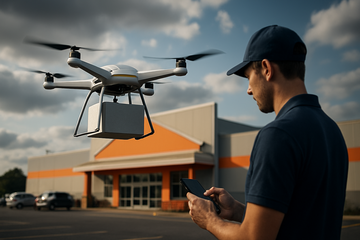
Lowe's launched its drone delivery pilot on Sept 24, 2026, out of a single store in Matthews, North Carolina, partnered with Alphabet's Wing for the aircraft and DoorDash for the ordering layer. More than 100 home-improvement SKUs — hand tools, painter's tape, caulk, soap, batteries, all-purpose cleaner — are now deliverable by air within a five-mile radius of the store in as fast as 20 minutes, up to roughly 2.5 pounds per flight. Customers order through a dedicated \"Lowe's by Drone\" storefront inside the DoorDash app, with Wing operating the dispatch.
The pilot builds on DoorDash and Wing's existing Charlotte operations and follows their April 2026 expansion to metro Atlanta. DoorDash also earned FAA Part 135 air-carrier certification in July 2026 and is launching an in-house service called DoorDash Air for fall 2026, while keeping the Wing partnership active — a dual structure that lets DoorDash own orchestration across mixed fleets. Lowe's said it could expand beyond Matthews if the metrics hold, and is monitoring associate feedback and DoorDash data to tune the program.
Why Hardware Hits Different From Pizza
Drone delivery economics have always looked weak on paper. Amazon reportedly pegged per-delivery drone cost at about $63 in 2025 against roughly $6–10 for a ground courier, and breakeven in the literature requires hitting $8–$12 per delivery at ~200 daily flights per depot. The headline economics haven't changed; what changed is the comparison case for the home-improvement SKU set.
- A 2.5-lb $14 screwdriver is not competing against a $14 pizza. It's competing against a same-day truck delivery that typically costs the retailer $8–$15 and takes 4–8 hours — or a missed sale where the customer drives to Home Depot.
- Drone wins on latency, not price. A 20-minute delivery turns \"I'll wait until the weekend\" into \"I'll finish the project tonight,\" which is a category-creation event, not just an expense line.
- Wing's 2.5-lb ceiling matches the median home-improvement impulse buy — exactly the items contractors and DIYers abandon cart on because they don't want a second store run.
The Last-Mile Stack Just Got a Winner Set
Three weeks before Lowe's announcement, Wing and Walmart crossed 1 million cumulative commercial drone deliveries and committed to a 270-store, 20-metro expansion by 2027. With Lowe's now onboard, Wing holds the infrastructure layer for the two largest U.S. big-box retailers — and the DoorDash restaurant network underneath them. That is effectively the default last-mile layer for U.S. omnichannel retail.
Wing's commercial delivery footprint,2024–2026
Cumulative deliveries across Wing's retailer and marketplace partners, per company and partner disclosures
Unit: deliveries (millions)
Through 2024 (Walmart pilot)
Walmart pilot expansion announced Jun 2025
0.2
Through Jun 2026 (Walmart)
1M milestone, June 9–10, 2026
1
Target by end 2027 (Walmart)
270 stores, 20 metros — projected by Wing/Walmart
4.5
DoorDash is the second winner. Its autonomous delivery platform already routes orders across drivers, drones, the Dot robot, and soon its own DoorDash Air fleet — meaning the marketplace becomes the moat, not the aircraft. With Lowe's ordering through the DoorDash app, the company gains another anchor retailer on top of its restaurant base, and another reason for third-party retailers to use DoorDash as a delivery front-end rather than building their own.
- Amazon Prime Air is racing to ~500 U.S. cities and towns by year-end 2026 — the largest drone footprint announcement in history, but still confined to Amazon's own SKUs.
- Home Depot is the conspicuous holdout. It launched nationwide three-hour Express Delivery on Aug 18, 2026, betting ground couriers can still defend the home-improvement basket.
- Instacart is the most exposed non-participant: its grocery delivery economics are ground-courier-based, and the home-improvement adjacency it never had is now the proof point for the very cost structure it's locked into.
What the Financials Already Show
The pilot is too small to move any of the parent companies' reported numbers, but the surrounding financial trajectories matter. Lowe's reported $25.96B in Q2 FY2026 revenue (+8.3% YoY) with online sales +15.7% and same-day delivery +25%, with management narrowing full-year guidance to ~$92B — meaning the drone pilot lands inside a same-day channel that is already growing faster than the store base.
| Company | Quarter ended | Revenue | Y/Y growth | Operating income | Stock-based comp / revenue |
|---|---|---|---|---|---|
| Lowe's (Q2 FY2026) | Aug 1, 2026 | $26.0B | +8.3% | $3.55B | 0.3% |
| DoorDash (Q2 CY2026) | Jun 30, 2026 | $4.45B | +35.6% | $0.45B | 7.8% |
| Alphabet (Q2 CY2026) | Jun 30, 2026 | $119.8B | +24.0% | $40.8B | 6.6% |
| Walmart (Q2 FY2027) | Jul 31, 2026 | $187.9B | +5.6% | $9.38B | n/d |
| Home Depot (Q2 FY2026) | Aug 2, 2026 | $45.3B | +1.7% | ~$5.7B (est.) | 0.3% |
DoorDash is the most interesting number. Q2 revenue of $4.45B was up 35.6% YoY and topped expectations of $23B, but GAAP EPS of $0.46 fell29% YoY — the cost of growth, with R&D running 12.0% of revenue as DoorDash Labs funds the in-house DoorDash Air program. The Lowe's deal widens the take-rate opportunity on every hardware delivery that routes through the DoorDash app, which is the strategic logic behind the parallel DoorDash Air build-out.
Alphabet's Other Bets segment, which houses Wing, posted $382M in Q2 revenue against a $1.8B operating loss. Wing is still a cost center inside a $4.3T-market-cap parent, but the network effect from Walmart + Lowe's + DoorDash restaurant volume is what makes the path to break-even credible at the Wing depot level rather than the segment level — a distinction the market usually misses when it lumps Wing into \"Other Bets\".
Short-Term Catalysts and the Three-Year Frame
Days to quarters: Lowe's will read pilot conversion and average order value from the Matthews store before deciding whether to expand; the most likely next move is adding two to four additional stores in the Charlotte and Atlanta metros within 6–9 months, then a second-tier retailer test by mid-2027. DoorDash Air's first commercial routes — also fall 2026 — will give a read on whether its own aircraft materially changes the unit cost or is just a redundancy layer for Wing.
One to three years: the structural question is whether drone delivery reaches per-flight breakeven at retail-relevant SKUs. Break-even in the published modeling sits at $8–$12 per delivery with ~200 flights per depot per day — Wing's scale in Atlanta and Charlotte already runs in that neighborhood at the unit level. If the recent FAA Part 135 certifications for DoorDash and others produce a regulatory tailwind (BVLOS expansion, night flying, heavier payloads), the 2.5-lb ceiling rises and the Lowe's SKU catalog widens with it. The repricing isn't in restaurants anymore; it's in the $200 basket of impulse-buy home-improvement items.
Stocks this event touches
- First-mover in home-improvement drone delivery lets Lowe's convert same-day demand (already +25% in Q2 FY2026) into a 20-minute delivery moat that Home Depot cannot match without its own drone partner.
- Pilot SKU set of 100+ items covers the high-velocity impulse basket — screwdrivers, tape, caulk — exactly the SKUs that drive abandoned-cart recovery.
- Risk: partner dependency on Wing for aircraft and DoorDash for ordering leaves Lowe's with no proprietary edge if either raises prices or pivots to a competitor.
- DoorDash extends its autonomous delivery platform from restaurants into home-improvement retail, broadening take-rate exposure on every Lowe's drone order placed in its app.
- Q2 2026 revenue grew 35.6% YoY but GAAP EPS fell 29% as DoorDash Labs funded the in-house DoorDash Air build — the Lowe's deal is the offset to that R&D spend.
- FAA Part 135 certification in July 2026 plus a parallel Wing partnership is a dual-track strategy: own the orchestration layer regardless of which aircraft flies.
- Wing now holds the default last-mile layer for Walmart, Lowe's, and the DoorDash restaurant network — a network effect the segment P&L doesn't capture (Other Bets lost $1.8B in Q2 2026).
- Long-term:1M+ Wing deliveries to date and a 270-store / 20-metro Walmart expansion plan by 2027 mean depot-level unit economics can plausibly reach breakeven before the segment does.
- Risk: Wing remains bundled inside Other Bets, so a successful drone franchise may stay mispriced in Alphabet shares until a segment break-out or spin-off.
- Home Depot launched nationwide three-hour Express Delivery on Aug 18, 2026 — five weeks before Lowe's's drone announcement — and now faces a 20-minute-vs-three-hour gap on impulse SKUs it cannot close without a drone partner.
- Q2 FY2026 comp sales of +1.7% lag Lowe's's +8.3% revenue growth, so the differentiation cost is being paid while share momentum already runs the wrong way.
- If Home Depot signs a drone partner inside12 months, the Express Delivery build-out looks like a transitional spend; if it doesn't, the gap with Lowe's widens every quarter.
- Walmart is the incumbent Wing partner with 1M+ cumulative drone deliveries and a 270-store / 20-metro expansion plan announced June 2026 — the structural advantage that Lowe's just validated for the category.
- Walmart has the largest drone-delivery retail footprint in the U.S. and can extend to more categories (grocery-adjacent, pharmacy) faster than Lowe's can scale.
- Risk: the Lowe's–Wing–DoorDash stack forces Walmart to keep funding Wing capacity even if its own order volume plateaus, since competitor utilization of the same network would erode the moat.
- Amazon Prime Air targets ~500 U.S. cities and towns by end-2026 — the largest drone-delivery footprint announcement to date — but operates as a captive, single-SKU network for Amazon-owned inventory.
- Per-delivery drone cost at ~$63 vs $6–10 for ground (per eMarketer) means Amazon needs Prime Air to drive enough incremental basket size to clear the cost gap before 2030.
- The Lowe's deal signals that the multi-tenant Wing/DoorDash model may reach retail reach faster than Amazon's captive build-out.
- Instacart is the most exposed non-participant in the drone-delivery cost repricing because its model is anchored entirely on ground couriers for grocery baskets, the SKU set where drone 2.5-lb limits still apply.
- No drone partnership or in-house build has been announced — the next Instacart earnings call (Q3 CY2026) is the first real catalyst to watch.
- If DoorDash extends into retail and Wing widens its third-party retailer base, Instacart's relative cost-per-delivery advantage on adjacent categories erodes.
- Uber is the listed adjacency most likely to react: its Uber Eats and Uber Direct businesses sit on the same merchant/retailer relationships that DoorDash is now extending into home improvement.
- No drone build of its own is public — the strategic question is whether Uber partners with Wing or another operator, or lets DoorDash lock the orchestration layer first.
- Watch the next Uber earnings call for any mention of drone pilot economics or a third-party retailer win that signals a counter-move.