
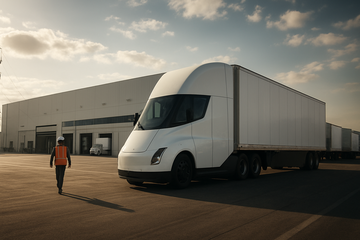
Tesla opened its first dedicated, high-volume Semi factory in Sparks, Nevada on September 24, 2026 — a 1.8 million sq ft plant beside Gigafactory Nevada, sized for 50,000 Class 8 trucks a year and fed by 4680 cells built on the same site. The event, the customer's first real delivery window, and the order book behind it reset the freight-electrification narrative: the Semi's production line now exists, it is ramping, and it is the largest single piece of Tesla's $25 billion 2026 capital plan.
From Pilot Line to Real Plant — What Changed on September 24
Volume production on the new line began in March 2026, the first high-volume truck rolled off in late April, and the September 24 inauguration was a ceremonial opening rather than the start of manufacturing — but the customer list on the line made it the moment Tesla crossed from promise to product. A drone flyover captured 11 Semi tractors wearing customer logos, including PepsiCo, DHL, US Foods, ABF, Einride, IMC Logistics, OK Produce, WattEV, and LTS.
Plant footprint
1.8M sq ft
Sparks, Nevada; adjacent to Gigafactory Nevada and 4680 cell lines
Designed annual capacity
50,000 trucks
~1,000 per week; reiterated by Tesla at the September 24, 2026 event
Long Range price
$290,000
500-mile variant, quoted since February 2026, up from the original $180,000
Standard Range price
$260,000
325-mile variant; both versions available now
The Ramp Is Already Showing Up in the Numbers
Tesla's Q2 2026 production and delivery report, filed July 2, 2026, lumps the Semi together with Cybertruck and the legacy Model S/X in the \"Other Models\" line — but that bucket jumped to 12,364 vehicles delivered versus negligible volumes a year earlier, with8,822 produced. Tesla's Q2 2026 update also states \"Tesla Semi remains on track for production this year at our new factory in Nevada,\" while the Q2 2026 earnings call confirmed Semi production has started.
Tesla's Semi-Linked Capex Pressure, Quarterly Capex ($B)
Tesla capex jumped to $5.79B in Q2 2026 from $2.39B a year earlier, the bulk of the $25B 2026 plan funding the Semi factory plus Cybercab, Megapack 3, Optimus and AI infrastructure
Unit: USD billions
Q2 2025
Pre-Semi-ramp baseline
2.4
Q1 2026
Initial Nevada build-out
2.5
Q2 2026
First full Semi-line capex quarter
5.8
- Q2 2026 revenue: $28.24B (+26% YoY) — strong enough to fund the build, but operating leverage is being consumed by capex
- Q2 2026 net income: $1.11B, down 5% YoY; diluted EPS $0.32 vs $0.33 — the first margin slip since the capex ramp began
- 2026 full-year capex guidance: ~$25B, raised from $20B; Tesla's largest annual outlay in company history, ~3x the 2025 baseline of $8.5B
- Cumulative Semi deliveries through Q1 2026 estimated in the 350–500 range; Q2 2026 alone added 12,364 vehicles to the \"Other Models\" line
The Order Book Just Quietly Doubled in Six Months
Three fleet orders disclosed between May and September 2026 turn the Semi from a fleet test into a backlog. Together they cover more Class 8 BEV units than Daimler Truck North America sold in all of 2025.
| Order | Date | Trucks | Implied value | Geography / Notes |
|---|---|---|---|---|
| WattEV | May 5, 2026 | 370 | ~$100M | California; first 50 in 2026, full fleet by end-2027 |
| Einride | Aug 18, 2026 | 500 | ~$130–145M | North America; 24-month deployment starting Sep 2026; runs on Saga AI |
| ZET SCALE / Catalyst | Sep 23, 2026 | 2,500 | $725M+ at $290K | Lead OEM; 10 hubs across CA, WA, TX, IL, GA, NY/NJ |
For comparison, Daimler Truck North America — the dominant Class 8 player — delivered just 6,726 battery-electric trucks across all of 2025 and 1,405 BEVs in Q2 2026. Tesla's 12,364 \"Other Models\" deliveries in Q2 2026 alone, combined with the disclosed backlog, put the Semi on a trajectory to overtake Daimler in US Class 8 BEV volumes within the next two quarters even before the 50,000-unit plant hits its design rate.
What This Does to Daimler, PACCAR and Volvo
The Class 8 BEV segment is small — only 875 zero-emission heavy trucks were sold in the US in all of 2025, per ICCT's August 2026 monitor — but it is also the segment where pricing power, charging economics, and scale advantages compound fastest. Tesla's combination of price, range and integrated battery production lands as a direct competitive hit on three incumbents.
| Truck | Sticker price | Range | Battery pack |
|---|---|---|---|
| Tesla Semi Long Range | $290,000 | 500 mi | 4680 cells, integrated in Sparks, NV |
| Tesla Semi Standard | $260,000 | 325 mi | 4680 cells, integrated in Sparks, NV |
| Daimler Freightliner eCascadia (2026) | ~$400,000+ | 230 mi | 438 kWh usable, sourced from CATL/LGES suppliers |
| Diesel Cascadia baseline | ~$180,000 | ~1,500 mi | Diesel |
- Daimler Truck — 39.6% North American Class 8 share in 2025, but its BEV share is single-digit and shrinking relative to Tesla's vertical integration; eCascadia pricing $400K+ versus $290K for the Semi is a ~38% premium with less range
- PACCAR — Kenworth T680E and Peterbilt 579EV share the PACCAR ePowertrain and a smaller dealer-installed footprint; its 2025 Class 8 BEV market share sat at 9.1%, behind Daimler and well behind Tesla's 58.3% US Class 8 BEV share in Q1 2026 (ICCT)
- Volvo — VNR Electric tops out at 275 miles and Volvo has more than 750 trucks in US/Canada operation; its largest BEV order book is still measured in hundreds of units per quarter versus Tesla's thousands
- CATL and LG Energy Solution — both supply Daimler today and both remain on Tesla's standardized 4680 supplier list; Tesla's in-house dry-electrode 4680 production becoming its lowest-cost cell per kWh puts margin pressure back on the same two suppliers
The Charging Moat Most Coverage Misses
Tesla opened its first public Megacharger site in Ontario, California in March 2026, capable of up to 1.2 MW peak (currently capped at 750 kW), with 64 Megacharger sites planned nationwide. That power level is now the Tesla Semi's structural advantage over the Daimler-led Greenlane network at 750 kW and Volvo's 600 kW stations, and it is what lets a 500-mile Semi add 60% of range inside a 30-minute mandatory driver break.
What to Watch Over the Next 12 Months
- Q3 2026 deliveries — Tesla will likely begin disclosing Semi volumes separately from Cybertruck; look for the line to clear 15,000 units if the Nevada ramp holds
- 4680 cell output — Tesla's dry-electrode 4680 is now its lowest-cost cell per kWh but is still behind the original 100 GWh target; Semi volume is gated by cell supply, not assembly
- Megacharger buildout — 64 planned sites is the gating infrastructure piece for the 2,500-unit ZET SCALE order; slow rollout pushes2027 Class 8 BEV share back to Daimler
- Daimler BEV Q3/Q4 2026 unit sales — Daimler Q2 2026 NA BEVs were 1,405; if Tesla pulls 3,000+ Semis a quarter while Daimler stays flat, the US Class 8 BEV market share curve breaks decisively
- Tesla free cash flow — Tesla's Q2 2026 FCF went negative $1.09B; another negative quarter forces the Semi story into a 'cash burn before margin' frame that the market typically punishes
Stocks this story actually moves
- Q2 2026 free cash flow went negative $1.09B as Semi factory, Cybercab, Megapack 3 and Optimus all drew cash at once — near-term margin pressure
- 12,364 \"Other Models\" deliveries in Q2 2026 plus 3,370+ Class 8 orders (WattEV, Einride, ZET SCALE) make Semi the largest identifiable 2027 revenue lever outside AI/compute
- Tesla Semi at $290,000 for the 500-mile variant undercuts Daimler's eCascadia by ~$110,000 and runs 270 miles further — Tesla's vertical4680 advantage compounds over1–3 years
- Freightliner eCascadia priced at ~$400,000+ with 230-mile range sits at a 38% premium to Tesla Semi Long Range at half the operating range — Class 8 BEV pricing power shifts to Tesla over 1–3 years
- Daimler NA Q2 2026 BEV sales of 1,405 units trail Tesla's Q2 2026 \"Other Models\" deliveries of 12,364 by ~9x; share gap widens in the next two quarters if Tesla's Q3 2026 separates Semi from Cybertruck
- Daimler's39.6% Class 8 NA share is intact on diesel, but its BEV line still depends on CATL/LG Energy Solution cells while Tesla builds 4680s in-house — 1–3 year cost curve favors Tesla
- PACCAR's Peterbilt 579EV and Kenworth T680E share the PACCAR ePowertrain and captured only 9.1% of US Class 8 BEV registrations in Q1 2026 (ICCT) versus Tesla's 58.3%
- PACCAR's TTM net income of $2.50B and Q2 2026 EPS of $1.43 depend on diesel Cascadia profitability that the Tesla Semi cost-per-mile math erodes by ~$0.46/mile
- Days to watch: PACCAR's Q3 2026 truck unit release in late October — BEV mix in the order intake is the leading indicator of Tesla Semi share gain
- VNR Electric caps at 275-mile range and Volvo's 750+ North American fleet cannot match Tesla Semi's 500-mile single-charge advantage — long-haul Class 8 BEV share stays out of reach over 1–3 years
- Volvo Group Q2 2026 revenue of €12.29B is dominated by diesel trucks; BEV growth tracked by Volvo's planned US/Europe launches is the binary catalyst for the next 12 months
- Days to watch: Volvo Group Q3 2026 results on October 23, 2026 — North America Class 8 BEV order intake is the disclosure that decides the bullish/bearish case
- CATL remains on Tesla's standardized 4680 supplier list even as Tesla in-house 4680 becomes lowest-cost per kWh — incremental Tesla Semi cell demand is a watch item for the next 12 months
- CATL's largest North American Class 8 BEV exposure today is via Daimler Freightliner; a Tesla Semi in-house ramp erodes that share at the margin over 1–3 years
- Days to watch: CATL's Q3 2026 results — any disclosure of new Tesla 4680 supply contracts or North American Class 8 cell pricing re-rates the stock
- LGES is a supplier to both Daimler eCascadia cells and the standardized Tesla 4680 format — it can ride Tesla Semi volume if it wins the 4680 cell supply contracts over 1–3 years
- Tesla's in-house 4680 dry-electrode process becoming its lowest-cost cell per kWh compresses pricing leverage for LGES and Panasonic — near-term gross margin headwind
- Days to watch: LGES Q3 2026 earnings call disclosure of any new 4680 supply contract wins from Tesla for the Nevada Semi plant
- Panasonic operates4680 cell lines at Gigafactory Nevada alongside Tesla; the Semi plant ramping to 50,000 trucks/year lifts long-term4680 offtake demand — bullish for the next 12 months
- Tesla's in-house dry-electrode 4680 narrowing the cost gap with Panasonic-supplied cells compresses Panasonic's per-kWh margin — bearish for the 1–3 year pricing story
- Days to watch: Panasonic Energy's Nevada capacity disclosure in its Q2 FY2026 results — the leading indicator of whether Tesla Semi4680 offtake shifts in-house