
FTC action
Sep 24–25, 2026
ANPR on Impersonation Rule (2-0 vote) + Ferguson Reuters Momentum AI Austin interview
Salesforce Agentforce ARR
$1.5B+
Q2 FY27, reported Aug 26, 2026 — up 240% Y/Y
Microsoft Copilot seats
30M+
FY26 Q4 earnings, reported Jul 29, 2026
ServiceNow AI ACV
$1B
Q2 2026, reported Jul 22, 2026
Enterprise AI agent attach
40%
Gartner forecast for end-2026 (vs. <5% in 2025)
AI agent market 2026
$10.9B
Industry estimate, enterprise software segment
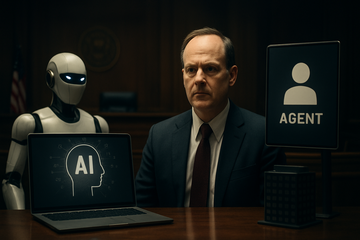
Two signals landed within 36 hours of each other, and together they recast the AI agent economy as a product-liability question. On September 24, 2026 the FTC voted 2-0 to advance an advance notice of proposed rulemaking (ANPR) on whether to expand the Impersonation Rule to cover platforms whose ad-optimization tools further scam operations. The next morning, FTC Chair Andrew Ferguson told Reuters, on stage at Momentum AI Austin, that the agency would keep treating AI agents as tools — not \"actors that break loose with wills and desires of their own\" — and that the developer instructing the agent would carry the liability. He then floated the Commission's breach-disclosure authority as a model for AI-developer disclosure obligations.
The signal
Two days, one framework: the developer is the principal
Ferguson's core move is doctrinal. \"If someone tells a tool to do something, and the tool does it, I don't think we would say, 'Oh, what do we do about the tool?'\" he told Reuters. He added that audit-trail reviews of past incidents consistently show systems \"carrying out instructions they had been given.\" The implication: under Section 5 of the FTC Act — which already covers unfair or deceptive practices — the legal person who designed and shipped the agent is treated as the principal, and the agent's conduct is the developer's conduct. There is no Section 5 safe harbor for \"the agent did it on its own.\"
The September 24 ANPR sharpens the second front. It asks whether platform ad-optimization tools — the systems that pick which ad to show, to whom, and when — are themselves covered by the Impersonation Rule when scams slip through. Read alongside Ferguson, the line between \"the platform ran a scam ad\" and \"the agent ran a scam transaction\" collapses. The comment period runs 60 days after Federal Register publication, but the enforcement theory is already on the record.
The mechanism
What developer-as-principal actually changes on the balance sheet
- Forces an AI-agent risk factor into every S-1 and 10-K. Microsoft's FY26 10-K already lists AI implementation as a source of \"legal liability, regulatory action, litigation, brand, reputational, or competitive harm\"; that language now travels down to every agent vendor's prospectus, including the confidential OpenAI and Anthropic filings submitted in May and June 2026.
- Makes contract indemnity terms a P&L line. Each Agentforce and Copilot contract will need to specify who absorbs FTC fines, state AG actions, and consumer class settlements. Today those costs sit in COGS-adjacent reserves; tomorrow they price into seat-based ARR.
- Re-prices insurance. Standard general liability carriers began carving AI out of policies on January 1, 2026 via ISO endorsements CG 40 47 and CG 40 48. Standalone AI liability policies — Munich Re's HSB product expanded to $25M per occurrence in January 2026 — are now the only path to coverage, and pricing is moving with claim severity.
- Turns audit trails into a required feature. Ferguson explicitly noted that incident reviews show agents \"carrying out instructions.\" That means every deployed agent must keep a tamper-resistant instruction log — a build cost that hits R&D line items across the platform vendors.
The precedent trail
Rite Aid and DoNotPay show where this ends
| Case | Year | Conduct | Outcome |
|---|---|---|---|
| FTC v. Rite Aid | Dec 2023 | Deployed facial-recognition AI without reasonable safeguards; misidentified consumers (esp. women and people of color) as shoplifters | 5-year ban on facial-recognition AI use; consent order with monitoring obligations |
| FTC v. DoNotPay | Sep 2024, finalized Feb 2025 | \"AI lawyer\" marketing claims that overstated capability | Monetary relief; bar on deceptive AI capability claims; notice to past subscribers |
| FTC ANPR on platforms | Sep 24, 2026 | Whether platform ad-optimization tools enable impersonation scams | 2-0 vote to seek public comment; 60-day window after Federal Register publication |
Neither precedent is an agent case, but both apply the same Section 5 logic Ferguson now extends to agent conduct: the entity that ships the system owns the outcome. For a Salesforce or ServiceNow customer reading the agent license, the precedent means the developer cannot point at \"model behavior\" or \"emergent action\" to escape a Section 5 notice.
The bill comes due
Who eats the cost: Salesforce, Microsoft, and ServiceNow economics
AI agent revenue exposure at the three public platforms
Most recent reported quarters
Unit: $ millions / percent
Salesforce Agentforce ARR
$M, Q2 FY27 (Aug 2026), +240% Y/Y
1,500
ServiceNow AI ACV
$M, Q2 2026 (Jul 2026)
1,000
ServiceNow non-seat new business
% of net new, Q2 2026
50
Salesforce Agentforce + Data 360 ARR
$M, Q2 FY27 (Aug 2026)
3,900
Salesforce's Agentforce crossed $1.5B in annual recurring revenue in Q2 FY27, up 240% year-over-year, and the broader Agentforce + Data 360 line reached $3.9B. That is the fastest product ramp in Salesforce history. It is also the largest agent base now exposed to a Section 5 liability frame that has no precedent for software-as-a-service. The cost lands first in contract redlines (sales cycles lengthen), then in reserves (contingent legal obligations expand), and ultimately in gross margin if indemnity caps absorb more of the platform's product-liability tail.
Microsoft sits on both sides of the table. Copilot reported 30M paid seats in FY26 Q4 with revenue accelerating more than 60% quarter-over-quarter, and Azure consumption still compounding at 43%. At the same time, Microsoft's 25% stake in OpenAI — accounted for under the equity method — means every ChatGPT agent action is a downstream event the FTC could trace back to a Microsoft disclosure chain. The FY26 10-K already flags \"legal liability, regulatory action, litigation\" from AI implementation; the new framing just makes that paragraph longer.
ServiceNow is structurally the least exposed and the most advantaged. Its $1B AI annual contract value milestone came in Q2 2026 with 50% of net new business moving to non-seat pricing — pricing power that is rare in enterprise software. ServiceNow's AI Control Tower and Now Assist governance tooling also turn agent oversight into a billable product. If customers start demanding the audit trails Ferguson described, ServiceNow is sitting on the only major platform that already sells them.
The insurance layer
ISO exclusions turn AI agent risk into a self-insured line item
The carrier market moved ahead of the FTC. ISO endorsements CG 40 47 and CG 40 48, effective January 1, 2026, carve AI-related bodily injury, property damage, and advertising injury out of standard commercial general liability policies. Enterprises deploying agents now have to buy standalone coverage — Munich Re's HSB expanded its AI Liability Policy to $25M per occurrence in January 2026, and the broader market is estimated to carry a 38% allocation to AI liability coverage within the agentic-insurance segment in 2026. Premiums are climbing as claims frequency rises; capacity is still short of demand.
- Standard GL no longer covers agent actions. Carriers have explicitly excluded AI-related bodily injury, property damage, and advertising injury.
- Standalone AI liability premiums are rising into a hard market. Coverage limits cap at $25M per occurrence for the most aggressive new forms — well below the loss profile of a mass consumer class action.
- The EU's revised Product Liability Directive must be transposed by December 9, 2026. That extends strict-liability concepts to AI outputs and overlaps directly with FTC §5 reach for any U.S. platform serving EU customers.
The S-1 problem
OpenAI and Anthropic have to rewrite the risk factors before the public S-1
OpenAI submitted a confidential draft S-1 on May 22, 2026; Anthropic followed on June 1, 2026. Neither filing is public, but Anthropic's prospectus is already expected to list AI backlash as a risk factor, per CNBC reporting in August. The September FTC actions move that language from \"AI backlash\" — vague and qualitative — to a quantified Section 5 enforcement vector tied to the developer's own agent conduct. Disclosure obligations change the moment a regulator names the legal theory.
Anthropic's reported $74B annualized revenue run rate and OpenAI's roughly $24B annualized run rate (per The Information and Reuters, mid-2026) are both exposed to the same framing. Both companies also have enterprise contracts where indemnity caps are negotiated on the assumption that the customer, not the developer, owns agent errors — exactly the allocation Ferguson just rejected in the policy arena.
What to watch
The calendar that turns FTC rhetoric into reported numbers
- ANPR comment window closes 60 days after Federal Register publication — expect the first wave of trade-association filings from agent developers and platforms.
- ServiceNow Q3 2026 earnings land October 28, 2026 — the first print after the FTC action; AI ACV guidance update is the cleanest read.
- Anthropic's public S-1 must land before its targeted fall 2026 listing for any AI-agent risk-factor language to be priced into the IPO.
- ISO carriers are expected to file updated exclusions for agentic AI in early 2027; the 2026 GL market is the last \"pre-agentic\" pricing baseline.
Short-term (days to quarters): the immediate catalysts are the ANPR comment window and the next quarter of platform earnings. Watch for any contract indemnity language changes in8-K filings from Salesforce, Microsoft, and ServiceNow, and for any 10-Q addition of contingent-liability reserves tied to AI agent conduct. Long-term (1–3 years): the structural shift is that \"AI agent risk\" moves from an off-balance-sheet footnote to a quantified line in product-liability reserves and insurance premiums. The platforms that ship governance tooling first (ServiceNow's lead) capture the highest-margin slice of the new compliance spend; the platforms that ship the most agent volume first (Salesforce's lead, with Microsoft's distribution) absorb the largest absolute exposure. The S-1 filings at OpenAI and Anthropic are the venue where this gets priced by public markets for the first time.
Stocks in scope
- Agentforce ARR of $1.5B (Q2 FY27, reported Aug 26, 2026) and Agentforce + Data 360 ARR of $3.9B make Salesforce the largest absolute FTC-liability exposure among pure agent platforms.
- Section 5 developer-liability framing forces contract redlines on the next 18 months of renewals — a margin headwind against 240% Y/Y ARR growth.
- Q1 FY27 GAAP EPS of $2.42 (May 27, 2026) shows operating leverage if governance spend stays inside existing R&D; watch contingent-liability reserves in the next 10-Q.
- 30M+ paid Copilot seats (FY26 Q4, reported Jul 29, 2026) plus 43% Azure growth place Microsoft on both sides of the agent-developer liability equation.
- FY26 10-K already lists AI legal liability as a risk factor; the new FTC framing forces that paragraph to grow with each10-Q.
- 25% equity stake in OpenAI ties Microsoft's disclosure chain to ChatGPT agent conduct — a $3.8T-market-cap platform absorbing policy risk from a still-private lab.
- AI ACV crossed $1B in Q2 2026 (reported Jul 22, 2026) with 50% of net new business on non-seat pricing — rare pricing power that absorbs indemnity costs without margin compression.
- Now Assist and AI Control Tower turn Fergusion's audit-trail requirement into a billable governance product.
- Q3 2026 print on Oct 28, 2026 is the first post-FTC report — watch AI ACV guidance for the cleanest read on whether liability headwinds are real.
- Consumer-facing TurboTax and Credit Karma AI agents run direct consumer-protection exposure under FTC §5; the same framework that hit DoNotPay applies.
- Intuit's QuickBooks AI agents are a smaller-scale deployment but a closer template for the FTC's \"developer-as-principal\" test than enterprise platforms.
- Watch Q1 FY27 results (early November 2026) for any contingent-liability language tied to AI agent conduct.
- Workday Illuminate agents handle HR and payroll decisions — a high-stakes category where audit-trail failure becomes a Section 5 enforcement event.
- Smaller revenue base than Salesforce or ServiceNow makes the contingent-liability impact proportionally larger on margin.
- Q3 FY27 print in late November 2026 will be the first post-FTC read on whether customer contracts are repricing.