
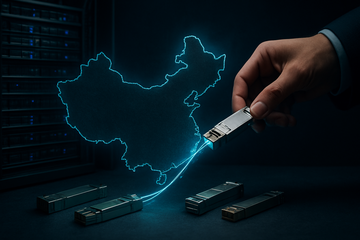
Bill introduced
Sep 25, 2026
Securing National Security Systems from Chinese Optical Transceivers Act
Named Chinese vendors
InnoLight + Eoptolink
Commerce/War Secretaries may add more
Compliance phase-in
5 years
Renewable, Congress-reported waivers if no trusted alternative
InnoLight Q1 2026 revenue
$2.9B (+192% YoY)
46% gross margin; >90% of revenue from outside China
InnoLight US revenue share
61.7%
Q1 2026, per HK listing prospectus
Chinese share of global optics
~70%
Per Coalition for a Prosperous America, May 2026
Lumentum Q4 FY26 revenue
$1.006B (+109% YoY)
10-Q filed Aug 17, 2026
Coherent datacenter Q4 FY26
$1.62B (+58.6% YoY)
10-K filed Aug 14, 2026; 79% of total
The Bill: A Procurement Statute, Not an Export Control
Senators Dave McCormick (R-PA), Ruben Gallego (D-AZ), John Cornyn (R-TX) and John Fetterman (D-PA) introduced the Securing National Security Systems from Chinese Optical Transceivers Act on September 25, 2026. The bill extends the federal procurement restriction already used against Chinese semiconductors to a narrower but more specific target: optical transceivers — the pluggable modules that convert electrical signals to light pulses inside AI data-center switches and servers.
Zhongji Innolight and Eoptolink are the two companies named in the bill text, alongside any subsidiaries or affiliates. The Secretaries of Commerce and Defense get standing authority to add additional adversary-linked firms to the covered list, and the bill directs Commerce to map US and allied production capacity and write a strategy to rebuild a trusted optical-transceiver supply chain. Federal agencies have a five-year window to comply; waivers are renewable only when no trusted alternative exists, and every waiver must be reported to Congress.
The Compliance Split: Incumbents vs. the US Reshore
The two-sided trade is the clearest fact in the bill. On one side sit Chinese vendors who already dominate merchant supply: Counterpoint Research puts Zhongji Innolight at roughly 27% of the global data-center transceiver market by revenue, Eoptolink growing even faster, and a third — Accelink Technologies — ranked among the top five worldwide. Together with a handful of smaller Chinese peers, they control around 70% of global optical module shipments according to a Coalition for a Prosperous America report.
On the other side, Coherent holds about 17% of transceiver revenue and Lumentum roughly 6% of finished modules, per the same Counterpoint estimate. The procurement signal has already moved US multiples: on the August 4 Reuters report that the FCC was drafting a separate import ban, Lumentum rose 7%, Coherent jumped 11%, and Applied Optoelectronics rallied 18% in a single session.
| Company | Listing | Approx. global share | Most recent revenue | Most recent growth |
|---|---|---|---|---|
| Zhongji Innolight | 3308.HK / 300308.SZ | ~27% | RMB 19.5B (Q1 2026) | +192% YoY |
| Coherent | COHR | ~17% | $1.62B datacomm (Q4 FY26) | +58.6% YoY |
| Accelink Technologies | 002281.SZ | top 5 | ¥11.93B (FY25) | +44.2% YoY |
| Lumentum | LITE | ~6% finished | $1.006B (Q4 FY26) | +109% YoY |
| Eoptolink | 300502.SZ | top 5 | ¥24.84B (FY25) | +187% YoY |
| Applied Optoelectronics | AAOI | <2% | $192M (Q2 FY26) | +86% YoY |
Supply-Chain Map: From Chip to Switch to Federal Rack
Optical transceivers are the bridge layer of the AI buildout. A modern GPU cluster from NVIDIA needs thousands of them per rack — Innolight has been shipping into more than half of NVIDIA's 800G optical module demand. The modules then plug into switches and servers assembled by Dell Technologies, Hewlett Packard Enterprise and Super Micro Computer and finally land in racks operated by hyperscalers and federal agencies.
Upstream chip exposure: Broadcom is the dominant US supplier of the switch ASICs that consume transceivers, and NVIDIA's networking business uses optics aggressively in its NVLink and InfiniBand platforms. Midstream, server OEMs turn the optical modules into revenue per rack — the procurement law does not directly touch OEM revenue, but it does force every federal bid to disclose transceiver provenance. Downstream, the hyperscalers (Alphabet, Amazon, Meta Platforms) account for the bulk of Innolight's overseas sales — Alphabet alone was 22% of Innolight's revenue in Q1 2026, per the HK listing prospectus.
InnoLight Q1 2026 revenue mix — where the US exposure sits
Per HK listing prospectus; Q1 2026 was the period disclosed in the HKEX filing, July 2026.
Unit: % of revenue
Alphabet
% of revenue
22
Amazon
% of revenue
11
Meta
% of revenue
6.4
All other outside China
% of revenue
51.3
Mainland China
% of revenue
9.3
The 5-Year Phase-In: How Much of Innolight Is Actually at Risk
The headline number — Innolight gets 61.7% of revenue from the United States in Q1 2026 — overstates the immediate hit. Federal national-security systems are a sliver of total US optical-module demand; the bulk sits with hyperscalers running commercial AI clouds. The bill's value to investors is therefore less the immediate revenue loss and more the precedent it sets: a five-year procurement clock that runs alongside a parallel FCC draft rule, plus standing authority for Commerce and Defense to keep adding names.
Earnings durability still matters. Innolight posted RMB 5.7B (~$850M) of net profit on RMB 19.5B of revenue in Q1 2026 — a 46% gross margin that is a company record. Eoptolink printed ¥24.84B of 2025 revenue with net profit up 236%, riding800G and 1.6T mix. The five-year window is long enough that a US reshoring push — Lumentum, Coherent and Applied Optoelectronics are already expanding indium-phosphide and laser capacity — could materially compress that margin once alternative supply is qualified.
The Federal Anchor: Server OEMs Already Positioning for It
The procurement law does not directly regulate server OEMs, but it reshapes how they bid. Federal customers will pay a premium for documented, US-assembled, non-Chinese-optics configurations — exactly the wedge Super Micro Computer opened with its October 29, 2025 creation of Super Micro Federal LLC, a US-domiciled entity that manufactures and validates full data-center IT stacks out of its Silicon Valley facilities for federal customers.
Dell Technologies and Hewlett Packard Enterprise have similar exposure to the same procurement calculus. Dell reported $46.97B of revenue in its fiscal Q2 2027 (ended July 31, 2026) — its largest quarter ever — while HPE posted $12.21B in fiscal Q3 2026 (ended July 31, 2026), with operating margin recovery. The differentiated upside comes from owning a transceiver-bill-of-materials that maps cleanly to non-covered suppliers: Lumentum and Coherent qualified optics already in HPE and Dell platforms gain a procurement advantage versus a Super Micro build that still uses Innolight or Eoptolink modules in non-federal SKUs.
Outlook: Two Clocks, One Market
Two regulatory clocks now run in parallel. The Senate bill phases federal procurement over five years; the FCC draft, if published, would ban imports of new Chinese optical transceiver models immediately upon publication. Either way, the reshoring math is already showing up in capex: Lumentum is doubling indium-phosphide wafer capacity, Coherent is guiding fiscal Q1 2027 revenue up to $2.4B with datacenter and communications at 79% of Q4 FY26 mix, and Applied Optoelectronics is rebuilding engineering around 800G.
The investable split is sharp: Coherent and Lumentum are the direct reshoring beneficiaries with multi-quarter order books already visible in their FY26 results; Super Micro Computer holds a structural advantage in federal bidding; Dell Technologies and HPE capture the procurement premium through supply-chain documentation rather than hardware exclusivity. On the other side, Innolight and Eoptolink still own the technology curve on 800G and 1.6T but face a five-year federal demand fade and a parallel FCC import freeze that will reshape US commercial buying behavior well before the statutory deadline.
Investable names across the optics and federal-server stack
- Datacenter and communications revenue climbed 58.6% YoY to $1.62B in Q4 FY26, and Q1 FY27 guidance points to $2.4B — direct reshoring demand fills the gap as Chinese supply is phased out.
- Federal procurement premium accrues to whichever OEM carries Coherent-qualified optics, and Coherent's17% global share gives it the scale to absorb share-shift from the ~27% held by Innolight.
- Stock moved +11% on the August 4 FCC draft report, and the underlying order book is locked into 2028 — multi-quarter visibility well beyond the 5-year bill phase-in.
- Q4 FY26 revenue of $1.006B was up 109% YoY on cloud-transceiver and laser-chip demand — capacity additions in indium-phosphide directly target the federal and hyperscaler replacement pool.
- Counterpoint puts Lumentum at only ~6% of finished-module share today, leaving the largest absolute upside if Chinese supply is forced out of US federal and Tier-1 hyperscaler designs.
- Stock up roughly 900% over the trailing year through August 2026; the FCC import-ban draft delivered a7% single-day pop, signaling how sensitive the tape is to incremental supply-restriction news.
- Q2 FY26 revenue of $192M (+86% YoY) shows the 800G ramp is real, but the company is still loss-making on a TTM basis — execution risk if Chinese alternatives remain in commercial accounts.
- Stock jumped +18% on the August 4 FCC draft, the largest one-day move of the three US peers, because AAOI has the most torque per incremental disqualification of Innolight and Eoptolink.
- Long-shot alternative with capacity questions — the 1–3 year thesis depends on whether AAOI can win a hyperscaler slot before Coherent and Lumentum absorb the displacement.
- Q1 2026 revenue of RMB 19.5B grew192% YoY and net profit hit RMB 5.7B on a 46% gross margin, but 61.7% of revenue came from the United States — the addressable market that the bill and the FCC draft both target.
- The5-year phase-in is generous but conditional: waivers require no-trusted-alternative certification, and Commerce has a statutory deadline to publish a reshoring strategy.
- Even with35–40% of the800G module market and 50–70% of the emerging 1.6T segment, a federal-exclusion overlay plus rising Lumentum/Coherent capacity point to US share losses beginning in days-to-quarters even as commercial demand holds.
- Super Micro Federal LLC, established October 29, 2025, manufactures and validates full data-center IT stacks from Silicon Valley for federal customers — the bill codifies a procurement pattern SMCI already built around.
- FY26 TTM revenue of $39.06B and the federal entity give SMCI a structural advantage in any bid that demands documented, non-Chinese transceiver provenance.
- Watch the Taiwan indictment overhang from August 24, 2026: nine people, including two SMCI Taiwan employees, were charged with illegally routing 74 AI servers to China — the legal drag is the main near-term risk to the federal-entity thesis.
- Fiscal Q2 2027 revenue of $46.97B (ended July 31, 2026) is the largest quarter in company history and gives Dell the scale to absorb a federal procurement overlay without margin shock.
- The differentiator is documentation: federal buyers will favor Dell configurations that map cleanly to Lumentum and Coherent qualified optics rather than generic SKUs.
- Watch the next federal datacenter refresh cycle as the first observable data point on whether the procurement premium accrues to Dell versus HPE.
- Fiscal Q3 2026 revenue of $12.21B (ended July 31, 2026) and the January 2025 $1B X (Twitter) AI-server win show HPE is competitive on hyperscaler-style deals, but federal exposure is more dependent on procurement-premium capture than on raw share.
- Operating margin recovery from a loss-making FY25 makes HPE a leverage play on federal and regulated-industry server refreshes tied to the optics provenance requirement.
- Main near-term risk: an FCC import ban could push HPE's transceiver cost up before Coherent and Lumentum capacity fully qualifies, squeezing mix before the reshoring thesis flows through.
- FY25 revenue of ¥11.93B (+44.2% YoY) places Accelink in the global top five, but it sits in the same adversary-linked bucket as Innolight and Eoptolink — the bill gives Commerce and Defense authority to add it to the covered list.
- Even without a formal designation, US hyperscalers will pressure-test Accelink supply against the FCC draft, compressing US-bound orders well before the 5-year federal deadline.
- Domestic Chinese demand (Accelink sells to domestic cloud and telecom) cushions the downside relative to Innolight's US-skewed mix.