
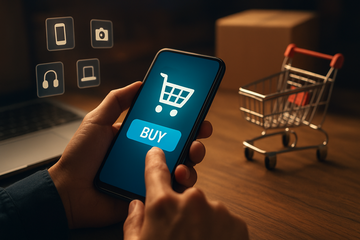
On September 26, 2026, Alphabet began testing a Buy button on a small set of Walmart-owned Flipkart listings inside Gemini and Google Search's AI Mode in India, with checkout routing through Flipkart without leaving the AI surface. The early product set is narrow — smartphones, electronics, mobile accessories — but a wider rollout is planned for late October, landing days before Flipkart's flagship Big Billion Days sale opens on October 9. The rails underneath that single button, Alphabet's Universal Commerce Protocol co-developed with Shopify, Walmart, Target, Best Buy and the Flipkart catalogue, are what makes the test consequential: India becomes the first market outside the U.S. where an agent, not a webpage, completes a purchase.
Flipkart's share of India's e-commerce GMV
~50–60%
vs. Amazon India contracting 1–6% YoY in MAU, July 2026
India festive e-commerce GMV (2025)
₹1.15 lakh crore
projected to cross ₹1.2 lakh crore in Oct–Nov 2026
PhonePe + Google Pay share of UPI
~78%
PhonePe 45.9% + Google Pay 32.3%, August 2026 NPCI
Walmart Q2 FY27 global e-commerce growth
+23%
Q2 FY27 earnings, Aug 20, 2026; India named as a driver of eCommerce economics
Flipkart Big Billion Days 2026 start
Oct 9, 2026
early access for Plus/VIP members Oct 8
From Ads to Actual Checkouts: What Alphabet Just Switched On
What is being tested is small in product count and large in plumbing. When an Indian shopper uses Gemini or AI Mode to research a phone or a pair of earbuds, a subset of Walmart-owned Flipkart listings now surfaces a Buy button; tapping it opens the Flipkart checkout flow inline, with the retailer remaining the seller of record. The original Walmart-Alphabet partnership was announced at the NRF Big Show on January 11, 2026, with U.S. launch first and international rollout \"thereafter\"; this India test is the first international deployment, and it sits on the Universal Commerce Protocol (Shopify and Alphabet co-developed) that defines how agents, retailers and payment providers exchange cart, identity and payment data.
Three Models of AI Commerce, Three Different Bets
| Player | Surface in India | Money motion | Open vs. walled garden |
|---|---|---|---|
| Alphabet × Flipkart (UCP) | Gemini + AI Mode; inline checkout | Takerate on GMV routed through Buy button | Open protocol, retailer remains seller of record |
| Amazon (Alexa for Shopping, ex-Rufus) | Amazon.in app and site; in-storefront assistant | Reinforces Amazon's own catalog and ad business | Walled garden; only Amazon-sold inventory |
| OpenAI (ChatGPT Ads India) | ChatGPT free/Go tiers | Sponsored answers, no checkout integration | Walled garden; advertisers bid into conversations |
| Reliance JioMart (private) | jiomart.com + quick-commerce dark stores | Own retail + ads on Jio platforms | Walled garden; only Reliance inventory |
The structural difference is whether the AI surface owns the transaction or just the attention. Amazon's Alexa for Shopping keeps the buy inside Amazon's own app and own catalog; OpenAI's India ads monetize intent inside the chat with sponsored placements. Alphabet's UCP path is the third model: Gemini surfaces the product, but the merchant — Flipkart, Target, Best Buy, Macy's — closes the sale, with Google Pay likely handling the credential and the wallet. For investors, the distinction matters because checkout economics (take rate, payment float, ad placement on the Buy surface) accrue to the protocol owner, not just the model owner.
- UCP was co-developed with Shopify, Walmart, Target, Best Buy and Etsy and is endorsed by Adyen, Mastercard, Visa, Stripe and PayPal, giving the protocol a default-in merchant and payments stack from day one.
- Amazon's AMZN Alexa+ shopping assistant launched on May 13, 2026 and is limited to Amazon-sold inventory; OpenAI's India ads went live on August 27, 2026 for Free and Go tiers but does not process checkout.
- Reliance Industries operates JioMart across roughly 3,100 stores and 1.6 million daily orders, but has no public agentic-commerce partnership as of September 2026.
- One 97 Communications (Paytm) sits at ~8% UPI share — exposed if Alphabet Pay absorbs Flipkart checkout volumes, but a beneficiary if it wins MDR revenue on merchant flows above ₹2,000 starting October 15, 2026.
Why India Is the Right Lab, and Why Now
Three structural features make India the cleanest live test bed for agentic checkout. First, the rails: UPI processed a record 24.51 billion transactions in August 2026, and the top two apps — PhonePe (Walmart's 71.77%-owned payments arm) and Google Pay — together settle around 78% of value, giving Gemini a default payment credential no other country can match. Second, the inventory: Flipkart's catalogue covers the high-intent, high-AOV categories (smartphones, electronics) that the test starts with, and Flipkart alone is estimated at ~50–60% of India's e-commerce GMV while Amazon's India MAU base contracted 1–6% year over year in July 2026. Third, the timing: India's festive trade reached a record ₹6.05 lakh crore in 2025, with e-commerce alone at ₹1.15 lakh crore, and Flipkart's Big Billion Days 2026 sale opens on October 9 — two weeks after the agentic checkout test begins.
India UPI transaction volume share, August 2026
Two of the three UPI apps that settle most Indian digital payments sit inside the Google–Walmart orbit
Unit: % of UPI transactions
PhonePe (Walmart 71.77%)
45.9%
Google Pay (Alphabet)
32.3%
Paytm (PAYTM.NS)
8.1%
Navi + Super.money + others
13.7%
The Supply Chain Behind a Single Buy Button
Every agentic purchase touches four layers: the model, the protocol, the retailer, and the payment. The model is Gemini; the protocol is UCP; the retailer is Flipkart on top of Google Cloud (migrated fully in 2023); and the payment is routed through Google Pay with the merchant's instruments standing behind. The endorsements list on UCP — Adyen, Mastercard, Visa, Stripe and PayPal — means a Flipkart Buy button today is structurally no different from a Target or Macy's Buy button tomorrow, which is what makes the protocol rather than the model the load-bearing asset.
- Upstream — infrastructure: Alphabet Cloud hosts Flipkart's data platform and now provides the inference and protocol layer for the Buy button, putting compute, storage and agent runtime on the same balance sheet.
- Upstream — payments rails: Visa, Mastercard, Adyen and PayPal endorsed UCP from launch and are positioned to clear the agentic transactions, taking a thin per-transaction layer of India's payment volume.
- Downstream — merchant: Flipkart is the launch partner; subsequent adds (Target, Best Buy, Macy's, Etsy, Wayfair) turn UCP into a multi-retailer surface and dilute Flipkart's exclusivity by mid-2027.
- Downstream — consumer: India's price-sensitive festive shopper is the demand sink — 90 million carts in last year's festive season — and the test starts with the categories where intent-to-purchase is highest (smartphones, electronics).
Where the Money Actually Lands
The investment-relevant question is who captures the take rate on each agentic Flipkart transaction. Two layers monetize: Alphabet on the Buy-button surface (ads, sponsored placement, payment routing) and Walmart on the underlying retail margin. The richer the agentic AI action, the more the share migrates upstream — which is why Alphabet's $4.14 trillion market cap and 15.2% R&D-to-revenue ratio in Q2 2026 are being repriced against an open-protocol narrative rather than a chatbot narrative. For Shopify, the co-developer role turns its merchant base into a default-on UCP endpoint and underwrites the agentic-commerce narrative that helped the stock reach a Q4 FY25 enterprise value of $207.7 billion.
| Ticker | Linkage | Direction | Why it matters now |
|---|---|---|---|
| GOOGL | Protocol owner + payment wallet + cloud | Bullish | 78% of India's UPI sits inside its checkout surface; UCP turns search ads into a commerce take rate |
| WMT | Flipkart + PhonePe parent | Bullish | India named as a driver of eCommerce economics improvement in Q2 FY27 earnings, Aug 20, 2026 |
| SHOP | UCP co-developer | Bullish | Spring '26 Edition made Agentic Storefronts default for eligible U.S. merchants, June 17, 2026 |
| AMZN | Amazon.in rival | Bearish | India MAU contracted 1–6% YoY in July 2026; agentic threat comes from outside the wall |
| RELIANCE.NS | JioMart competitor | Mixed | 3,100 stores + quick-commerce scale are defensive moats; no public agentic-commerce deal yet |
| PAYTM.NS | UPI alternative | Mixed | 0.4% MDR on UPI >₹2,000 from Oct 15, 2026 lifts merchant take rate but Flipkart volume flows to PhonePe |
| V / MA / ADYEN.AS | UCP-endorsed payment networks | Watch | Settlement layer takes a thin slice only if agentic volume scales past festival |
Horizons: The 30-Day Setup vs. the Three-Year Reordering
Over the next 30–90 days, the catalyst is festive-season GMV. With Flipkart's Big Billion Days opening October 9 and Walmart's Q2 FY27 earnings (Aug 20, 2026) already calling out India as a driver of eCommerce economics, the test gives analysts a measurable handle on how much incremental take rate a Buy button can generate in the highest-volume retail window of the year. Watch the late-October broader rollout as the second checkpoint, and PhonePe's mid-2026 India IPO (targeting up to $10.5 billion valuation, per the January22, 2026 DRHP) as the funding event that prices the agentic-flywheel thesis in public markets.
Over one to three years, the structural question is whether UCP becomes the HTTP of agentic commerce or whether walled gardens reassert. If Amazon responds with a public agentic API and Reliance Industries bundles JioMart into a Jio AI agent, the protocol loses its first-mover edge; if the Buy button simply becomes the default path on every Gemini surface, Alphabet re-rates from a search-ad company to a commerce take-rate company. The biggest risk is regulatory: India's Competition Commission has already flagged UCP's potential to shape user behavior, and an open-protocol story only works if the rails stay open.
Investable takeaways from the India agentic-commerce test
- UCP turns Gemini from a chat surface into a commerce take rate: India test gives the protocol its first international GMV dataset ahead of Diwali.
- Google Pay's 32.3% UPI share plus PhonePe's 45.9% (both in the Alphabet-Walmart orbit) pull roughly 78% of India's payment volume into the same checkout layer as the Buy button.
- Near-term catalyst: late-October broader rollout before Big Billion Days (Oct 9, 2026); long-term, the flip from search-ads revenue to commerce-protocol revenue.
- Q2 FY27 earnings (Aug 20, 2026) called out India as a driver of eCommerce economics improvements; the Buy button extends that lead into the festive quarter.
- Flipkart's ~50–60% India e-commerce share plus PhonePe's 71.77% stake make Walmart the only listed US retailer with both the catalogue and the payment rail for agentic checkout at scale.
- Long-term: as UCP opens to Target, Best Buy and Macy's, Flipkart's exclusivity erodes but Walmart's protocol ownership remains intact.
- Co-developer of UCP turns Shopify's merchant base into a default-on agentic endpoint; Spring '26 Edition made Agentic Storefronts default for eligible U.S. merchants on June 17, 2026.
- Listed but pure-play exposure to agentic-commerce narrative: if UCP becomes the HTTP of AI shopping, SHOP's $185B market cap rerates on protocol leverage, not retail margin.
- Watch Q3 FY26 earnings for explicit UCP GMV disclosure; first read on whether agentic volume is incremental or cannibalistic to existing Shopify checkout.
- India MAU contracted 1–6% YoY in July 2026 (Bernstein); agentic checkout outside Amazon's wall accelerates the share loss to Flipkart during Big Billion Days.
- Alexa for Shopping (ex-Rufus, rebranded May 13, 2026) is walled-garden-only; competing with UCP requires Amazon to open its catalog to third-party agents, which dilutes its ad moat.
- Long-term risk: if UCP becomes the default agentic surface, Amazon's $2.69T market cap rerates against a slower-growing retail take rate even as AWS and ads hold.
- JioMart's 3,100-store quick-commerce footprint is a defensive moat, but no public agentic-commerce partnership leaves Reliance exposed to being routed around during festive season.
- Counter-position is real: a Jio AI agent that bundles JioMart, JioMart-grocery and Jio cinema into a single conversational checkout could match UCP inside the Jio ecosystem.
- Watch RIL AGM 2027 commentary for any UCP-equivalent partnership; absent one, festive-season share losses crystallize in the next two quarters.
- 0.4% MDR on UPI transactions above ₹2,000 starting Oct 15, 2026 lifted Paytm to a 52-week high, but Flipkart checkout volumes will flow to PhonePe, not Paytm.
- Agentic commerce structurally favors wallets with retailer integrations (PhonePe inside Flipkart, Google Pay inside AI Mode); Paytm's path is to be the merchant-side checkout for small sellers.
- Near-term: stock is up ~7% post-MDR announcement (Sep 16, 2026); long-term risk is being a payment back-end rather than a commerce front-end.
- UCP endorsement (Jan 11, 2026) keeps Visa on the settlement layer for agentic transactions; upside is contingent on Flipkart card-not-present volume scaling after Diwali.
- In India specifically, UPI volumes are 78% PhonePe + Google Pay, so Visa's incremental take rate is a rounding error unless agentic checkout expands to cross-border high-value goods.
- Catalyst date: Walmart Q3 FY27 (Nov 2026) and any Q4 disclosure on Flipkart GMV routed through non-UPI rails.