
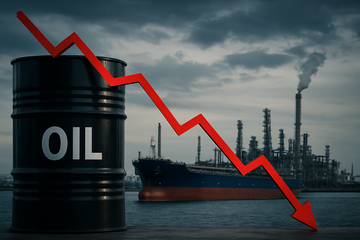
Brent crude on Sept 26 (Trump rejection day)
$97.44/bbl
Down 2.77% on the day; vs. $103.08 settle on Sept 23 after Iran's 'never surrender' comments
EIA Brent forecast, 2H26 average
$90/bbl
vs. $74 in 2027 and $67 in 2H27 in the Sept 9 STEO, on assumption of 5.7M b/d of Middle East shut-ins through 4Q26
VLCC rate, Persian Gulf to Asia
$1.03M–$1.27M/day
Roughly 8–10x the pre-war $132K/day; Baltic Exchange TD3C Ras Tanura–Ningbo basis
Hormuz crude flow, week of Sept 20
33.7M bbl (~4.8M b/d)
Down 31% week-on-week from 49.2M bbl; vs. ~20M b/d pre-crisis normal
Marathon Petroleum Q2 R&M margin
$36.33/bbl
vs. $17.58/bbl a year earlier; net income $5.14B on $52B of revenue
The Offer Was Concrete. The Rejection Was the Easy Plan.
Iran's foreign minister Abbas Araghchi laid a specific seven-day plan at the UN General Assembly on Friday Sept 25: reopen the Strait of Hormuz to commercial traffic and restart nuclear talks within a week if the US lifts its naval blockade of Iranian ports, releases frozen Iranian funds, and waives sanctions on Iranian crude sales. Araghchi said mediators could deliver the lift in four or five days, with final talks by day seven. Trump rejected it on Saturday Sept 26, telling reporters \"I'd like to make a deal, too. But that deal would not be acceptable,\" and claiming Iran wanted the corridor reopened because \"they are losing so badly.\"
Brent Fell on the Rejection. That Itself Is the Story.
Front-month Brent settled at $97.44 on Sept 26, down 2.77% on the day and well below the $103.08 settle on Sept 23 that followed Iran's \"never surrender\" comments. The drop tells you the deal was never really in the price. Traders had already concluded Iran's terms were unworkable, so a public rejection only confirmed a status quo that was trading at a war premium, not at a peace premium. The same logic explains why the curve is in deep backwardation through 2027 — every backwardated month is a market saying the disruption is going to take time to heal.
- ICE Brent Nov'26 contract at $104.38 vs. Jan'27 at $94.01 vs. Feb'27 at $91.76 (ICE settle Sept 25 evening), a $12+ backwardation that prices years of supply tightness
- EIA STEO (Sept 9) still expects 5.7M b/d of Middle East shut-ins across 4Q26, only marginally below the 6.7M b/d seen in August
- WTI settled Sept 23 at $92.16, with Brent-WTI spread near $11/bbl — the gap that Gulf refiners monetize
Upstream: Gulf Refiners Are Printing the Largest Crack Spreads of the Cycle
The rejection keeps the structural setup that has made US Gulf Coast refiners the single biggest winner of the war. With Brent holding at $90+ and a wide transatlantic spread to WTI, Marathon Petroleum, Valero, and Phillips 66 all reported Q2 refining-and-marketing margins roughly double their year-ago levels. Marathon's R&M margin reached $36.33/bbl in Q2 2026, up from $17.58 a year earlier, with management capturing 108% of the 3-2-1 crack and more than $1 billion of incremental margin capture in a single quarter.
| Refiner | Q2 2026 revenue | Q2 2026 net income | YoY net income change | Trailing P/E |
|---|---|---|---|---|
| Marathon Petroleum | $52.0B | $5.14B | Multi-fold expansion | 13.6x |
| Valero | $36.6B | $3.72B | $714M → $3.72B (~5.2x) | 16.2x |
| Phillips 66 | $51.0B | $3.85B | $207M (Q1) → $3.85B | 14.6x |
Refining-and-marketing margin, Q2 2026 vs. Q2 2025
Crack spreads roughly doubled year-over-year at all three Gulf independents, with Marathon's R&M margin reaching $36.33/bbl.
Unit: USD per barrel
Marathon Q2 2025
17.6
Marathon Q2 2026
36.3
Valero Q2 2026
approx., vs. ~$15 prior year
32.5
Phillips 66 Q2 2026
approx., vs. ~$13 prior year
28.4
The structural feature: Gulf Coast refiners run on heavy Maya and WTI-sourced sour crudes that are not stuck in the Gulf, while their product realizations track Brent-linked global gasoline and diesel prices. Every week the Hormuz disruption continues widens that wedge. Marathon's Q12026 net income was just $511M — by Q2 it was $5.14B, a 10x sequential jump on essentially the same physical asset base.
Midstream: Tankers Are Charging More per Day Than Their Hulls Cost to Build
VLCC spot rates on the Persian Gulf-to-Asia benchmark TD3C route touched $1.035M per day in mid-September and have since pushed toward $1.27M per day, per Baltic Exchange data and the Lloyd's List VLCC index. That is roughly eight to ten times the $132K/day pre-war average, and the rates now exceed the cost of building a new VLCC in a single year of operation. The pricing power reflects a forced longer-haul trade: with most Gulf crude moving through dark-fleet shuttle operations rather than the strait, effective fleet capacity is functionally smaller, and war-risk insurance premiums of ~1% of hull value per transit push more standard tonnage out of the route.
| Operator | TTM net margin | Trailing P/E | Dividend yield |
|---|---|---|---|
| Frontline | 54.8% | 7.2x | 11.3% |
| International Seaways | 61.9% | 6.8x | 0.5% (variable) |
| DHT Holdings | 65.5% | 7.4x | 22.4% |
| Teekay Tankers | 51.3% | 5.5x | 1.1% |
Iran Has Already Lost Its Crude. The Blockade Is Working.
For the first time on record, Iran has now gone roughly seven consecutive weeks without shipping meaningful crude exports through Hormuz, per Reuters' tanker tracking. That is the precondition that makes Iran's offer interesting and Trump's rejection consequential: Tehran is offering to concede something it can no longer unilaterally give away, because the US naval blockade has already done the work that sanctions alone never managed. Hormuz transits are running at less than a third of the pre-war ~20M b/d average — the week of Sept 20 saw only 33.7 million barrels ship out, down 31% week-on-week from 49.2M bbl the week before.
- Kpler data shows 19 tankers (17 VLCCs) moved through the strait during the Sept 20 week — a far cry from the 30+ daily transits typical of peacetime
- Iran's June2026 oil export value was estimated at ~$4.51B before the blockade tightened; by early September, effective exports through Hormuz had collapsed to near zero
- Saudi Arabia's Petroline east-west pipeline can move up to ~7M bbl/day to Yanbu on the Red Sea, but the Yanbu port itself only loads ~4.5M bbl/day — capping the structural bypass at roughly two-thirds of the ~7M bbl that would normally exit Hormuz from Saudi alone
The Two Horizons: How the Trade Ages
Short-term (days to a quarter): Brent is caught between EIA's $90 average forecast for 2H26 and the spot price near $97. The next leg higher needs either a verifiable tanker incident or a Trump signal that the post-midterm bombing is on. The next leg lower needs either a genuine counter-offer from Tehran or visible Saudi/UAE crude arriving at Yanbu and Fujairah in volume. Refining margins and tanker rates are both sticky in either direction because they respond to relative spreads, not to the absolute Brent level.
Long-term (one to three years): The structural bypass is being built. The UAE is fast-tracking a West-East pipeline expansion to 3.6M b/d by mid-2027; Saudi Arabia's Petroline is at ~7M b/d capacity but bottlenecked at Yanbu. If those projects complete on schedule, the long-run Hormuz risk premium compresses — but the next twelve months are still a tanker owner's market, with Frontline's fleet of 41 VLCCs and DHT Holdings's 22-VLCC pure-play printing through the disruption. Integrated majors like ExxonMobil and Chevron carry less of this trade because their global barrels price off a Brent strip that EIA forecasts will average $74 in 2027 and $67 in 2H27 once shut-ins unwind.
Investable names
- Q2 2026 R&M margin of $36.33/bbl — more than 2x the prior-year $17.58 — extends as long as the Brent-WTI spread holds and Hormuz remains disrupted
- A no-deal outcome keeps the war premium intact into Q4, which is the EIA's forecast window for 5.7M b/d of Middle East shut-ins
- Risk: a Hormuz reopening would compress the transatlantic spread and pull the R&M margin back toward the low-$20s within a quarter
- Q2 2026 net income of $3.72B vs. $714M a year earlier — roughly 5x — shows operating leverage to crack spreads
- Valero's diversified Gulf Coast, Mid-Continent, and Caribbean footprint monetizes the spread on every barrel
- Trailing P/E of 16.2x already reflects margin expansion; a deal-driven peace would clip 2027 EPS by an estimated 30-40%
- Q2 2026 net income of $3.85B vs. $207M in Q1 — a 19x sequential jump on the same refining capacity
- Refining segment lifted 2026 adjusted results by ~300% year-over-year through August, per company commentary
- The integrated Midstream and Chemicals segments provide a floor if refining margins normalize faster than the market is pricing
- TD3C VLCC spot rates at $1.03M-$1.27M/day, vs. $132K pre-war — operating leverage is essentially unbounded while Hormuz is disrupted
- Q2 2026 net income of $659M on $943M of revenue; declared a special one-time dividend in September after asset sales
- Trailing P/E of 7.2x and dividend yield above 11% signal the market is still pricing some mean reversion in rates
- TTM net margin of 61.9% on a fleet of 83 vessels spanning VLCCs, Suezmaxes, Aframaxes, and LR2s
- Trailing P/E of 6.8x is the lowest among the US-listed tanker names despite the broadest product exposure
- Variable dividend policy (declared $0.48/share in Q2) means cash flow is returned to shareholders rather than reinvested
- Pure-play22-VLCC operator; TTM net margin of 65.5% is the highest in the group with no product-tanker offset
- Dividend yield of 22.4% on the TTM basis reflects an aggressive payout policy that scales directly with VLCC rates
- Single-asset concentration means a Hormuz reopening would compress earnings faster than diversified operators
- Upstream realizations benefit from the Brent strip near $97 in the near term but face the EIA's $67/bbl 2H27 forecast
- Permian and Guyana barrels hedge US producers against the eventual reversion
- Net debt-to-EBITDA and dividend yield make this a defensive energy holding rather than a war-premium vehicle
- Tight oil from the Permian Basin gives Chevron a domestic-cash-flow cushion if global Brent mean-reverts per the EIA's2027 forecast
- Refining exposure is smaller than the independents, limiting the upside from crack-spread expansion
- Stock has historically traded as a Brent-pricing proxy; the rejection extends the bull case by a quarter but not by a year