
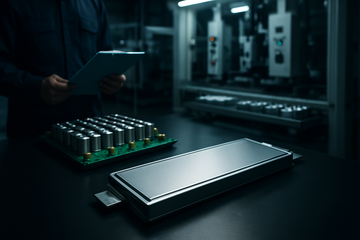
On the morning of September 28, 2026, Amprius Technologies told investors the U.S. Department of War had awarded it a grant of up to $75 million under the Industrial Base Analysis and Sustainment (IBAS) program. The money retrofits an existing U.S. electric-vehicle battery production line — operated by a still-unnamed major South Korean battery partner — into a domestic source of high-energy-density SiCore cells for small and mid-sized military drones, with completion targeted for early 2028 and a stated capacity of 12 million cells per year. The conversion costs roughly $100 million, including in-kind investment from the Korean partner. Payments are milestone-based and depend on future appropriations.
Award (ceiling)
$75M
U.S. Department of War IBAS grant, announced Sep 28, 2026
Project cost
~$100M
Includes in-kind from Amprius and the South Korean partner
Annual cell capacity
12M
Pouch cells, NDAA-compliant, target completion early 2028
Q2 2026 revenue
$34.0M
+126% YoY; GAAP gross margin 27%, per Q2 2026 earnings release
2026 guidance (raised)
≥$140M revenue
Gross margin ≥28%, net loss <$10M, per Q2 2026 release
The grant
A Conditional $75M, a Converted EV Line, and a Cell Bottleneck the Pentagon Is Racing to Close
The grant is not a procurement contract. It is a capacity-building award under DoW's IBAS program — designed to seed domestic manufacturing for defense supply chains that the U.S. government deems too concentrated abroad. Amprius's share is a retrofit of an existing domestic EV battery production line run by a major South Korean battery manufacturer (a member of the Amprius Korea Battery Alliance the company launched in November 2025). The Korean partner's identity is not disclosed in the press release or the 2025 10-K, but the economics are clear: Amprius contributes its silicon-anode cell technology and process know-how; the partner contributes plant, equipment and roughly one-quarter of the conversion cost in kind. At full output in early 2028 the line is sized for 12 million Amprius SiCore cells per year — primarily pouch format — destined for Group 1, 2 and 3 unmanned aircraft systems.
Why a drone battery line matters strategically: the Pentagon's April 2026 FY2027 budget request earmarked $75 billion for drones and counter-drone systems, including $54.6 billion routed through the Defense Autonomous Working Group. The dollar scale is the demand pull. The supply side is the squeeze — and Amprius's grant is one of the first explicit U.S. government moves to fund the cell layer of that supply chain rather than the airframe.
The policy driver
Section 842 of the FY2026 NDAA Sets a January 2028 Deadline — and a Chinese-Free Floor
The grant is the response to a regulatory cliff. Section 842 of the FY2026 NDAA restricts DoD procurement of advanced batteries and cells owned by, sourced from, refined in, or produced by a Foreign Entity of Concern — defined to cover China, Russia, Iran and North Korea. The prohibition applies at both cell and component level (cathode, anode, separator, electrolyte salts) and extends to batteries embedded in warfighting platforms. New acquisition programs must comply by January 1, 2028; standard batteries by January 1, 2029; existing programs by January 30, 2031.
- Slams the door on Chinese-material cells at exactly the moment Amprius's U.S. capacity comes online
- Exempts only batteries where >95% of costs are non-FEOC, final assembly is non-FEOC, and no FEOC-licensed technology is used
- Forces every drone prime — including AeroVironment, L3Harris and BAE Systems — to qualify an alternate domestic or allied cell supplier before2028
- Provides a narrow one-year non-availability waiver, not a permanent escape hatch
Read against that timeline, the Amprius grant's early-2028 completion date is not coincidental — it sits inside the Section 842 new-program compliance window, and it converts a regulatory risk for drone primes into a buy-American specification. That is the economic value the grant actually confers: not the cash, but the designation.
The demand side
The Customer Roster Already Runs on Amprius — the Question Is Volume, Not Validation
Amprius has spent the last three years converting drone primes from sample testers to paying customers. Its 2025 10-K names six platforms currently validated on its cells: AeroVironment, Teledyne FLIR (a Teledyne Technologies subsidiary), L3Harris, Kraus Hamdani Aerospace, BAE Systems and AALTO (an Airbus subsidiary). The Defense Innovation Unit contract, originally $14.8 million in March 2026, has been expanded three times to $18.1 million and now covers three cylindrical and four standard-sized pouch cell formats — the cell library primes will sample against.
| Program / platform | Prime | DoD contract tied to the platform |
|---|---|---|
| Switchblade 600 Block 2 (loitering munition) | AeroVironment | $186M U.S. Army delivery order (Feb 2026); $51M order (Aug 2026) |
| K1000ULE (24-hr, 1,000-mile Group 2 UAS) | Kraus Hamdani Aerospace | $270M Air Force Central Command contract |
| UAS battery family | L3Harris | — (validated on SiCore; volume TBD) |
| UAS battery family | BAE Systems | — (validated on SiCore; volume TBD) |
| Small-UAS power | Teledyne FLIR (Teledyne Technologies) | — (validated on SiCore; volume TBD) |
Customer concentration is high — one buyer drove $27.1 million of 2025 revenue, per the 10-K — and that buyer is overwhelmingly the AeroVironment Switchblade line. The $35 million repeat SiCore order Amprius booked in September 2025 (and the earlier $15 million order in February 2025) both came from a leading UAS manufacturer that the company has not formally named, but operating math ties it to the Switchblade supply chain. The risk is obvious; the offset is that AeroVironment just printed record fiscal 2026 revenue of $1.98 billion (+141% year-over-year) on the back of those Switchblade orders, with funded backlog of $1.2 billion at fiscal-year end.
The bottleneck
12 Million Cells Is Not the Capacity Story — It Is the Customer-Acquisition Budget
Mathematically, 12 million cells per year from a single domestic line is roughly the size of Amprius's full contracted manufacturing footprint in mid-2025 (the company disclosed 1.8 GWh of contract capacity in July 2025 and 2.0 GWh by year-end in its 10-K). The new IBAS line does not necessarily raise total accessible capacity; it relocates the bottleneck from cell output to customer output. The line lets Amprius ship NDAA-compliant pouch cells at a scale where it can take a multi-year sole-source position on a major drone program instead of competing for sample slots.
That is why the IBAS grant's strategic value exceeds its dollar value. Amprius's Q2 2026 GAAP gross margin reached 27%, and management raised full-year guidance to at least $140 million in revenue and at least 28% gross margin — a profile that requires factory absorption, not just cell ASPs. Without a domestic, NDAA-compliant pouch line, the company cannot underwrite long-term take-or-pay contracts with AeroVironment, L3Harris and the rest. With it, the 2028 capacity opens a multi-year sole-source bidding window that silicon-anode competitors without U.S. pouch manufacturing cannot match.
The supply chain
The South Korean Lever and the China Squeeze Behind It
The grant is vertically incomplete without its Korean partner — and Amprius has not named that partner. The company has built a multi-supplier moat around that anonymity: the Amprius Korea Battery Alliance launched in November 2025 as a consortium of Korean cell manufacturers, materials suppliers and equipment makers, then expanded in December 2025 with three additional contract manufacturers announced at a Daejeon event. Total accessible capacity through these agreements exceeds 2.0 GWh, per the 2025 10-K. The IBAS retrofit sits on top of that network.
Why Korea and not a U.S. cell partner? Three reasons visible in the 10-K. First, U.S. gigawatt-scale lithium-ion cell lines are largely owned by Korean parents — SK On's two Commerce, Georgia plants are the canonical example. Second, EV cell utilization across those U.S. Korean-owned plants has been running at roughly half capacity, per industry reporting, making idle lines available for low-cost retrofit. Third, Amprius's silicon-anode drop-in process is designed to convert existing graphite-anode lines without retooling the cathode side, which makes an idle Korean EV line the fastest path to domestic UAS cell output.
The 10-K's risk factor reads in two sentences what most coverage misses: SiCore cell production depends on materials sourced primarily from China, and on contract manufacturing partners from China and South Korea. China has already imposed export licensing on certain graphite and lithium-battery products, and has signaled restrictions on additional battery materials and equipment. Section 842 of the FY2026 NDAA does not change that fact — it imposes a U.S. government floor on what defense primes can buy, not a Chinese floor on what Amprius can source. The IBAS grant's deeper value is therefore not just the $75 million; it is the start of a multi-line, multi-partner U.S. cell network that reduces single-source dependency, one line at a time.
The valuation
126% Growth, Negative GAAP Earnings, and a $1.4 Billion Market Cap
Amprius closed at $9.75 on September 28, 2026, against a 52-week range of $7.71–$24.23. Shares outstanding stand at 146.1 million; market capitalization is $1.38 billion. TTM revenue is $109 million against a net loss of $38 million — a P/S multiple of 12.6x against still-negative GAAP earnings. The stock is up sharply year-to-date on SiCore volume but well off its 52-week high, reflecting the gap between the rate-of-change story (Q2 revenue +126% YoY) and the rate-of-profit story (Q2 net loss of $5.1 million, gross profit $9.3 million).
Amprius quarterly revenue, fiscal 2024–Q2 2026 ($M)
SiCore volume drove seven straight quarters of YoY growth; 2026 guidance implies $140M+ full year.
Unit: USD millions
Q1 2024
First SiCore ramp quarter
2.3
Q2 2024
Gross margin still negative
3.3
Q3 2024
Switchblade validation
7.9
Q4 2024
Gross margin flips positive
10.6
Q1 2025
Gross margin briefly negative
11.3
Q2 2025
Step-up quarter
15.1
Q3 2025
SiCore scaling
21.4
Q4 2025
$27.1M from one customer
25.2
Q1 2026
+153% YoY
28.5
Q2 2026
+126% YoY; 27% gross margin
34
The two valuation readings are both true and both unhelpful on their own. At12.6x trailing sales, Amprius is priced as if the SiCore volume ramp has already happened. At a $1.4 billion market cap against a defense drone TAM (the Pentagon's $75 billion FY2027 ask, even assuming a fraction routes to cell content) the same stock is priced as if none of it has. The IBAS grant does not resolve that tension; it sharpens it — the early-2028 capacity is now on the calendar, but customer commitments that would absorb 12 million cells annually are not yet on the income statement.
- Gross margin just hit 27% in Q2 — the first quarter at scale the cost story is working
- Net loss is still negative but guided under $10M for full-year 2026, with EBITDA guided to at least $4M
- Customer concentration in a single UAS buyer (37% of 2025 revenue) is the unresolved overhang on the growth story
The investor map
Who Wins the Cell Crunch — and Who Is Already Behind
The IBAS grant reframes Amprius from a silicon-anode novelty stock into a defense-industrial-base name — a category where U.S. listed peers are scarce. That scarcity is the analytical point. There are essentially four listed-equity ways to play the Section 842 cell crunch:
The first is the drone integrator — AeroVironment, L3Harris, BAE Systems and Teledyne Technologies — that wins when domestic cell supply unlocks more Switchblade-class procurement. The second is Amprius itself, which captures the sole-source cell designation. The third is the silicon-anode peer, Enovix, which has the same chemistry story but is currently concentrated in consumer-electronics customers and lacks a U.S. defense pouch line. The fourth is Solid Power, which is targeting a different chemistry (sulfide solid-state) and a different endpoint (automotive cells), and is therefore a tangential — not a direct — beneficiary.
Stocks the $75M grant touches
- Wins the Section 842 cell designation: a sole-source-eligible U.S. pouch line that no silicon-anode peer currently has
- Q2 2026 revenue +126% YoY and a raised 2026 guide (≥$140M, ≥28% GM) sit underneath the early-2028 capacity turn-on
- Customer concentration in AeroVironment's Switchblade is the near-term ceiling — upside hinges on L3Harris, BAE Systems and Teledyne Technologies converting validation to multi-year volume
- The IBAS grant insulates AeroVironment's Switchblade supply chain from the January 2028 Section 842 cliff
- Fiscal 2026 revenue of $1.98B (+141% YoY) and $1.2B funded backlog already priced in; new Amprius pouch volume unblocks incremental Switchblade 600 Block 2 deliveries
- FY2027 guidance ($2.125B–$2.225B revenue) assumes the cell bottleneck clears — the IBAS line materially de-risks that assumption
- Named in the Amprius 10-K as a validated SiCore customer — volume conversion is the binary catalyst, not the validation itself
- FY2027 DoD budget tailwinds favor L3Harris's tactical comms and UAS payloads if Section 842-compliant cells remain scarce
- No published Amprius cell volume disclosure yet — catalyst pending on next Amprius customer-mix update
- Validated on SiCore per Amprius's 10-K — same volume-conversion binary as L3Harris
- BAE Systems's larger Eurofighter and combat-vehicle mix dilutes the UAS-cell read-through; UAS is the small but fastest-growing piece
- Catalyst pending: any Amprius disclosure of BAE Systems-sourced cell volumes
- Owns Teledyne FLIR — the small-UAS thermal-imaging prime whose batteries run on SiCore
- Teledyne Technologies's broader defense electronics mix means UAS cells are a marginal contributor to revenue but a real contributor to FY2027–28 margin
- Indirect beneficiary: as Section 842 raises the bar, Teledyne Technologies's drone payloads are easier to sell alongside a U.S.-sourced cell stack
- Same silicon-anode chemistry as Amprius, but Enovix has no U.S. defense pouch line and no Section 842-compliant customer base
- Smartphone and AI-1 platform exposure is the offset — Enovix wins if commercial silicon-anode demand scales regardless of defense policy
- Long-term: if the IBAS model succeeds, Enovix becomes a defense-primer candidate for a follow-on grant — but it has not secured one
- Sulfide solid-state is the wrong chemistry for the Section 842 drone-cell category — Solid Power is a tangential peer at best
- Auto-OEM partnerships (Solid Power joint development with BMW and SK On) keep the EV-battery story alive even if the defense route is closed
- Catalyst pending: any Solid Power pilot-line conversion to defense or UAS formats — none disclosed