
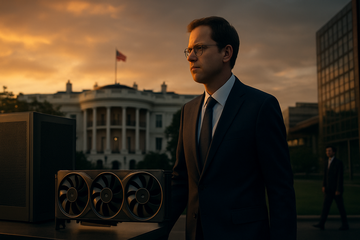
AI policy turns into procurement terms
Amodei’s dinner with Trump is less about philosophy—and more about turning safety into purchaseable compliance
The immediate news is simple: Anthropic CEO Dario Amodei was slated to attend a private White House dinner with President Donald Trump on Sep. 27, 2026, in what reporting framed as the first one-on-one meeting after months of public tension.
The investor relevance is not the guest list. It’s that Anthropic’s safety-first posture is now colliding with federal procurement and national-security gating—and Amodei’s “pacing” pitch directly translates into a concrete compliance mechanism governments can require: embedded third-party evaluators, coordination standards, and verification timelines.
Two primary documents anchor the supply-chain angle.
1) Amodei’s public “We Must Pace the Frontier” plan proposes a safety cadence that can be verified by third parties (not just asserted by labs).
2) The D.C. Circuit upheld a Department of War decision excluding Anthropic from its supply chain under the Federal Acquisition Supply Chain Security Act—explicitly tied to Anthropic’s contractual restrictions around “lethal autonomous warfare” and “mass surveillance of Americans.”
From safety claims to contract language
Anthropic’s “pacing” framework is built like a procurement checklist—not a slogan
Amodei’s “We Must Pace the Frontier” essay outlines a three-part approach to slowing the pace of frontier AI while strengthening safety verification.
The mechanism that matters for federal buyers is the first step: “embedded” evaluators—an ongoing, access-based verification function that checks whether a company is actually meeting its stated safety commitments.
In other words, the essay implicitly answers a procurement problem: “How do we measure whether the lab is doing what it says it will do—before we deploy?”
That framing becomes especially investable in light of the court record. The D.C. Circuit decision describes an exclusion where the government viewed Anthropic’s use restrictions as a “significant supply chain risk,” and where the removal was ordered quickly, alongside prohibitions on contractors using Anthropic products in Department work.
This is where “policy trade” turns into a business model variable: the more safety can be expressed as verifiable, contract-compatible processes, the less a lab’s model becomes administratively stranded during procurement disputes.
What the court ruling implies for “federal AI procurement”
The D.C. Circuit ruling shows the procurement trigger is use-restriction scope, not safety intent
In the D.C. Circuit case Anthropic PBC v. United States Department of War (decision dated Sep. 25, 2026), the court record describes the Department of War’s supply-chain action as a function of Anthropic’s refusal to relax contractual prohibitions on Claude’s use for:
- “lethal autonomous warfare”
- “mass surveillance of Americans”
The decision describes the agency’s rationale as protecting national security and eliminating “supply chain risk,” finding no reasonably available “less intrusive measures.”
For investors watching federal AI procurement, the key learning is causal—not rhetorical: governments can accept model capability while still excluding the provider if contractual “allowed use” terms conflict with mission needs.
Amodei’s dinner with Trump can therefore be interpreted as a bid to reframe Anthropic’s safety posture so it is compatible with procurement requirements—without giving up the underlying safety architecture.
IPO stake: $2T valuation meets explicit safety risk disclosure
Anthropic’s $2T IPO narrative is being underwritten by safety governance—because investors are demanding it
The IPO valuation narrative has already become public: reporting tied to an October IPO window described expectations that Anthropic could reach a ~$2 trillion valuation, and it framed that valuation debate as inseparable from safety and governance credibility.
Separately, the same reporting described safety-related disclosures circulating around Anthropic insiders/responsible-safety leadership, including an estimate that the odds of AI-driven human extinction are “greater than 10%” within the next decade (with the caveat that the estimate is about future superintelligent systems rather than today’s models).
White House dinner timing
Sep 27, 2026
Dario Amodei was reported to be slated for a private White House dinner with President Trump
Confidential draft IPO filing
Jun 1, 2026
Anthropic reported it confidentially submitted a draft Form S-1 for a proposed IPO
Federal supply-chain action upheld
Sep 25, 2026
D.C. Circuit upheld the Department of War’s Anthropic supply-chain exclusion rationale
The supply chain: where the dinner can move real economics
If procurement friction eases, the biggest practical winners may be the infrastructure stack—especially NVIDIA
The supply chain doesn’t end at model weights. It runs through cloud capacity commitments and data-center leverage.
Reuters reported Nvidia was in talks to become an anchor investor in Anthropic’s mega IPO and described the negotiating posture as considering up to $10 billion. That same Reuters reporting also referenced a broader partnership structure where Anthropic committed to purchase large amounts of Azure computing capacity supported by Nvidia chips.
That matters for the dinner: any perceived thaw with the White House can reduce the probability that Anthropic’s government access remains administratively constrained—making it easier for the infrastructure relationship to translate into ongoing, contractable demand rather than procurement standoffs.
In short, the dinner is a policy signal. But the tradable linkage runs through measurable procurement pathways and capacity commitments that infrastructure partners underwrite.
What to watch next (days–quarters vs. 1–3 years)
Short-term market read: announcement cadence and federal access signals. Long-term read: safety verification becomes an industry standard
- Follow whether Anthropic’s government/defense access expands after the dinner—watch for contract language updates consistent with embedded third-party verification.
- Track whether AWS GovCloud expands or updates public-sector model availability for Claude-style offerings; cloud access is a near-term demand “routing” lever.
- Look for IPO-process disclosure changes: safety risk framing that ties into third-party evaluation and operational verification will likely reduce investor discount rates.
- Watch whether anchor-investor talks (reported for Nvidia) harden into confirmed commitments—IPO pricing is often sensitive to perceived policy/regulatory continuity.
- Measure if partner platforms repackage compliance: if Azure/AWS-hosted offerings emphasize auditability, that can convert safety process into faster procurement cycles.
Fundamentals tie-in: why the infrastructure stack can re-rate on policy clarity
Valuation tension: high-multiple infrastructure firms can still rally if procurement pathways look survivable
Selected valuation multiples (TTM) that investors will scrutinize for AI policy shocks
Higher multiples imply less tolerance for procurement delays; policy clarity can compress perceived risk and support multiple stability (figures from key metrics snapshots).
Unit: x
NVIDIA ev/sales (TTM)
TTM as of 2026-09-28
18
Microsoft ev/sales (TTM)
TTM as of 2026-09-28
11.9
Amazon ev/sales (TTM)
TTM as of 2026-09-28
3.6
Palantir ev/sales (TTM)
TTM as of 2026-09-28
70.4
TSMC ev/sales (TTM, USD)
TTM snapshot includes currency-specific normalization
12.4
Because these multiples embed long-run growth expectations, the market will reward any credible sign that federal procurement constraints are being converted into contracts that can scale—rather than policy disputes that delay deployments.
That’s the practical route from Amodei’s dinner to equity outcomes across the AI supply chain.
Investable linkage across the AI procurement stack
- Nvidia benefits from reduced procurement standoff risk if Anthropic’s access expands, supporting platform-level demand visibility (TTM multiples highlight sensitivity).
- Nvidia anchors IPO narrative leverage as Reuters described talks considering up to $10B (policy thaw can support pricing follow-through).
- Multiple resilience improves when buyers treat compliance as contractable rather than vetoable—matters for ev/sales at TTM levels.
- If Anthropic’s government path eases, Azure hosting can capture more recurring inference workloads through compliance-aligned offerings (TTM ev/sales reflects policy sensitivity).
- But if safety terms remain disputed, Microsoft could see utilization volatility from delayed deployments even when models are technically available.
- AWS GovCloud model routing can increase incremental government demand if procurement processes favor auditable availability (policy clarity reduces rejection risk).
- Even with lower ev/sales than peers, AWS can re-rate on mission-justified utilization if Anthropic-style offerings broaden access.
- If Anthropic’s federal eligibility improves, Palantir’s integration pathways can see lower compliance friction (high ev/sales makes delays especially costly).
- However, if contracts still prohibit certain Anthropic use cases, Palantir may need alternate model governance, limiting upside.
- Procurement stability can support AI capacity utilization expectations, which matters for foundry demand durability over 1–3 years.
- But the direct linkage is indirect: TSMC re-rates primarily on broader compute capex, so watch for follow-through rather than immediate policy headlines.