
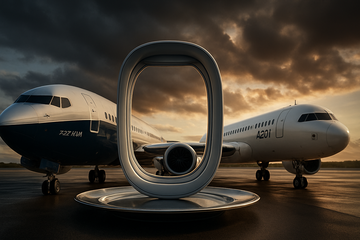
Boeing told the FAA and operators in late August that a flight-management computer software issue — sitting in FMS versions U.14 and U.14.1 — can disengage vertical navigation (VNAV) after a missed approach when pilots revise the programmed flight path. The FAA has convened a Corrective Action Review Board; Boeing said it first learned of the issue in November 2024 and judged it non-safety-critical because pilots are trained to fly the missed approach manually. The regulator estimates roughly 95 US-registered airplanes carry the affected software.
Two large MAX operators just vetoed Boeing's near-term delivery book
Southwest — the largest 737 operator with 323 MAX 8s and 400+ MAX on order — and United Airlines — with 370+ MAX on firm order plus a separately held 180-aircraft A321neo order — have both told Boeing they will not take new MAX with the U.14 software. Both airlines say their in-service fleets are unaffected; Alaska Air and American Airlines reported the same. But the distinction between in-service and new-build is the entire point of the disruption.
- Southwest ended Q2 2026 with 803 aircraft (288 737-700s, 192 737-800s, 323 737 MAX 8s) per its June 2026 fleet disclosure, and was planning 28 MAX 8 deliveries in 2026 plus 17 737-700 retirements
- United Airlines mainline fleet stood at 1,137 aircraft in September 2026, with first 737 MAX 10 deliveries now scheduled for 2027 (up to 20) and 147 MAX 10s on order
- Boeing delivered 171 commercial jets in Q2 2026 — 104 of them 737s — and is mid-ramp from a 38/month cap to 47/month, a target now complicated by software-driven delivery holds
The MAX 10 clock is now tied to a software patch the FAA has to bless
FAA certification of the 737 MAX 10 was expected \"within days\" as of September 24, 2026, per Alaska Air COO Jason Berry. The MAX 10 — the longest-delayed variant in the entire MAX family — is the launchpad for Alaska Air's growth plan: 22 deliveries in 2027 and 30 in 2028, on top of a 105-aircraft order placed in January that is the largest in the airline's 90-year history. The new glitch sits in the same flight-management software that runs across the MAX family, and Boeing concedes it is \"unclear whether the software issue will impact the timing of either milestone.\"
| Metric | Boeing 737 family | Airbus A320neo family |
|---|---|---|
| Total backlog (Aug 2026) | 4,811 aircraft | 7,571 A320neo family + 568 A220 = 8,139 |
| Years of production visibility | ~10.0 years | ~10.8 years |
| Typical single-class seat count (top variant) | 188–204 (MAX 10) | 180–220 (A321neo); up to 244 on A321neo XLR |
| Launch-customer 2027 deliveries | 22 MAX 10 (Alaska) | 57 single-aisle in Aug 2026 alone (26 A321neo) |
The A321neo is the structural winner, even if Boeing clears the patch
Even setting the certification question aside, the U.14 freeze hands Airbus leverage on the most consequential narrowbody sale of the cycle: incremental 2027–2028 single-aisle slots. Airbus's A320neo family backlog of 7,571 aircraft sits 57% above Boeing's entire 737-family backlog of 4,811, and the A321neo — Boeing's direct head-to-head against the MAX 10 — already dominates new-order tallies in 2026. Each month a MAX delivery is held back at the factory gates is a slot Airbus can convert at the marginal customer.
- Airbus raised its 2026 delivery target from 870 to 900 aircraft in early September, citing the largest single order of the cycle
- August 2026 narrowbody split: Airbus 53 single-aisle deliveries (26 A321neo) versus Boeing 42 (32 MAX 8, 9 MAX 9)
- Airbus cumulative TTM revenue of ~$77B and EBIT margin of ~10.3% give it room to absorb an incremental order wave without margin compression
Airbus ADRs trade at ~25.8x trailing earnings, EV/Sales of 2.05x, with $5.4B of free cash flow TTM and a net-debt-to-EBITDA of just 0.43x. That balance sheet has fueled consistent share-buyback capacity while Boeing is still rebuilding cash after the 737 MAX crisis and the 2024 Alaska Airlines door-plug incident — context that matters when a customer compares delivery certainty.
Upstream: Spirit is now inside the firewall, so the pain stays Boeing's
Boeing closed its $4.7B (or $8.3B including assumed debt) reacquisition of Spirit AeroSystems on December 8, 2025 — the largest supply-chain realignment in commercial aerospace in a decade. Spirit's 737 fuselage line, plus 767/777/787 structures and Short Brothers (Belfast) operations, are now Boeing divisions. Spirit Defense remains a separate supplier to U.S. government programs. The result: a software-driven delivery slowdown no longer cascades to a public Spirit AeroSystems — fuselages stay inside Boeing's P&L.
- CFM International (a 50/50 GE/Safran joint venture, not separately listed) powers every 737 MAX via the LEAP-1B; LEAP engine backlog exceeds 12,500 units and CFM is targeting >2,000 LEAP deliveries in 2026 (H1 2026 LEAP deliveries +41% YoY)
- GE Aerospace holds the LEAP commercial-engine cash flow; TTM operating margin of ~20.6% and TTM revenue of ~$50.6B — LEAP shop-visit revenue is largely insulated from a Boeing delivery pause
- Howmet Aerospace and TransDigm supply airfoils, fasteners, and actuators into both LEAP and the A320neo's PW1100G, so the two suppliers absorb demand from whichever OEM pulls forward
Boeing can still recover — but the cost of recovery just went up
The path back is mechanical, not strategic: ship a software update, re-clear the affected tail numbers with the FAA, accept the held aircraft. Boeing's Q2 2026 results showed Commercial Airplanes revenue of $11.75B (+8% YoY) with an operating loss of just $322M, and the company guided to $1–3B of full-year operating cash flow — its first positive cash year since the pandemic. A 4–8 week delivery pause costs single-digit billions in working-capital tie-up, not an existential reset.
Boeing FY2025 commercial backlog
$597B
Commercial Airplanes backlog, Boeing Q2 2026 release, reported Jul 28, 2026
Boeing 737 family backlog (Aug 2026)
4,811
Forecast International summary of Boeing orders and deliveries, Sep 9, 2026
Airbus A320neo family backlog (Aug 2026)
7,571
Forecast International summary of Airbus orders and deliveries, Sep 9, 2026
FAA est. US jets affected by U.14 glitch
~95
FAA briefing cited by CNBC and Instagram coverage of WSJ report, Sep 26–27, 2026
Two horizons, two opposing trades
Short-term (days to quarters): the airlines win either way. Southwest and United Airlines extract delivery concessions from Boeing by holding out; Airbus captures the marginal slot request. The stock that most directly captures the leverage is Airbus — its order book just absorbed a 900-unit 2026 target raise, and a Boeing stumble does not need to be severe to add a few hundred incremental slots by mid-2027. Boeing bears the cost: another certification scrutiny cycle at the worst possible point in its post-strike, post-Spirit integration rebuild.
Long-term (1–3 years): Boeing retains a structural advantage it must defend. The MAX 10 is the only narrowbody family member still on the launch pad, and the 105-aircraft Alaska Air order plus 147 MAX 10s at United Airlines are committed. If Boeing clears certification by Q1 2027 and stabilizes deliveries at 47/month — and Spirit's fuselage line stays inside the firewall — the financial leverage of converting $597B of backlog into cash dominates the noise. If the patch forces a multi-month delivery pause into peak 2027 travel season, Airbus's A321neo becomes the default narrowbody for every airline growth plan Boeing cannot serve.
The investable conclusion: Airbus is the higher-conviction long on the 6–12 month horizon, where this single software event does more marginal work than an entire quarter of order announcements; Boeing is a watch, not a fade, until the FAA signs off on the patch and MAX 10 type cert in the same window.
Investable names tied to the glitch
- Q2 FY2026 commercial deliveries of 171 jets (104 MAX) and 737 family backlog of 4,811 aircraft make every week of U.14 delivery hold a working-capital drag on the 47/month ramp
- FAA Corrective Action Review Board and any software Airworthiness Directive are the binary catalysts — a clean closure preserves the MAX 10 type cert path, a re-open pushes the cert into 2027 and frees up A321neo slots
- Spirit AeroSystems integration (closed Dec 8, 2025) keeps the fuselage risk inside Boeing's P&L, so the supply-chain read-through to suppliers is more limited than in prior MAX episodes
- A320neo family backlog of 7,571 aircraft already sits 57% above Boeing's 737-family queue; incremental 2027 slots are the marginal prize from any MAX delivery pause
- TTM operating margin of ~10.3% and net-debt-to-EBITDA of 0.43x give Airbus the capacity to add narrowbody slots without margin compression
- A321neo typical seat count of 180–220 (up to 244 on XLR) overlaps almost exactly with MAX 10 (188–204), making it the default replacement for any airline whose MAX 10 plan slips
- 803-aircraft June 2026 fleet (323 MAX 8s) and 400+ MAX on order give Southwest leverage in delivery negotiations; the airline confirmed no in-service jets carry U.14
- Holding out for prior-software deliveries could push MAX 8 handovers past planned 2026 milestones, leaving older 737-700s in the fleet longer and pressuring fuel-cost per ASM
- Forward P/E of 8.3x and an analyst consensus price target of $50.22 (vs ~$41.8 spot) imply capacity-driven upside if MAX deliveries resume cleanly
- First MAX 10 delivery target of 2027 (up to 20 aircraft, with 147 on order) is the cleanest read on whether United Airlines hits its 2027 capacity plan
- Separately held order book of 180 A321neos gives the airline an asymmetric hedge — if MAX 10 slips, A321neo slots fill the gap, supporting the \"40%+ CASM-ex growth\" plan
- Forward P/E of 7.4x and TTM operating margin of ~7.7% leave meaningful room for upward revisions if delivery cadence holds
- 105-aircraft MAX 10 order — the largest in Alaska Air's 90-year history — is the most MAX-10-dependent growth story in the US market
- Plan of 22 MAX 10 deliveries in 2027 and 30 in 2028 collapses to a single-year delay if the FAA's Corrective Action Review Board reopens the type cert
- Forward P/E of 7.4x prices in near-term margin pressure; an on-time MAX 10 entry into service in spring 2027 is the catalyst for consensus EPS revisions
- CFM International LEAP-1B backlog exceeds 12,500 engines; a brief MAX delivery pause delays shop-visit cash flow but does not impair the installed-base revenue stream
- H1 2026 LEAP deliveries rose 41% YoY; TTM operating margin of ~20.6% reflects the shop-visit mix that is largely decoupled from Boeing build rates
- GE Aerospace's 50% share of the CFM JV means incremental A320neo PW1100G demand lifts GE-affiliated MRO spend less directly, but LEAP-1A volume growth on the Airbus side is a clean offset
- Engine Products segment supplies airfoils and seamless rolled rings into both LEAP-1B (737 MAX) and LEAP-1A (A321neo), so any shift in OEM mix is broadly neutral
- TTM operating margin of ~28.3% and TTM revenue of ~$9.1B leave room to absorb modest delivery-timing volatility from either Boeing or Airbus
- Quarterly revenue growth of +24% YoY in Q2 FY2026 is driven by LEAP shop-visit demand, which is largely insulated from near-term OEM build-rate swings
- Airframe and Power & Control segments supply actuators, sensors, and ignition components into both 737 MAX and A320neo families — OEM mix shifts are a wash
- TTM EBITDA margin of ~49.7% on $10B of revenue gives TransDigm the cushion to absorb single-digit shifts in narrowbody delivery cadence
- Aftermarket-heavy business model (most revenue from parts and service, not build-rate) means a brief delivery pause is largely immaterial to the underlying franchise