
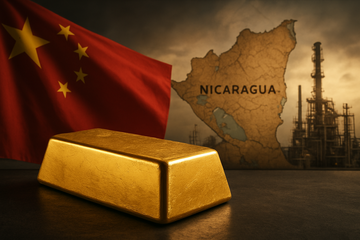
The first reading of Nicaragua's concession handover is a Latin America story. The second reading — the one with capital-markets consequences — is a Central American gateway into the same critical-minerals map Beijing has been filling in across Venezuela gold, DR Congo copper-cobalt and Greenland rare earths: a portfolio of non-aligned jurisdictions where capital is cheap, oversight is thin and the ore ends up feeding Chinese refiners that supply the world's jewellery, electronics and reserve banks. The Financial Times story published Sep 26, 2026 — built on a Fundación del Río dataset of the official Nicaraguan mining registry — confirmed the headline number for the first time across an English-language wire: 15 Chinese companies now control 1,013,225 hectares of concessions, equal to 8.5% of Nicaraguan territory, with the top four firms alone holding 786,000 hectares. Below the headline, the dataset quietly redraws the Central American supply map for an industry that priced gold at a record $5,602/oz in January 2026 and still settles near $4,261/oz on the LBMA PM fix three weeks ago.
The Footprint: 71 Concessions, Four Anchor Tenants, Seven State Royalties
Nicaragua's mining registry went from roughly 100 active concessions covering around 1.2 million hectares in 2021 to 213 concessions covering 2.4 million hectares — about a fifth of the country — by mid-2026, with 113 of those concessions issued in the last three years, per Mongabay's review of Ministry of Energy and Mines data. Chinese operators hold 84 of those blocks and 1.2 million-plus hectares, and Fundación del Río's count of 71 concession lots to 15 firms implies roughly 85% of those blocks concentrate in the hands of just four anchor tenants.
China-anchored concession holdings by operator (hectares)
Top four Chinese concession holders in Nicaragua per Fundación del Río dataset, cited by La Prensa, March 2026. Thomas Metal alone controls more land than Hong Kong Island and Manhattan combined.
Unit: hectares
Thomas Metal S.A.
228,273
Brother Metal S.A.
208,959
Zhong Fu Development S.A.
204,533
Xinxin Linze Group S.A.
144,885
The Pattern: Beijing's Critical-Minerals Map Now Touches Five Continents
Nicaragua fits a template. In the DRC, Chinese state-linked vehicles have absorbed the largest copper and cobalt concessions as US operators — including Freeport-McMoRan and Glencore — were forced to divest under pressure from Beijing's mineral export curbs in April 2025. In Venezuela, Chinese refiners quietly absorbed sanction-era gold output that would otherwise have been stranded. Greenland opened the door to Chinese rare-earth capital in 2024 after a US acquisition bid collapsed. The pattern across each deal is identical: a non-aligned government with hard-currency needs, a Chinese counter-party that will accept political risk pricing and a Western competitor that ultimately walks away. Zijin Mining has been the most visible Chinese counter-party — taking Continental Gold's Buriticá mine in Colombia in 2020, the Rosebel mine in Suriname in 2023, AGM in Guyana in 2024, the La Arena copper-gold complex in Peru for $245 million in late 2024, and announcing plans for $10 billion of further Latin American investment in May 2026. Nicaragua was the missing piece; the FT numbers suggest it is now being filled by 15 firms instead of one.
- Nicaragua: 71 Chinese concessions / 1.013 million hectares / 15 firms / $25 million of sanctioned Xinxin Linze gold flowed to US refineries in H1 2025 before OFAC moved
- DRC: Chinese buyers absorbed copper-cobalt concessions from Western majors after Beijing's April 2025 rare-earth export curbs; DFC's $600 million Orion CMC vehicle is the US counter-bid
- Peru: Zijin Mining closed La Arena for $245 million in 2024 and committed a further $1.5 billion to extend the mine's life by 19 years in April 2026
- Greenland: rare-earth concessions opened to Chinese capital after a US acquisition attempt collapsed in 2024; new drilling underway in 2026
The US Response: A Sanctions List Without a Refinery Counter-Bid
Washington's answer to the Nicaragua footprint has been OFAC designations, not counter-acquisitions. The Treasury action on Apr 16, 2026 froze the US property of seven gold-sector firms — including all four of Nicaragua's anchor Chinese tenants, EMSA (the Managua smelter that aggregates unrefined doré from six sites and ships bulk to US refiners), and Santa Rita Mining — plus two Ortega sons and the Vice Minister of Energy and Mines. The designation blocks Xinxin Linze, which Treasury confirmed had shipped more than $25 million of gold to the United States in the first half of 2025 alone, from accessing US dollar clearing. It does not block the concessions, does not recover BHMB Mining's Palacagüina plant (which was forcibly occupied in September 2025 and returned only in May 2026), and does not displace the seven operators from the registry. The structural gap is the refinery: the DFC's $600 million Orion Critical Mineral Consortium commitment, closed in January 2026, and its $5 million project-development support for Cerro de Pasco Resources in Peru are the only named US critical-mineral flows-of-capital vehicle in the region — neither touches Nicaragua gold. Zijin Mining's H1 2026 revenue of RMB 194 billion (TTM RMB 375 billion, net income RMB 67.4 billion) is roughly 6,000 times the DFC's Peru tailings commitment.
| Counter-party | Vehicle / Tool | Disclosed size | Geography | Status |
|---|---|---|---|---|
| DFC + Orion CMC | Critical Minerals Consortium | $600M | DRC / multi-jurisdictional | Closed Jan 2026 |
| DFC | Project development loan | $5M | Peru (Cerro de Pasco tailings) | Disclosed 2026 |
| OFAC | Specially Designated Nationals (Apr 16, 2026) | 7 entities / 5 individuals | Nicaragua gold sector | Effective |
| Zijin Mining | Buriticá + Rosebel + AGM + La Arena (combined) | Disclosed $245M La Arena + $1.5B planned | Colombia / Suriname / Guyana / Peru | Operating + announced May 2026 |
Why the Gold Price Has an Authoritarian Floor Underneath It
Nicaragua matters less for its 8 tonnes of annual production than for what its concessions imply about the marginal ore that feeds Chinese smelters — and through them, the global benchmark price. The People's Bank of China ended Q2 2026 with 2,346.43 tonnes of gold reserves, up from 2,313.46 tonnes at end-Q1 and continuing a 19-month buying streak; the People's Bank added 480,000 troy ounces in June 2026 alone, the largest monthly increase since October 2023. Global central banks bought a net 288.9 tonnes in Q2 2026, up 62% year-over-year per the World Gold Council, even as spot gold retreated from the January 28, 2026 record of $5,602.22/oz to a $4,261.05 LBMA PM fix on Sep 25, 2026. El País reports Costa Rican authorities assess the cross-border illegal mining economy — where Chinese concession-holders buy ore processed with mercury and cyanide inside protected reserves — could surpass $250 million a year, with prices above $5,000/oz making it economic regardless of sanctions. The transmission mechanism: sanctioned or not, ore from Thomas Metal and Zhong Fu Development flows through Chinese-controlled smelters, the price that smelter pays becomes the marginal bid for every other ounce in the region, and that bid has no reason to fall while Beijing's central bank keeps buying.
Nicaragua concession land (Chinese-controlled)
1.01M ha
8.5% of national territory, per Fundación del Río (March 2026)
Nicaragua concession land (total all operators)
2.4M ha
~20% of national territory, Mongabay review of Ministry data (Aug 2026)
Spot gold — LBMA PM fix
$4,261.05/oz
Sep 25, 2026
Spot gold — all-time high
$5,602.22/oz
Recorded Jan 28, 2026
PBoC gold reserves (end-Q2 2026)
2,346 t
Q1-to-Q2 increase of 33 tonnes; 19-month buying streak
Central bank net purchases Q2 2026
288.9 t
+62% YoY, per World Gold Council
The Western Counter-Bid Is Already Operating Inside the Sandbox
Equinox Gold closed its C$2.6 billion acquisition of Calibre Mining on Jun 17, 2025, inheriting two producing Nicaraguan mines — El Limón and La Libertad — that the company guides to 225,000–250,000 oz of gold production in 2026 at all-in sustaining costs of $2,000–$2,100/oz. The merger presentation flagged Limón and La Libertad as "prolific mining districts" holding more than 6 million ounces of combined resource. Equinox is therefore the only Western-listed gold producer actually operating large-scale mines in the same jurisdiction where the seven OFAC-sanctioned Chinese firms hold 1 million-plus hectares, which gives it two things no new entrant can replicate overnight: existing permits, existing workforce, and existing doré that — under LBMA Responsible Gold Guidance v9/v10 oversight — qualifies for Good Delivery refiner acceptance. The strategic question for the next 12 months is whether Equinox chooses to expand organically, lease or buy adjacent concessions from sanctioned counterparties at distressed prices, or partner with the DFC on a refining-of-record arrangement that effectively walls Chinese ore out of the LBMA chain. Each of those paths is now plausible because the May 2026 return of the BHMB Palacagüina plant — awarded to a US-backed operator after the Sept 2025 forcible seizure — set a precedent: title in Nicaragua is enforceable when the US owner files ICSID arbitration and the regime wants to avoid another designation.
Gold is Nicaragua's top commodity export, and this action aims to degrade the ability of the Ortega-Murillo regime to manipulate the sector and use the profits to help support paramilitary groups and repressive activities.
What the Footprint Means for the Next Four Quarters
Three near-term catalysts will tell investors whether the Nicaragua story stays a regional story or escalates into a global pricing event. First, OFAC's General License 5 issued Apr 16, 2026 has a built-in wind-down timeline — once it expires, EMSA's US refinery relationships must either be unwound or formally documented; any uncleared shipment post-expiry risks secondary sanctions on the receiving refiner. Second, Xinxin Linze's sister firm Linze Excelente Mineria was granted a 262 sq km, 25-year gold concession called "Jade" in August 2026 — three months after the original Xinxin was sanctioned — using the same legal representative (Lijun Dong) on file with the Nicaraguan mining registry. That is the test case: if Managua continues registering sister-firm concessions for OFAC-listed operators, expect a second designation wave targeting refinery-side counterparties rather than mining-side operators. Third, Zijin Mining's H1 2026 attributable gold output of 1,203 koz — up materially on 2025's full-year 90 tonnes (+23% YoY) and an EPS of RMB 1.473 (+67.96% YoY) — will be tested against the realised gold price for the rest of 2026. LBMA has been hovering between $4,200 and $4,500 since the spring; a break below $4,000 would compress Zijin's incremental margin even as its Latin American pipeline (Buriticá, Rosebel, AGM, La Arena, and an unannounced Nicaragua candidate) keeps expanding.
Listed names that touch this story
- Buriticá (Colombia), Rosebel (Suriname), AGM (Guyana) and La Arena (Peru) plus a $10B Latin America pipeline already give Zijin Mining the only listed balance sheet positioned to absorb additional Nicaraguan concessions at distressed prices if OFAC escalates
- H1 2026 attributable gold output of 1,203 koz and EPS of RMB 1.473 (+68% YoY) confirm the operating leverage to the $4,200–$4,500 LBMA band; a sustained push above $5,000 adds materially to net income
- Risk: any direct Nicaragua entry would invite US secondary sanctions, so the realistic upside is displacement of Russian/Canadian juniors rather than aggressive Nicaragua bids in the next 12 months
- Zijin Gold International was spun out of Zijin Mining on Sep 30, 2025 to consolidate global ex-China gold assets and trades at HK$160 against an HK$268 52-week high — the cleanest single ticker for the Chinese gold-Latin America thesis
- Buriticá, Rosebel, AGM and a stalled Allied Gold acquisition give it room to add Central American ounces without balance-sheet strain, but it remains a small-cap illiquid listing
- Near-term catalyst: any disclosed Central American project in 2027 would re-rate the multiple; risk is the loss of Chinese political cover if US widens sanctions to parent-group affiliates
- Zhaojin Mining is the second-largest Chinese gold producer and partly owned by Zijin Mining, so any Nicaragua-related supply-chain consolidation lifts the broader state-aligned gold complex
- H1 2026 financials show net debt/EBITDA of 2.3x and only 18.7% net margins — far less leverage to rising gold prices than Zijin, so this is a beneficiary of the geopolitical narrative more than the price action
- Limited direct Central American exposure; trade on relative multiple compression versus Zijin rather than direct footprint
- Shandong Gold is the largest A-share gold pure-play but has no disclosed Latin American footprint, so it participates only via the Chinese-state-gold-bid thematic
- PBoC's Q2 2026 reserves increase of 33 tonnes reinforces the official-sector bid that anchors the LBMA price band, which directly benefits domestic A-share gold equities
- Watch the State Council's next critical-minerals framework (last bilateral MOUs signed Feb 4, 2026) for any direct Shandong Gold mandate on overseas projects
- Equinox Gold is the only Western-listed operator with producing Nicaraguan mines (El Limón + La Libertad) guiding to 225,000–250,000 oz in 2026 at $2,000–$2,100/oz AISC
- Distressed acquisition of concessions vacated by sanctioned counterparties — or a DFC-backed refining partnership — would re-rate the stock; the May 2026 BHMB Palacagüina precedent shows title disputes are enforceable
- Risk: the Calibre Mining integration closed only Jun 17, 2025 and Q1 2026 free cash flow yield is essentially zero at 0.6%, so any Nicaragua capex needs equity-friendly financing
- Newmont reports 2025 mineral reserves of 118.2 million attributable gold ounces and is the US proxy for the geopolitical narrative: a Western major with the balance sheet to enter Central America if the DFC underwrites refining capacity
- No direct Nicaragua footprint today, so this is a multiple/positioning trade rather than an asset story
- Watch for DFC or US-backed consortium announcements around Central American refining — that would unlock NEM's optionality
- Barrick Gold has the operational depth to take over a sanctioned operator's Nicaraguan concessions via a forced divestiture, similar to its 2019–2021 Acacia resolution in Tanzania
- No current Nicaragua exposure; the trade is on whether the company chooses to engage or stay out — Barrick's 2025 reserve life and balance sheet support either path
- Key risk: political cover from Ottawa/Washington is weaker than in Canada-aligned jurisdictions, so a Barrick move would need explicit DFC underwriting
- Agnico Eagle is the highest-multiple North American senior gold producer (TTM P/E 18.3x) and would be the natural Western consolidator for any sanctioned Nicaragua assets put up for divestiture
- No current Nicaragua footprint; the company prefers Tier-1 jurisdictions and has historically avoided politically exposed geographies
- Trade thesis: AEM is a beneficiary of any LBMA price-floor repricing but is unlikely to be the operational answer to the Nicaragua concession problem