
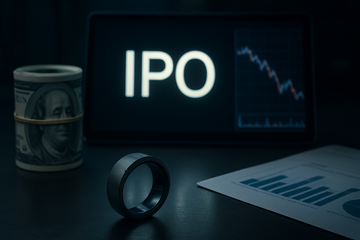
On Tuesday, Oura became the third sizable US IPO hopeful in two weeks to walk away from a listing date. The company said it would postpone the Nasdaq debut \"despite strong demand,\" and CEO Tom Hale framed it as a luxury of timing: \"We have the luxury of choosing our moment.\" The numbers back that up: the deal was roughly four times oversubscribed, the company posted $60.8M of GAAP net income in the first nine months of fiscal 2026, and operating cash flow more than doubled to $328M.
What changed was not the company — it was the tape.
The S-1 Was Stronger Than the Pull Suggests
Oura filed its S-1 on Sept. 3, 2026 and set terms a week before launch:50 million shares at $40–$44, valuing the smart-ring maker at up to $16B on roughly $2.2B raised. The pitch deck the company handed the SEC was unusually clean for a hardware-led consumer brand. Nine months ended June 30, 2026: revenue $1,214.5M (+74% YoY), paid members5.0M (vs. 2.5M a year earlier), GAAP net income $60.8M, operating cash flow $328M.
Revenue (9M FY26)
$1.21B
+74% YoY, vs. $697.6M a year earlier
Paid Members
5.0M
100% YoY; 94% of ring sales convert to subscription
GAAP Net Income
$60.8M
vs. $1.6M prior 9M period
Subscription GM
89%
On $241M membership revenue, +121% YoY
12-Month Retention
85%
Up to 87% for the FY2025 cohort
Operating Cash Flow
$328M
More than 2x the prior-year $135M
The accounting layer was stranger. Net loss attributable to common stockholders ballooned to $(924.3)M from $(182.8)M, because Oura had accelerated buybacks ahead of the listing. In February2026 it ran a $534M tender at $40.18 per share, then followed with another $437M of repurchases at up to $56.25. Paying preferred holders above carrying value created a $985M deemed dividend that depresses GAAP earnings available to common — a paper loss, not a cash burn.
The Risk-Off Tape Made the Decision for Them
The pull lands at the worst moment of the fall tape. On Sept. 14, AI stocks sold off after Anthropic, OpenAI and xAI executives publicly called for a slower pace of AI development; the Nasdaq fell 1.2%, Nvidia dropped 3.6%. Two weeks later, on Sept. 16, Holtec Nuclear shelved its planned ~$900M listing. Six days after that, on Sept. 22, CVC-backed Bamboo Insurance postponed its ~$665M NYSE IPO. Oura's three September pull dates now sit in the same week as those events.
| Date | Issuer | Targeted raise | Stated reason |
|---|---|---|---|
| Sep 16, 2026 | Holtec Nuclear | ~$900M | Market conditions; AI-trade turbulence |
| Sep 22, 2026 | Bamboo Insurance Services | ~$665M | Adverse equity-market sentiment |
| Sep 29, 2026 | Oura | Up to $2.2B | Uncertainty in the IPO market |
Two pieces of evidence say Oura's call was about timing, not weakness. First, demand: the deal was reportedly four times oversubscribed, meaning bookrunner Goldman Sachs could have priced at or above the range. Second, deal structure: 73% of the float was insider selling. That gives insiders every reason to wait for a friendlier tape rather than accept a haircut — they are not raising primary capital that locks in cost-of-capital, they are monetizing gains.
Subscription Economics Are the Real Story Behind the Pull
Look past the headline valuation and the business model is unusually software-like for a wearable. Eighty percent of Oura's $1.21B in revenue still comes from hardware, but the 20% subscription layer is the part that justifies a $16B multiple. Subscription revenue grew 121% YoY in the first nine months of FY2026, with 89% gross margin and 85% twelve-month retention. On $241M of subscription revenue, that is roughly $214M of gross profit — about a third of total gross profit on a fraction of the volume.
Oura revenue mix has shifted toward higher-margin subscriptions
Mix change fiscal2025 to first nine months of fiscal 2026
Unit: % of revenue
FY2025 mix
Hardware
83
FY2025 mix
Subscription
17
9M FY2026 mix
Hardware
80
9M FY2026 mix
Subscription
20
That subscription layer is what makes the postponement low-cost. The hardware business is profitable and self-funding; the recurring base grows organically with each ring sold. With 5 million paid members and 94% of new activations converting, Oura does not need fresh public-market capital to keep compounding — and that is why the insiders could afford to wait out September.
What the Listed Wearables Look Like Against That Math
The interesting comparison set is not other private wearables, but the listed names that have to defend or attack the same consumer wallet.
| Company | Recent revenue | Segment / model | Notable metric |
|---|---|---|---|
| Garmin | $7.25B (FY2025) | Fitness segment: $2.36B (+33% YoY) | Q4 fitness revenue +42% YoY; segment OM ~34% |
| Apple | $416.2B (FY2025) | Wearables, Home & Accessories | Quarterly wearables revenue held near $9B |
| Peloton | $2.45B (FY2026) | Connected fitness hardware + subscription | FY26 EPS $0.14 — first profitable year since IPO |
| Alphabet | $412.9B (CY2025 proxy) | Devices & Pixel (includes Fitbit) | Fitbit revenue ~$770M est. 2025; Pixel Watch now lead device |
Two takeaways stand out. First, Garmin is the only listed peer with a true fitness-wearables segment growing at Oura-like rates — Fitness revenue up 33% to $2.36B in FY2025, with Q4 fitness up 42% — yet Garmin trades at roughly 7.4x sales, while Oura was about to print at 11x. The subscription gap is exactly that: Garmin's fitness layer is mostly hardware, with limited recurring revenue, which is why the multiple sits where it does. Second, Peloton is now a real cautionary tale for the consumer-fitness IPO class — after years of losses, it finally booked $63M of net income in FY2026 on a stock that has compressed to a ~$2.1B market cap. The market remembers.
The Smart Ring Field Is Narrowing but Not Closed
About 4.9 million smart rings are projected to ship globally in 2026, up 12.8% on IDC's count, against more than 160 million smartwatches. Oura still controls roughly three out of every four smart-ring shipments. Samsung Electronics's Galaxy Ring is the closest second, with the rest of the field — Ultrahuman, RingConn, Amazfit Helio — split across sub-$400 price points and no subscription fee. That pricing architecture is the single biggest long-run risk to Oura's economics.
Two adjacent private names frame the next test. Whoop, a screenless health wearable, closed a $575M Series G at a $10.1B valuation in March 2026 and has signaled an IPO is next. Strava, with roughly $490M of annual recurring revenue and a $2.2B valuation, filed confidentially for a listing. If either prices into a recovered tape, Oura's subscription thesis gets an instant public-market comparable. If both retreat, the September pull becomes a category-wide event, not an Oura-specific one.
Short-Term Catalysts and the1–3 Year Picture
Over the next several quarters, three dates matter. First, the VIX-and-tape window: a re-launch is most likely after the Fed's October meeting and post-Q3 earnings, when the AI-driven September wobble either fades or hardens. Second, Whoop's eventual S-1: it carries a $10.1B private mark, and if it prices near that, Oura's $16B print gets validated. Third, Apple's wearable roadmap — reporting in September suggested Apple is exploring screenless health trackers, the form factor where Oura plays. Any credible Apple entry caps the smart-ring multiple.
Over a 1–3 year horizon, three structural questions decide who wins. Can Oura lift subscription penetration above 25% of revenue and prove the platform comp? Will Samsung keep iterating Galaxy Ring fast enough to break Oura's 75% share, especially in Europe and South Korea? And can Peloton-style connected-fitness incumbents rebuild recurring revenue at the gross-margin profile Oura now commands?
Stocks this delay actually moves
- Oura's postponement removes the only credible 11x-sales wearable listing of 2026, leaving Garmin's Fitness segment at 33% YoY growth as the cleanest wearables growth story in US markets.
- Garmin's fitness segment produced $2.36B of FY2025 revenue on roughly 60% gross margins, but with limited recurring revenue, the stock trades at ~7.4x sales versus Oura's ~11x — a gap that widens if no subscription-led wearable IPO clears this fall.
- Near-term: any pullback on Garmin tied to broader wearables softness is a relative-value entry versus a still-private Oura. Long-term: Garmin needs to add a subscription layer to its fitness platform to close the multiple gap.
- Reports in September indicated Apple is exploring screenless health trackers — the same form factor Oura owns — and any product launch caps Oura's pricing power and forces the eventual relaunch at a lower multiple.
- Apple's Wearables, Home & Accessories segment held near $9B per quarter through FY2025, dwarfing Oura's $1.2B nine-month revenue, but at lower gross margins and without the subscription halo.
- Watch the Oct–Nov product cycle for any new health-band SKU; that is the binary catalyst for both Apple upside and Oura's multiple.
- Peloton just turned profitable in FY2026 with $63M of net income on $2.45B of revenue, but its market cap is still ~$2.1B — a reminder that consumer-fitness IPOs without subscription growth get punished.
- If Oura eventually prices at $16B on $1.4B trailing revenue (roughly 11x sales) while Peloton trades under 1x sales, the comparison underlines how much of Oura's multiple depends on the recurring 89%-margin subscription layer.
- Short-term: Peloton is the cleanest 'what if Oura's subscription thesis fails' comparable — a compression comp, not a beneficiary.
- Alphabet acquired Fitbit in 2021 and has shifted strategy to the Pixel Watch line, with Fitbit revenue estimated near $770M in 2025 — effectively conceding the smart-ring form factor to Oura and Samsung Electronics.
- If Oura pulls its listing indefinitely, Alphabet loses one of the few public-market reference points for valuing subscription-led consumer health hardware, making any Pixel Watch subscription play harder to underwrite.
- Long-term: Alphabet has the balance sheet ($4T market cap) to enter smart rings via Pixel if the category keeps compounding — that is the existential risk for Oura, not the IPO delay itself.
- Samsung Electronics's Galaxy Ring is the closest direct competitor to Oura and the only one with global carrier distribution; an Oura pull removes a near-term IPO comp that could have lifted smart-ring category multiples industry-wide.
- Samsung's wearables strategy is part of a much larger consumer-electronics platform, so a slower Oura listing pace is a tactical win for Galaxy Ring share, not a strategic one.
- Watch Samsung's Q4 2026 wearables commentary — sustained Galaxy Ring momentum into the holiday quarter is a leading indicator of share loss for Oura at the 2027 relaunch.