
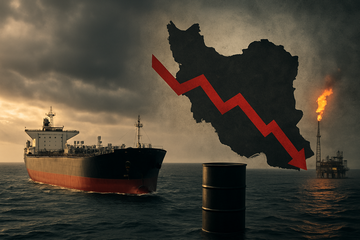
Iran crude exports, Aug 2026
~210,000 bpd
vs. 1.68M bpd 2025 average; lowest since 2020
Iran crude production, Aug 2026
2.086M bpd
OPEC MOMR; down 399k bpd MoM and lowest since Oct 1980
VLCC daily rate, mid-Sept 2026
$1.2M/day
vs. ~$50,000/day pre-war; +800% in twelve months
Iranian crude arrivals in China, Sept 2026
475,000 bpd
vs. 1.37M bpd in May 2026; 65% drop in four months
OFAC-designated shadow-fleet vessels, 2026
100+
Treasury tally through Sept 2026
Saudi Aramco net profit, Q2 FY2026
$32.69B
+44% YoY; CEO cites 2.6B barrels lost globally since war began
The supply side
The 1.5 million barrel drop is structural, not cyclical
Iran didn't lose its exports in a single shock — it lost them across three layers that compound. Output fell from roughly 3.2M bpd before the war to 2.086M bpd in August 2026, the lowest monthly print since October 1980 on OPEC data. Loadings collapsed from 1.8M bpd in March to 260,000 bpd in May after the US blockade of Kharg Island, and the August average sat at 210,000 bpd on Vortexa's tracking. The gap to the 2025 baseline of 1.68M bpd is now ~1.47M bpd — and because US sanctions enforcement continues to widen rather than narrow, that gap behaves more like a permanent supply destruction than a temporary outage.
Iran crude exports, 2025–Sept 2026
Monthly average loadings and what flowed into China
Unit: thousand barrels/day
2025 average
1,680
Apr 2026
1,340
May 2026
209
Jun 2026
740
Jul 2026
890
Aug 2026
210
Sept 2026 (to date)
250
The rebound months (June–July) are a tell. After the April blockade announcement loadings briefly recovered under a 60-day US-Iran memorandum, but once that reprieve lapsed in August shipments fell back to 210–250,000 bpd — and the floating stockpile that had buffered the gap drained from 160M barrels in mid-April to roughly 86M barrels by mid-September, with 23M of those barrels still trapped inside the Persian Gulf. That floating-stock cushion was Iran's only spare valve; with it nearly spent, the headline export number starts to behave like an honest reading of the seller's ability to deliver.
The buyer side
The buyer side collapsed first — five teapots, one Shandong cluster
OFAC didn't need to stop Iran from selling crude. It stopped China from buying it. Treasury's April 28, 2026 advisory warned banks that Chinese teapot refineries — which take roughly 90% of Iran's seaborne crude — would expose them to secondary sanctions. Within weeks, Hengli Petrochemical, China's second-largest independent refiner, was designated alongside four other Shandong-based operators; Treasury's \"Economic Fury\" campaign had named the entire buy-side network in a single geographic cluster.
- Shandong Shouguang Luqing Petrochemical — designated by OFAC; one of the largest Shandong teapots processing Iranian medium-sour
- Shandong Shengxing Chemical — designated April 16, 2025; first major teapot blacklisted in this cycle
- Hebei Xinhai Chemical Group — designated for processing Iranian-origin crude worth billions of dollars
- Shandong Jincheng Petrochemical Group — added to the SDN list in 2026; another Shandong node
- Hengli Petrochemical (Dalian) Refinery — designated April 24, 2026; China's second-largest independent refiner and the largest public-listed name in the cluster
China invoked a five-year-old blocking statute in May 2026 to blunt the designations, but the practical effect was already locked in: insurance, dollar clearing, and ship-financing all run through institutions that read OFAC more carefully than Beijing's domestic rules. Sinopec has been visibly substituting toward Russian Far East barrels and away from the Middle East spot market, and Qingdao — a pipeline hub feeding 12 independent refineries — saw Iranian intake drop from roughly 40% of 690,000 bpd in 2025 to a record low near 150,000 bpd over the most recent three months.
The transmission
Shadow-fleet enforcement turned tanker capacity into a strategic asset
OFAC's second prong targeted the maritime plumbing. Through September 2026, Treasury sanctioned more than 100 vessels linked to Iran's shadow fleet — 14 vessels identified by State in February, 12 designated by OFAC in late February, eight more plus an illicit maritime-insurance network in July. With Iran-flagged, dark-fleet, and ship-to-ship transfer tonnage all pushed into the same risky bucket, the compliant VLCC universe shrank by exactly the amount needed to push spot rates vertical.
VLCC daily TCE, quarterly average
Frontline's published VLCC TCE tells the rate story before the indices do
Unit: USD per day
Q2 2025
35,000
Q3 2025
40,000
Q4 2025
55,000
Q1 2026
103,500
Q2 2026
152,700
Sept 2026 spot peak
1,200,000
| Tanker operator | Q1 2025 | Q2 2025 | Q3 2025 | Q4 2025 | Q1 2026 | Q2 2026 |
|---|---|---|---|---|---|---|
| Frontline | $33M | $78M | $40M | $228M | $559M | $659M |
| Scorpio Tankers | $58M | $74M | $84M | $128M | $216M | $388M |
| DHT Holdings | $44M | $56M | $45M | $66M | $165M | $198M |
| International Seaways | $50M | $62M | $71M | $128M | $286M | $295M |
Frontline's Q2 2026 print of $659M in net profit — three times the year-ago quarter at $78M — is the cleanest signal that compliance-side enforcement, not war-risk premium alone, is what's bidding tankers. The company itself flagged in its earnings commentary that the \"ultimate endgame of the ongoing conflict\" is hard to read, which is the tanker industry politely admitting that even a ceasefire may not restore Iran's old buyer base. VLCCs that previously hauled sanctioned Iranian crude now circle the Gulf, hold for paperwork, or sit waiting for compliant cargoes that pay the same rate — and that idleness is exactly what tightens tonnage for everyone else.
The second-order effect
Refiners paid three times for the same missing barrel
The teapot blacklists didn't just delete a buyer; they broke the discount. Iran historically sold its medium-sour crude at $5–10/bbl below Brent, with most of that discount captured by Shandong operators running high-sour slates. Once those operators cannot legally take Iranian crude, replacement barrels come from Saudi Arabia, Russia, and Brazil — at much narrower discounts and on longer voyages. Three pressures compound on the same refiner balance sheet: a higher input cost, a longer shipping leg, and a thinner end-product spread because Chinese retail diesel and gasoline prices are politically constrained.
On October 1, 2026, Chinese refiners went further and suspended October fuel exports entirely to keep domestic supply stable. That move alone confirms the squeeze has reached the product side. Western refiners with access to medium-sour alternatives — US Gulf Coast, Brazilian, and Indian complex operators — sit on the opposite side of the same trade, which is why the listed names worth watching are not all on the upstream side of the barrel.
The replacement map
Saudi took the volume, Russia and Brazil took the discount
The disappearance of Iran's 1.5M bpd opened a hole, and three producers are filling it from different sides. Saudi Arabia has the spare capacity (over 4M bpd available in Q4 2025 per the IEA) and used it directly — Riyadh sold roughly 100M barrels to Asia in a single week in late September 2026 to ease the post-blockade squeeze, and Aramco posted Q2 FY2026 net profit of $32.69B, up 44% year-on-year. The CEO's accompanying estimate — 2.6 billion barrels of oil lost from the global market since the war began, requiring 18 months of 2.1M bpd average throughput to replenish — is the framework the rest of the supply chain is now pricing against.
| Producer | Listed name | Mechanism | 2026 status |
|---|---|---|---|
| Saudi Arabia | Saudi Aramco | Spare capacity sold into Asia | 100M bbl sold in one week (Sept 2026); Q2 net profit $32.69B (+44% YoY) |
| Russia | (sellers mainly via traders) | Russian ESPO/Urals displaced onto Chinese refiners | Seaborne crude to China +62% YoY in Aug 2026 (CREA) |
| Brazil | Petrobras | Heavy-sour grade positioned as Iran substitute | Asian refiners pivoting to Buzios/Tupi barrels |
| U.S. Gulf Coast | Valero, Marathon Petroleum, Phillips 66 | Crack-spread beneficiaries; medium-sour importing program | 3-2-1 cracks at record highs through May–Sept 2026 |
The interesting wrinkle is that Saudi captured the volume but Russia captured the discount. Chinese teapots that previously bought Iranian barrels at $7–10/bbl under Brent are now buying Russian ESPO at a smaller discount than they used to, because Hormuz risk has rerouted every Persian Gulf barrel onto longer, more expensive voyages. Russian crude flowed into China at +62% year-on-year in August 2026, and the marginal buyer is no longer chasing sanctions arbitrage — it is chasing reliability.
Forward outlook
What stays vanished when the war ends
Three structural drivers separate this episode from a typical Hormuz outage. First, the teapot blacklist cannot be undone by a peace deal — OFAC designations travel with the entity, and even if China formally recognized the sanctions, the underlying banks and insurers will not. Second, shadow-fleet vessel sanctions have shrunk the compliant VLCC universe by enough capacity to keep rates elevated even if Hormuz flows fully normalize. Third, Saudi Aramco's own math — 18 months to refill inventories at 2.1M bpd — implies a multi-quarter oil-price floor even after the war risk premium fades.
- Short-term (days to quarters): VLCC owners and large refiners with medium-sour flexibility keep capturing the spread; Frontline, DHT Holdings, Scorpio Tankers, International Seaways likely print another strong quarter as Q3 tanker results land
- Watch point: any formal Hormuz reopening deal — Aramco's CEO framed this as the single biggest variable; reopening would also free Iran's trapped 23M barrels
- Long-term (1–3 years): the medium-sour market structurally re-rates higher as Iran stays sanctioned even post-conflict; Saudi/Russian/Brazilian barrels retain pricing power even with the war premium removed
- Bear case: a rapid diplomatic resolution that includes broad Iran sanctions relief could compress tanker rates within one to two quarters; Frontline's own $23,800/day VLCC cash breakeven still leaves plenty of cushion, but the gap between today and yesterday narrows fast
- Structural losers: Hengli Petrochemical and the broader Shandong teapot cluster carry compliance overhead for as long as OFAC's April 2026 advisory remains in force, regardless of how the war resolves
Investable names touched by Iran's vanishing barrels
- Q2 FY2026 net income $659M (vs. $78M YoY), three-year transformation captured in two quarters; VLCC cash breakeven $23.8k/day leaves cushion even after rates normalize
- Iranian shadow-fleet sanctions shrink compliant VLCC universe; structural rather than cyclical tailwind for the next 4–6 quarters
- Near-term risk: peace deal with Iran could compress VLCC rates; Horizon 1–2 years depends on Hormuz re-entry timing
- Q2 FY2026 net income $387.5M, TCE revenue $391.8M; pivoting from MRs to VLCCs with a $256M two-vessel order placed in Nov 2025
- LR2 TCE of $80k/day in Q2 2026 confirms product-tanker side also benefiting from rerouted barrels
- Mixed in 3-year horizon: VLCC exposure is upside, but legacy MR fleet faces structural pressure as product flows normalize
- Pure-play VLCC; Q2 FY2026 net income $198M vs. $56M a year earlier — cleanest leverage to the rate spike without diversified drag
- Revenue mix captures the rate move more directly than operators with older tonnage
- Watch: any Iran sanctions relief deal would compress the rate premium quickly; earnings already pricing a multi-quarter window
- Q2 FY2026 net income $295M (vs. $62M YoY) on a diversified VLCC/Suezmax/Aframax/LR2 fleet; less concentrated than pure-VLCC peers
- Gain on sale of two oldest Suezmax tankers ($54.7M) signals active fleet optimization into the rate spike
- 1–3 year horizon: as Iran's shadow-fleet tonnage ages out of compliance, INSW's younger fleet compounds advantage
- Q2 FY2026 net profit $32.69B (+44% YoY); CEO cites 2.6B barrels lost globally since war began, supporting elevated price deck
- Spare capacity 4M+ bpd gives Aramco direct absorption of Iran's lost market share — the structural beneficiary of the disappearance
- Long-term (1–3 years): dividend sustainability depends on oil price; structural supply tightness even post-conflict supports the floor
- Brazilian heavy-sour (Buzios/Tupi) positioned as substitute for Iranian medium-sour in Asian refining slates
- Captures the discount-premium shift: as Iranian barrels vanish, Atlantic-basin heavy crudes re-rate higher
- Long-term: pricing power depends on Chinese demand and Chinese-Russian crude flows; mixed if Russia displaces Brazil on price
- US Gulf Coast refiner with complex refining capacity to process heavier and sour crudes displaced from Iran
- 3-2-1 crack spreads at record highs through Q2/Q3 2026 support refining margin tailwind
- Near-term horizon (days–quarters): margin capture strongest; long-term depends on US product demand and SPR refill pace
- Designated by OFAC April 24, 2026; Treasury cited Hengli as 'one of Iran's largest' crude customers — secondary-sanctions risk now embedded in the cost of capital
- Shares ~16 CNY vs. 52-week high 27.26 CNY; sanctions overhang compresses valuation regardless of operational performance
- Long-term (1–3 years): compliance overhead persists even if war ends; only resolution path is OFAC delisting, which is not a near-term catalyst