
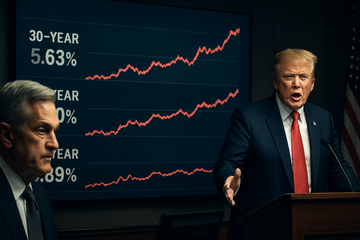
30-year Treasury yield, Sep 30, 2026
5.63%
Highest closing level since June 2002; up 6 bps on the session
10-year Treasury yield, Sep 30, 2026
5.30%
Up 5 bps on the day; close to its highest since 2007
2-year Treasury yield, Sep 30, 2026
4.89%
Essentially unchanged; still anchoring near Warsh Fed's 3.75–4.00% policy band
Federal funds target range
3.75–4.00%
Raised 25 bps on Sep 16, 2026; dot plot signals one more hike in 2026
S&P 500, Sep 30, 2026 close
7,652
Down 0.25%; Dow fell 0.86% on Trump comments late in the session
Fed renovation overrun
$1.3B → $2.4B
Original budget Feb 2020 to current, per Inspector General report
The IG report
Cleared of Crime, Found Culpable of Mismanagement — and Still Demoted
The Federal Reserve's Office of Inspector General, led by Michael Horowitz, released its long-awaited audit of the central bank's renovation of the Marriner S. Eccles Building and the adjacent 1951 Constitution Avenue building on September 30, 2026. The headline finding was unambiguous: no criminal law was broken by Jerome Powell or any Fed official. \"At no point during our evaluation did we find reasonable grounds to believe that a violation of federal criminal law had occurred,\" the report concluded, and no referrals were made to the U.S. attorney general.
The substance below that headline was less flattering. The IG said the Fed \"has not effectively executed\" the construction management risk contract and cited \"numerous deficiencies\" in how the Board oversaw the project. Renovation costs doubled from a February 2020 Board-approved budget of about $1.3 billion to $2.38 billion in December 2024 — and the report itself noted the marble, water, and garden terrace items that Donald Trump had mocked did not drive the increase. The overruns came from asbestos, lead-paint remediation, structural work, and a higher water table than expected.
Trump's response arrived within hours. In a Truth Social post and a written statement, he said Jerome Powell \"should be forced to resign from the Board, IMMEDIATELY,\" and threatened a lawsuit for \"corruption or incompetence\" if Powell refused. The President formally asked Attorney General Todd Blanche to \"study\" the IG report. The IG investigation itself had been opened in April at the recommendation of U.S. Attorney for D.C. Jeanine Pirro — a probe the Justice Department subsequently closed in late April before the IG took the file.
Bond market verdict
The 30-Year Yield Just Priced In Fed-Independence Risk
The U.S. bond market delivered a sharper signal than the equity market on September 30. The 30-year Treasury yield closed at 5.63%, the highest closing print since 2002. The 10-year finished at 5.30%, also within striking distance of its 2007 peak. Both rose 5–6 basis points on the session — modest in absolute terms but on top of a yield uptrend that has been running since mid-September, when the long bond first broke above 5.50% on a hawkish Warsh Fed, ballooning fiscal supply, and rising term premia.
What is new today is the trigger. The IG report arrived mid-morning; Trump's resignation call hit the tape just minutes before the closing bell. The S&P 500 erased an early rally on cooler-than-expected inflation data and closed down 0.25% at 7,652; the Dow fell 0.86%. Equities absorbed the news as one more dose of policy noise. The bond market read it as something different: a step closer to a world in which the central bank's credibility is at the mercy of the executive branch.
The paradox
Why the Curve Steepened Rather Than Crashed
The shape of the move on September 30 is the most informative part of the tape. The 2-year yield barely budged — closing at 4.89%, just one basis point higher — even as the long end sold off. That is a classic bear steepening: the short end held because nothing about the Warsh Fed's near-term path changed on September 30; the long end re-priced because the term premium moved. Investors demanded more compensation for holding duration when the institution backstopping the currency looks politically compromised.
The split is the opposite of what a traditional \"Fed capitulation\" trade would look like. If markets genuinely believed Trump would force the Fed to cut, the 2-year would have rallied hard and the curve would have bull-steepened. Instead, Kevin Warsh's Fed — which raised rates 25 bps to 3.75–4.00% on September 16 and signaled one more hike in 2026 in its dot plot — kept the front end pinned. The bond market's bet is that the Warsh Fed will not bend to political pressure on policy, but that the long end must price a higher risk premium for the institutional erosion that a Powell ouster would represent.
- Short end anchored:4.89% on Sep 30 — markets still price Warsh as the dominant voice on near-term policy, not Trump.
- Long end re-prices: the 30-year at 5.63% embeds a higher term premium for Fed-independence risk, not a near-term cut.
- Steepener, not crash: 2s30s widened on the day rather than collapsing — bond traders are discounting political risk, not a policy U-turn.
Sector implications
Banks Catch the Steepening Tailwind; Long Bonds and REITs Catch the Pain
A bear steepener is the one macro setup banks actually like. Lenders borrow short and lend long; when the 2s30s spread widens, net interest margins expand. The Financial Select Sector SPDR ETF (XLF) closed at $53.57 on September 30, down 0.82% on the session — but that masks the divergent fundamentals. JPMorgan Chase trades at 14.4x trailing earnings with a 17.8% return on equity; Bank of America trades at 12.8x with an 11.2% ROE. Both are positioned to harvest the steeper curve if the Warsh Fed stays hawkish and the long end stays bid on independence risk.
The other side of that steepener is the holders of long-duration paper. The iShares 20+ Year Treasury Bond ETF (TLT) has been a direct casualty of the 30-year's march to 5.63%. The Real Estate Select Sector SPDR (XLRE) is doubly exposed: REIT yields have to clear the 5.6% hurdle to attract capital, and commercial real-estate refinancing just got more painful. Office-heavy REITs are the most rate-correlated slice of the real estate universe.
| Asset | Ticker | Closing move Sep 30 | Primary exposure |
|---|---|---|---|
| Financial Select Sector ETF | XLF | −0.82% to $53.57 | Net interest margin expands on bear steepener |
| JPMorgan Chase | JPM | −1.24% to $330.83 | Diversified bank; ROE 17.8% on steeper curve |
| Bank of America | BAC | −0.96% to $54.43 | Rate-sensitive; ROE 11.2%, P/E 12.8x |
| Citigroup | C | Rate-sensitive franchise | Restructuring play + NIM expansion |
| iShares 20+ Year Treasury | TLT | Hit by 30Y at 5.63% | Longest-duration public Treasury vehicle |
| Real Estate Select Sector | XLRE | Pressured by 5.6% hurdle rate | Office REIT refinancing + REIT yield competition |
| Invesco DB US Dollar Bullish | UUP | Limited near-term reaction | Fed-independence erosion vs. hawkish Warsh support |
| SPDR S&P 500 | SPY | −0.25% to $762.57 | Erases early rally; AI names cushioned Nasdaq (+0.24%) |
The dollar sits awkwardly in the middle. The Invesco DB US Dollar Index Bullish Fund (UUP) was trading around $28.70 in late September — well below its 2026 highs — reflecting a year of dollar weakness driven by Fed-independence concerns and capital outflows. A successful Powell ouster would deepen that erosion. But Warsh's hawkish bias, with one more hike signaled for this year, partially offsets the political-premium damage by widening the rate differential against the ECB and BOJ. The net is a dollar that drifts rather than breaks.
Horizons
Days vs. Years: What Moves When
Short-term (days to quarters), the operative question is whether Trump can actually move Powell. He cannot. Federal Reserve governors can only be removed \"for cause,\" and the IG itself found no misconduct rising to that bar. Powell's Board term runs to January 31, 2028. The most Trump can do is keep applying public pressure, file a meritless lawsuit, and starve the Fed of political goodwill. The market has now seen this playbook before — Senator Thom Tillis used the same leverage in early 2026 to force the DOJ to close its Powell probe before confirming Kevin Warsh — and the bond market's measured response suggests traders are discounting more bark than bite. Watch the next FOMC meeting in late October and the October jobs report for the next real catalyst.
Long-term (one to three years), the structural story is the term premium embedded in long-duration Treasuries. The 30-year at 5.63% is no longer pricing a near-term Fed cut. It is pricing a multi-year erosion of institutional credibility — the slow bleed that Goldman Sachs research and the BIS have flagged as the dominant driver of long-end yields in 2026. Every public escalation from the executive branch widens that premium. The investment implication is asymmetric: long-duration Treasuries and rate-sensitive REITs carry hidden political-risk premium that compounds quietly; banks and short-duration credit carry the offsetting benefit of a steeper curve. The inflection point will be Powell's January 2028 Board departure — when the last institutional check voluntarily walks out the door.
How to Position Around the Powell Resignation Demand
- Net interest margin expands as2s30s bear-steepens; trades at 14.4x trailing earnings on 17.8% ROE
- Diversified revenue base means investment-banking and trading desks absorb the volatility that hurts pure-rate plays
- Over a 1–3 year horizon, a steeper curve plus Warsh-Fed stability is the most constructive macro setup for JPM since 2024
- Mortgage and commercial-banking books are the most rate-sensitive in the money-center universe; a30-year at 5.63% widens BAC's NIM structurally
- Trading at 12.8x earnings with a 2.0% dividend yield leaves room for re-rating if the Warsh Fed sustains the curve steepener
- Near-term risk: a sudden 2-year rally on Trump-Powell capitulation would compress NIM and punish BAC most
- Rate-sensitive consumer and commercial books benefit from bear-steepening like JPM and BAC
- Restructuring story under CEO Jane Fraser has been the dominant catalyst in 2026; Fed-independence noise could either accelerate or distract from that thesis
- Long-term: C's emerging-markets and FX-trading exposure is a partial hedge against dollar erosion driven by Fed-independence erosion
- Closed −0.82% at $53.57 on Sep 30, but the macro is tailwind: bear steepener widens NIMs across the basket
- Bank-heavy composition (JPM, BAC, Berkshire, WFC) means the ETF captures the steepener thesis in one line
- Watch the next FOMC for confirmation; a hawkish hold would re-rate the basket toward its July 2026 record high of $57.33
- The 30-year at 5.63% is the structural headwind; TLT duration is the cleanest public expression of the bear-steepener thesis
- Each additional 25 bps of long-end widening shaves roughly 5–6% off the NAV at this rate level
- Long-term: only a hard Fed-credibility break (e.g., an actual Powell removal) would invert the trade; absent that, the term premium keeps building
- REIT yields must clear a 5.6% hurdle rate to attract marginal buyers; office-heavy holdings are the most rate-correlated slice
- Commercial real-estate refinancing rolls into a 5.6% world for the first time in two decades
- Over 1–3 years, XLRE is the second-most-exposed public equity to Fed-independence erosion after TLT
- Fed-independence erosion is a multi-quarter headwind; Warsh's hawkish bias is a partial offset via rate-differential widening vs. ECB/BOJ
- UUP has already drifted ~2.6% below its 2026 highs, pricing much of the political-premium damage
- Watch for a successful Powell ouster or a formal lawsuit filing as the trigger for a sharper leg lower