
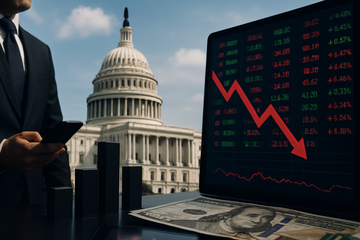
Stop Insider Trading Act cloture vote
53–47
Sept 30, 2026; 7 votes short of the 60 needed to advance
Ratepayer Protection Act vote
57–43
Same day; also short of the 60-vote filibuster threshold
Members' 2025 trades exceeding S&P 500's 16.8% return
100 of 311
Per Unusual Whales 2025 Congressional Trading Report
Trump trades vs. all of Congress, Jan 2025–Jun 2026
28,700 vs 22,200
Per Bloomberg financial-disclosure analysis, reported Sept 2026
STOCK Act fine for a first-time violator
$200
Law in force since 2012; zero criminal prosecutions on record
The Vote That Preserves Washington's Status Quo
The Senate on Sept 30, 2026 voted 53–47 to advance the Stop Insider Trading Act — seven votes short of the 60 needed to clear a filibuster — and effectively killed any near-term rewrite of the 14-year-old disclosure regime. The same afternoon, the chamber fell57–43 on the Ratepayer Protection Act, a separate bill aimed at shielding utility customers from AI data-center power costs, with only four Democrats crossing over to support it. With lawmakers heading home for the pre-midterm recess, the procedural defeat is functionally final: the2026 legislative window on both bills is closed.
Why Democrats Killed Their Own Talking Point
Public polling consistently shows roughly seven in ten voters want lawmakers barred from trading individual stocks. Democrats nevertheless voted unanimously against the bill, framing it as a backdoor voter-ID vehicle that would have also required federal-issued identification at the polls. That procedural packaging is the visible reason; the deeper reason is what the bill did and did not actually prohibit.
- The text barred new purchases by members, spouses and dependent children, but left existing portfolios fully intact — including letting members use dividends to compound holdings they purchased before enactment.
- President and Vice President were explicitly carved out, even though President Trump reported 28,700 trades between January 2025 and June 2026 —roughly 6,500 more than every lawmaker on Capitol Hill combined, per Bloomberg's financial-disclosure review.
- Pre-sale notice of 7 to 14 days is required, with penalties of $2,000 or 10% of trade value — meaningful disclosure optics, but well below the seven-figure returns a single timely trade can deliver.
- Chuck Schumer called the package 'Swiss-cheese legislating'; Senator Jack Reed labeled it a 'sham.' House passage had come on a 232–198 vote in which13 Democrats crossed over.
The Edge That Just Got a Longer Lease
Best and Worst 2025 Congressional Portfolio Returns vs. the S&P 500
Selected2025 portfolio returns for U.S. lawmakers, ranked by Unusual Whales. S&P 500 returned16.8% over the same period.
Unit: Return (%)
Warren Davidson (R)
78.8
Donald Norcross (D)
70.8
Terri Sewell (D)
67.9
Bryan Steil (R)
62.5
Alex Padilla (D)
61.7
Nick LaLota (R)
61.6
Rick Scott (R)
54.8
Michael Guest (R)
52.5
Tom McClintock (R)
50
S&P 500 (benchmark)
16.8
Average congressional outperformance is modest — Republicans' aggregate 2025 portfolio return was 17.3%, Democrats' 14.4%, against an S&P 500 of 16.8%. But the tails are where the persistence shows. Common Cause tallied 13,324 trades worth $635.6 million in 2024 alone; Capitol Trades logged 14,451 trades worth $720 million across 140 members last year. Disclosure is real, but enforcement is not: fines for a first STOCK Act violation start at $200, and no member of Congress has ever been criminally prosecuted under the 2012 law.
A Permanent 'Copy Congress' Sector
The disclosure regime survives intact, and so does the small but durable product ecosystem built on top of it. Two ETFs and a stack of subscription trackers now turn the 45-day STOCK Act filing cadence into a tradable signal — a structure that exists only because the law mandates timely public posting of every trade by every federal lawmaker.
| Instrument | Tracks | Status | Trailing return |
|---|---|---|---|
| Unusual Whales Subversive Democratic Trading ETF (NANC) | Buys/sells by Democratic members and spouses | Listed on Cboe BZX since Feb 2023 | +18.0% 1Y / +14.7% YTD (per fund disclosures) |
| Unusual Whales Subversive Republican Trading ETF (GOP) | Buys/sells by Republican members and spouses | Listed on Cboe BZX; ~$93M AUM | Trailing 12-mo gain of roughly 25%+ vs. SPY +16% (per Morningstar/MarketWatch) |
| Quiver Quantitative Congress Long-Short strategy | Long top-bought / short top-sold names | Free tracker; institutional access paid | +30.1% 1Y / +77% since inception (per Quiver) |
| Capitol Trades, Unusual Whales politics dashboards | Raw PTR filings with alerting | Subscription retail product | N/A — alpha tool, not an investable index |
What the Next Congress Actually Faces
Three structural forces will determine whether any version of a stock-trading restriction reaches the President's desk in 2027. First, the bill text itself is the obstacle: any measure that exempts sitting portfolios, exempts the executive branch, or rides alongside a voter-ID amendment will inherit the same 53–47 math. Second, the post-2026 midterm map is the wildcard: Republican control of the House and a Democratic Senate would reproduce the current filibuster gridlock; a unified Republican government would still need 60 votes for cloture.
- Short-term (days to quarters): expect a retail-volume pop in NANC and GOP as the failed vote becomes the headline for the 'copy Congress' marketing pitch; both funds saw notable inflows after similar 2022 disclosure-rule coverage.
- Short-term: data-center equities and AI power-trade stocks (utilities with hyperscaler exposure) lose a near-term federal-policy catalyst after the Ratepayer Protection Act's 57–43 defeat; the legislative vacuum extends the status quo for utility-rate allocation through the election.
- Long-term (1–3 years): with no federal action, the action shifts to the states — California's stricter conflict-of-interest rules and New York's existing ethics statutes become the de facto regulatory ceiling until a clean bill re-emerges.
- Long-term: the executive-branch loophole matters most. Trump's ~80 trades per market day is the single largest political-trade signal in the system, and any ban that omits the presidency is functionally toothless for the most-traded principal in Washington.
Investable names tied to the Sept 30 vote outcome
- Failed cloture vote preserves the 45-day disclosure cadence the fund is built on,extending its data-driven edge into 2027 with no federal rules tightening.
- +18% trailing 1-year return through Sep 2026 already outpaced the S&P 500's 16.8%; the bill's defeat removes the binary catalyst that would have eliminated the underlying trade signal.
- Short-term risk: post-vote inflows historically fade within 30 days; momentum traders should size the next 4–6 weeks, not multi-quarter.
- Republicans' aggregate 2025 portfolio returned 17.3% vs. 16.8% for the S&P 500, fundamentally justifying the fund's copy-trade thesis heading into a unified-government scenario.
- Bill's death keeps the 232–198 House Republican majority vote (with bipartisan crossover) on the table for any 2027 re-attempt — political momentum remains intact for the underlying GOP-side trades.
- Long-term overhang: if a future Congress passes a clean ban excluding existing holdings, GOP faces the same forced-redemption risk as NANC; size positions with a 12-month horizon, not a 5-year one.
- Copy-Congress app interest and political-trade alerting have driven a measurable slice of new-account growth on retail platforms that surface lawmaker filings, but it's a tailwind, not a thesis.
- Mixed signal: the same vote preserves disclosure frequency, which sustains the data ecosystem HOOD partners with (Quiver, Unusual Whales alerts), but does not change HOOD's core revenue mix.
- Most-frequent AI-stock pick in 2025 congressional disclosures; Khanna's household returned 112% above the S&P 500 over 28 months, driven materially by NVDA exposure.
- Watch catalyst: any disclosure-driven trading wave around the NVDA October earnings release becomes a self-fulfilling signal as the Stop Insider Trading Act — and any blind-trust requirement — is off the table until at least 2027.