
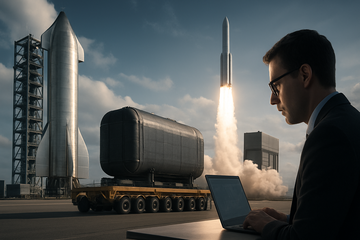
On October 1, 2026, a Falcon 9 riding the SpaceX Transporter-18 rideshare lifted the MVP prototype — a refrigerator-class spacecraft carrying four of Alphabet's Tensor Processing Units (TPUs) — into low-Earth orbit from Vandenberg. Planet Labs built the bus and slotted the chips into an existing satellite so Google could compress its 2027 test timeline into the same year Nvidia disclosed a $21 billion stake in SpaceX.
The launch was a footnote compared with the math that came with it. Google's preprint — Towards a future space-based, highly scalable AI infrastructure system design (arXiv:2511.19468, revised June 17, 2026) — estimates that orbital AI data centers become cost-comparable with terrestrial sites once Starship drives launch costs to roughly $200 per kilogram, and that pulling the Wright's Law learning curve at a 20% rate requires about 180 Starship flights a year for a decade. That is ~1,800 flights.
The FAA's current Starship authorization is 25 flights a year from Starbase. The gap between 25 and 180 is what this analysis is about.
Required Starship cadence
~180/year
Across ~10 years, per arXiv:2511.19468v2; cumulative ~370,000 t payload at ~200 t/flight
Cumulative payload needed
~370,000 t
Equivalent to ~1,800 Starship flights assuming 200-tonne reusable payload
Target launch cost
~$200/kg
Cost-comparable orbital compute threshold; current launch costs run $3,000-$7,000/kg
Current FAA Starship limit
25/year
Authorized at Starbase; 44/year proposed at KSC — still 7x short of Google's cadence
Nvidia's SpaceX stake
$21B → ~$17B
122.8M shares disclosed Aug 14, 2026 in 10-Q; marked down on subsequent price moves
Google's paper doesn't just describe orbital data centers — it sets the price
The paper, led by Blaise Agüera y Arcas and Travis Beals at Google, treats orbital data centers as an economics problem before they treat them as a hardware problem. Three numbers matter:
- A TPU-equipped solar panel in the right orbit produces up to eight times the power per area it does on Earth, almost continuously, eliminating most battery mass.
- Launch to LEO needs to fall from roughly $1,400-$1,800/kg today to less than $200/kg by the mid-2030s for orbital ML compute to undercut terrestrial capex on a fully-loaded basis.
- At a 20% learning rate and ~200 tonnes per Starship, cumulative demand of ~370,000 tonnes — ~180 launches per year for a decade — drives the cost down to that threshold.
Google framed the prototype as a learning mission rather than a commercial data center. The MVP carries ~1 kW of solar generation, runs TPUs in 15-minute cooling windows, and was originally planned for two satellites in 2027. Planet Labs compressed that into a single 2026 rideshare. The architecture that has to scale —81-satellite compute clusters arranged in a ~1 km array, exchanging data via free-space optical links — is sketched out in the paper and was previewed by Google's research blog in November 2025.
Nvidia's $21 billion SpaceX stake is now an option on cadence
Nvidia disclosed a $21 billion SpaceX position in its Q2 FY2027 10-Q filed August 26, 2026 — 122.8 million Class A shares at $170.86, valued as of June 30, 2026. The holding traces to a $10 billion xAI investment Nvidia made in 2025, which converted when Musk folded xAI into SpaceX in an all-stock deal announced February 2026 with a combined valuation of $1.25 trillion.
SpaceX has publicly committed its AI platform exclusively to Nvidia hardware, with a stated target of 20 GW of orbital compute capacity by end of 2027. Melius Research valued the Vera Rubin chip opportunity attached to that commitment at roughly $350 billion over 18 months. By August 26, the SpaceX stake had marked down to ~$17 billion as the stock pulled back from its post-IPO peak.
The connection runs both ways. SpaceX's orbital data center thesis is what justifies SpaceX's $1.95 trillion market capitalization at $148 a share (down from a $225 high, above the $135 IPO from June 12, 2026). Alphabet is the first hyperscaler publicly underwritten to a specific flight count; Nvidia is the chip supplier underwriting SpaceX's ability to spend its way there. If the cadence slips, both bets take the same mark.
The asymmetry is on the upside. If Starship does reach the cadence Google is modeling, the AI compute supply curve flattens in a way that is hard to replicate on the ground. Bain & Company estimates US data center power demand could reach 106 GW by 2035 against ~25 GW of large-project capacity already in planning; orbital supply would not have to clear that bar to be investable, only to clear a fraction of it.
What the math implies for the SpaceX stake at different cadences
Illustrative. Stake value computed on122.8M shares × SPCX price under each annual-cadence scenario; SpaceX share price assumed to track the implied orbital compute revenue multiple.
25 flights/yr (FAA limit)
21
100 flights/yr (Musk 2027 goal)
48
180 flights/yr (Suncatcher math)
85
9,000/yr (Musk long-run)
420
SpaceX launch scale-up needed to reach the math
Required annual Starship launches vs. SpaceX's actual cadence and stated goals.
FAA Starship limit (Starbase)
25
FAA proposed (KSC)
44
Project Suncatcher target
180
SpaceX stated long-run target
9,000
The launch-cadence reality is the binding constraint
SpaceX executed 165 orbital flights in 2025 — half of all worldwide launches. Through late September 2026 it had logged 234 launches, with the Falcon family on a perfect 63-for-63 record on orbital attempts. Starship has flown 14 missions on a single integrated-stack architecture; it completed its first orbital insertion on Flight 14 in late September.
None of that touches the cadence Google's math assumes. The FAA cleared25 Starship flights per year from Starbase in July 2026 and proposed44 per year from Kennedy Space Center, but SpaceX's stated internal target is one launch per hour — about 8,760 flights a year — within the next five years.
- Falcon 9 is capped under FAA authorization at 195 flights per year total across the SpaceX fleet; SpaceX leadership projects 140-145 in 2026.
- Starship V3 targets more than 100 tons to LEO in fully reusable configuration and up to ~200 tons expendable. Bain puts the realistic per-flight payload between 150 and 200 metric tons.
- A full orbital data center architecture that scales — thousands of satellites per constellation — runs into station-keeping, debris management, and free-space optical link bandwidth before it runs into launch cost.
SpaceX is the only operator on the planet with a credible path to 180 flights a year for a single vehicle. The closest competitor, Rocket Lab, flew 18 missions in 2026 — almost entirely with the small Electron — and has delayed Neutron, its medium-lift competitor, into 2027. The Economist framed the broader launch market as supply-constrained, which is the right lens: launch demand is not the problem; launch capacity for the right vehicle is.
The upstream supply chain has to scale before the cadence arrives
The 1,800-launch figure has a corollary: every orbital data center star needs solar arrays, deployable radiators, and high-efficiency thermal management. None of those subsystems exist at 100 kW per platform scale today.
Redwire published a 36-page-OFC white paper in May 2026 laying out the integrated thermal and power architecture required for orbital data centers — deployable roll-out solar arrays (ROSA), radiative panels sized for continuous 100 kW class payloads, and active thermal control systems that have no fully integrated supplier yet. Redwire is the closest listed proxy for what an orbital data center supply chain looks like. Its Q2 2026 revenue was $117 million with EBITDA of negative $27 million; the ODC opportunity is not yet in the numbers.
- Solar cells: Triple-junction GaAs cells come from a duopoly — Spectrolab (a Boeing subsidiary) and Azur Space Solar Power GmbH (a private German subsidiary of Canada's 5N Plus). SpaceX is the largest commercial buyer. Capacity is shared with the Golden Dome missile-tracking program and military demand.
- Radiators: Redwire is the named US integrator for deployable radiators sized for ODC-class platforms; Flectin, a private startup, has raised a Series A specifically for orbital-class heat rejection.
- Spacecraft buses: Planet Labs is the first named integrator (Project Suncatcher MVP); Muon Space's Condor-Ultra is the first Starship-class platform with an explicit orbital data center variant targeting 100 kW and 2028 pathfinder delivery.
- Power: For sustained 100+ kW platforms, compact fission reactors have been floated by multiple concept papers. BWX Technologies — the renamed Babcock & Wilcox, the original 'boilermaker' of US pressurized-water reactor hardware — is the only US-listed pure-play nuclear component supplier with the manufacturing depth to scale.
The sequencing is the key. Solar cells, radiators, and bus integration capacity must clear the bottleneck before Starship cadence does. If SpaceX starts pulling 180 flights a year before triple-junction cell capacity expands, the launch math runs into a thermal-panel bottleneck instead. Azur Space announced a 25% production capacity expansion in late 2025; Spectrolab has not publicly committed to a parallel step.
| Ticker | Company | Exposure to orbital data center build-out | Latest revenue (Q2 2026) | Latest EBITDA margin |
|---|---|---|---|---|
| Redwire | Redwire Corporation | Deployable solar arrays (ROSA), deployable radiators, ODC integrator; named in ODC white paper | $117M | -23.0% |
| BWXT | BWX Technologies | Nuclear component 'boilermaker' (legacy Babcock & Wilcox); potential compact reactor supplier for sustained high-power ODCs | $902M | 13.4% |
| Planet Labs | Planet Labs PBC | Built and integrated MVP satellite bus for Project Suncatcher; Tanager-2 / SuperDove bus family | $378M | -12.8% |
| Rocket Lab | Rocket Lab USA | Closest orbital launch competitor; Neutron (8-tonne) still unflown, delayed to 2027 | $193M | -19.6% |
Three out of four are unprofitable on an EBITDA basis at current scale. The orbital data center thesis is the path to scale revenue; what they lack today is order flow, not technology.
Downstream: who pays for the orbital compute — and who loses if it works
The customer base for orbital AI compute is the same customer base that built the terrestrial one. Microsoft, Meta, Alphabet, and Amazon are projected to spend roughly $760 billion combined on AI infrastructure in 2026 — the largest sustained capex ramp in commercial history. Alphabet alone raised its 2026 capex guide to $195-$205 billion in its Q2 earnings call after spending $44.9 billion in Q2 alone, up 100% year over year. That is the demand the orbital thesis is selling into.
If even a small fraction of that capex migrates to orbit, the listed supply chain absorbs a tailwind; if it doesn't, the terrestrial build-out simply continues.
- Winners if orbital compute lands: listed ODC integrators (Redwire), nuclear pressure-vessel suppliers (BWXT), chip vendors committed to space-qualified parts (Nvidia), launch incumbents (SpaceX).
- Neutral: terrestrial data center REITs and IPPs absorb no immediate pressure because orbital compute is incremental at first, not substitutive.
- Losers in the margins: incumbent cooling-and-power distribution names whose unit economics depend on terrestrial data center capex holding its current shape — particularly the second-tier suppliers of switchgear, transformers, and grid-edge power electronics that have priced in continued AI capex.
What moves first
Three short-term catalysts will set the cadence narrative for the next two quarters:
First, in-orbit results from MVP. Planet Labs confirmed initial contact with the prototype the day of launch and began commissioning. Any public disclosure from Google on TPU radiation performance, free-space optical link demonstration, or thermal-cycling data would re-rate the entire chain. The MVP is sized for three months of operation.
Second, SpaceX's Starship flight rate. Flight 14 cleared orbital insertion on September 28. A successful second-orbital mission before year-end would push the implicit cadence narrative higher and tighten the 25/year FAA authorization toward the 44/year KSC authorization.
Third, Alphabet's Q3 2026 capex color and the 2027 guide. The Q2 raise from $175-185 billion to $195-205 billion was the largest guidance move of the cycle. Any incremental allocation in the Q3 print to space-based AI infrastructure, even as a research line, would be a catalyst.
The structural question: who funds1,800 launches
The math does not require SpaceX to fund 1,800 launches alone. Alphabet's own research paper assumes that the launch-cost convergence requires cumulative demand of 370,000 tonnes — that is roughly the mass of Starlink V3 over the next decade if the constellation scales as SpaceX has signaled, plus a sizable but bounded additional customer base.
The capital intensity is the constraint. At $200/kg and 370,000 tonnes, the implied launch market is $74 billion per year — three times the size of the 2025 launch services market. The economic value is captured by whoever can clear the FAA, manufacturing, and supplier-chain constraints first.
SpaceX's $1.95 trillion market capitalization, post-IPO, is in part an answer to that constraint: it has the equity base to fund the build without external capital, and a customer (itself) large enough to absorb the early flights. Nvidia's $21 billion stake, now marked closer to $17 billion, is a smaller but explicit vote on the same question.
- Milestones that move the thesis: in-orbit TPU validation (90-day MVP mission); second orbital Starship flight in 2026; FAA decision on KSC 44/year authorization; SpaceX Q3 disclosure of orbital compute revenue mix.
- Milestones that stress the thesis: FAA failure to authorize beyond current caps; failure of triple-junction cell capacity to scale; Alphabet's 2027 capex pivot away from space; Nvidia marking down the SpaceX stake in Q3 FY2027.
- Long-run asymmetry: if orbital compute lands, the supply chain captures a $70B+/year launch market with no terrestrial analog. If it doesn't, the listed cost stack (SpaceX, Nvidia) reverts to traditional aerospace multiples — still positive, but a fraction of the current implied valuation.
Stocks with the most direct exposure to the orbital AI math
- raised 2026 capex guidance to $195-205B after spending $44.9B in Q2 (+100% YoY), the largest customer commitment underwriting SpaceX launch demand
- Project Suncatcher is the only listed hyperscaler program publicly anchored to a 1,800-launch cadence and a $200/kg cost curve
- Q3 capex color, plus any 2027 allocation toward space-based AI infrastructure, is the cleanest near-term catalyst for the entire orbital theme
- carries a ~$17B SpaceX stake (down from $21B at end of Q2 FY2027) that ties earnings directly to Starship cadence
- Object to commercialize is committed by the 20 GW Vera Rubin compute commitment Musk has tied to SpaceX
- Asymmetric: revalues up sharply if SpaceX clears 180 flights/yr; marks down with SpaceX if cadence stalls
- trades at $148.07, $1.95T market cap, vs $225 peak and $135 IPO from June 12, 2026 — still re-rates on cadence
- The $200/kg and 180-flights/yr thresholds from Google's paper are now market-anchored; clearing them is the only path back to the post-IPO peak
- Starship Flight 14 completed first orbital insertion Sep 28; a second orbital flight in 2026 would force the market to lean bullish on the cadence narrative
- only listed US integrator with a published ODC architecture and named ROSA solar array / radiator product line
- Q2 2026 revenue of $117M is unprofitable today; ODC order flow is the path to scale revenue
- Best single-stock leverage to thermal-panel and solar-array scaling required by the 1,800-launch math
- legacy Babcock & Wilcox 'boilermaker' with the only US-listed nuclear pressure-vessel depth for sustained high-power ODCs
- Q2 2026 revenue $902M, EBITDA margin 13.4% — profitable today, secondarily leveraged to ODC ambition
- Captures upside if compact fission reactors become the 100+ kW power architecture of choice; limited downside if orbital compute scales on solar alone
- built and integrated the Project Suncatcher MVP bus in2026, compressing Google's2027 timeline
- Stock down69% from $51.76 high to $16.39 — priced for a terrestrial-only business, not an ODC bus integrator
- Q2 FY2026 revenue $378M with -$1.10 EPS; ODC bus revenue is the upside scenario, MVP ground-side read is the binary catalyst
- Neutron (8-tonne medium-lift) delayed to 2027, neutralizing Rocket Lab as a credible competitor for ODC-scale lift
- Q2 revenue $692M run-rate with EBITDA of negative $116M;59x revenue multiple with no path to ODC-scale margin
- Stock at $70.65, $40.9B market cap — priced for a share of orbital launch that the1,800-launch math does not leave room for