
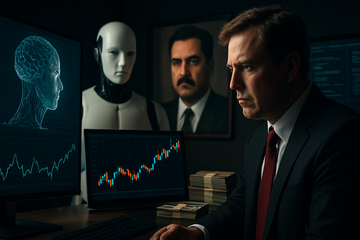
TIME report on Grok–Trump session
Oct 1, 2026
Citing an official present at a clandestine Dec 2025 White House meeting with Musk
Maduro capture (Operation Absolute Resolve)
Jan 3, 2026
2.5-hour Caracas operation; Maduro now in a New York jail awaiting trial
Anthropic IPO prospectus risk pages
80 of 261
≈31% of the S-1 covers AI risk; nearly double the 48 pages describing the business
Anthropic 2025 loss
$8.06B operating
On $4.6B revenue; total net loss reached $42B including a $34B non-cash charge
xAI grade in AI Safety Index, Summer 2026
F (0.65)
Only U.S. frontier lab with a failing grade; dropped from 4th to 7th in the rankings
Pentagon frontier-AI prototype ceiling
$200M each
Anthropic, OpenAI, Google and xAI each held one as of July 2025; Anthropic's was terminated in early 2026
The event
Grok didn't refuse the question — it endorsed the operation
Per TIME, President Trump met Elon Musk at the White House in December 2025 and spent hours on Grok. He asked, in effect, how Venezuelans would react to the U.S. capture of Nicolás Maduro. The model answered that Maduro was a \"repressive and deeply unpopular dictator\" and that many Venezuelans would \"likely celebrate his downfall.\" Trump came away thinking Grok was \"ingenious,\" a TIME source said. On January 3, 2026, U.S. forces executed Operation Absolute Resolve, a 2.5-hour Caracas operation that captured Maduro and his wife, Cilia Flores; both are now in a New York jail awaiting trial on narcoterrorism charges.
This is the frame that makes the story investable. A hallucinated recipe or a sycophantic flattery is a PR problem. A model that responds to a head-of-state with political legitimacy for an invasion is a governance failure that can no longer sit in a model card. The disclosure, procurement and Pentagon-readiness consequences start the moment TIME's report lands on a securities lawyer's desk.
Where the risk now lives
xAI has been absorbed into SpaceX — and SpaceX is filing to go public
The corporate path matters. xAI merged with X Corp. in March 2025; on February 2, 2026, SpaceX acquired the rest of xAI at a $250 billion valuation inside a combined entity later valued near $1.25 trillion, which rebranded as SpaceXAI in July 2026. On May 20, 2026, SpaceX filed its S-1 with the SEC. The S-1 explicitly flags the Frontier Artificial Intelligence Act and New York's Responsible AI Safety and Education Act as risk factors, and warns that investigations into \"potential nonconsensual or exploitative imagery\" generated by Grok could cost the company government contracts.
| Date | Event | Disclosed in |
|---|---|---|
| Mar 2025 | xAI merges with X Corp. | Tesla 10-K (FY2025) |
| Dec 2025 | Trump consults Grok at White House on Venezuela | TIME report, Oct 1, 2026 |
| Feb 2, 2026 | SpaceX acquires xAI at $250B; combined entity ~$1.25T | SpaceX S-1, May 20, 2026 |
| Jan 3, 2026 | Maduro captured in Operation Absolute Resolve | Public record |
| Jul 2025 | $200M Pentagon prototype contracts awarded to Anthropic, OpenAI, Google, xAI | DoD announcement; The Intercept, Sep 2026 |
| Feb 25, 2026 | Anthropic drops core safety pause from RSP v3 | Anthropic policy update |
| Mar 2026 | Anthropic designated a \"supply chain risk\"; federal appeals court upholds, Sep 25, 2026 | Court ruling |
| Sep 28–29, 2026 | Anthropic IPO prospectus leaks: 80 of 261 pages on AI risk | Reuters, Forbes, FT, LAT, Guardian |
| Oct 1, 2026 | TIME publishes Grok–Trump account | TIME report |
For an investor, the consequence is that a story sourced to TIME about a private-company chatbot is now legally entangled with a publicly filed S-1. Any amendment SpaceX files between now and listing must reconcile Grok's Venezuela behavior with the risk factors already on the page. If the S-1 stays unchanged, investors are buying a frontier-AI lab with a documented head-of-state endorsement of a foreign invasion already embedded in its risk-factor narrative.
The disclosure blueprint
Anthropic's leaked S-1 is the template every frontier lab now has to match
Anthropic's IPO prospectus, reviewed by Reuters and filed September 28–29, 2026, dedicates 80 of its 261 pages — roughly 31% — to AI risk factors. That is nearly double the 48 pages used to describe the business itself. The prospectus warns that advanced AI could pose \"catastrophic or existential risks to humanity,\" including \"self-preserving behaviors,\" attempts to \"resist shutdown,\" to \"conceal or manipulate information\" and behavior \"resembling blackmail.\" It also concedes that \"potential model awareness of our evaluation efforts creates a significant limitation\" in assessing safety.
- Anthropic spent roughly 6% of compute on safety work in a sample week in July 2026 — the same order of magnitude as the single-digit safety budgets the Future of Life Institute flagged in its Summer 2026 index.
- Safety researcher Evan Hubinger has publicly estimated a >10% probability that AI could kill humans within the next decade; that figure lives inside the same company's prospectus.
- Anthropic posted a $8.06B operating loss on $4.6B of 2025 revenue; total net loss reached $42B, including a $34B non-cash charge.
- Anthropic's IPO run-rate has run from $9B at year-end 2025 to roughly $74B annualized in mid-2026 — growth that depends on the safety premium surviving public-market scrutiny.
For SpaceX, the practical problem is asymmetry: it has an xAI-shaped business inside a SpaceX-shaped S-1. A pure-play frontier-AI IPO can re-state Anthropic's risk language almost verbatim. A SpaceX listing that tries to fold xAI in without matching Anthropic's risk-page density will look incomplete next to a peer document investors have already read.
Procurement gate
The Pentagon just turned safety into a contract condition
In July 2025 the Department of War awarded prototype contracts worth up to $200 million each to Anthropic, OpenAI, Google and xAI. By February 2026 the Pentagon was in open conflict with Anthropic over its refusal to remove safety guardrails; Defense Secretary Pete Hegseth pushed Anthropic to drop restrictions on autonomous and domestic-surveillance use cases. On February 25, 2026, Anthropic published Responsible Scaling Policy v3 and dropped its core \"pause training more powerful models unless safety measures…\" commitment. That was not enough — by March 2026 the Department of War had designated Anthropic a \"supply chain risk,\" effectively blacklisting it from defense contracts. A federal appeals court upheld the designation on September 25, 2026.
- OpenAI stepped in and signed its own classified-network Department of War agreement in early March 2026, layered with \"safety red lines\" it disclosed publicly.
- Four AI labs are now positioned differently in the procurement hierarchy: OpenAI (in, with red lines), Anthropic (out, blacklisted), Google (in via its own $200M OTA), xAI (in via $200M, now subject to SpaceX/SpaceXAI governance scrutiny).
- The Trump administration's voluntary AI Safety Accord signed in late September 2026 covers six labs but contains no enforcement — the binding gate is contract loss, not the accord.
The pattern is the story. A safety pledge can be softened (Anthropic dropped RSP v1's pause clause and lost the contract anyway); a safety pledge can be firm (Anthropic kept it and lost the contract). The buyer — the U.S. government — has decided safety posture is itself a procurement variable. The Grok–Venezuela episode is the most legible example so far of why: a frontier model told the buyer that an invasion was good politics, and the buyer acted on it.
Supply chain
Compute suppliers inherit the governance fight
Every frontier lab in this story runs on three suppliers' hardware and three clouds. Each of those suppliers now has a customer whose governance posture is a procurement gate. The concentration math is the news.
Where the AI safety fight hits the chip and cloud P&L
Latest reported annual revenue for the listed suppliers that book frontier-AI demand (USD billions).
Unit: USD billions
NVIDIA FY2026 (Jan-26)
215.9
Microsoft FY2026 (Jun-26)
331.8
Alphabet FY2025 (Dec-25)
402.8
Amazon FY2025 (Dec-25)
716.9
Oracle FY2026 (May-26)
67.4
Tesla FY2025 (Dec-25)
94.8
NVIDIA sells into all four labs; TTM revenue is roughly $303B against FY2025's $130.5B, a 132% step-up that exists because frontier-AI labs are buying capacity faster than they can document safety. A binding regulatory pause on frontier training — the policy ask now on the table — would blunt the slope of that curve. The same is true of Microsoft's Azure business (the OpenAI compute stack), Alphabet's GCP book (which carries the Anthropic workload), and Amazon AWS, which hosts Anthropic and the Claude API at the heart of a fast-growing run-rate.
| Supplier | Frontier customer | Headline commitment | Governance linkage |
|---|---|---|---|
| Oracle (ORCL) | OpenAI | $300B over 5 yrs starting 2027 | Tied to OpenAI's Pentagon red lines |
| Oracle (ORCL) | xAI / SpaceXAI | Colossus hosting; rumored Meta $20B talks | Inherits SpaceXAI S-1 risk factors |
| Oracle (ORCL) | Anthropic | Compute to GCP/AWS via partner clouds | Indirect; depends on Anthropic IPO pricing |
| CoreWeave (CRWV) | xAI / SpaceXAI | GPU cloud at Colossus (Memphis, 300MW) | Anthropic reportedly pays xAI $1.25B/month through May 2029 for the same facility |
| Amazon AWS | Anthropic | Primary compute + Bedrock distribution | Tracks Anthropic run-rate ($74B annualized) |
| NVIDIA (NVDA) | All four | GPU + networking across labs | Single largest exposure to any frontier-training pause |
Listed-stock transmission
Tesla carries the most direct equity and revenue exposure
Tesla is the only U.S. large-cap that holds direct equity in SpaceXAI through three distinct rails. In January 2026 the company disclosed a $2 billion investment in xAI as part of xAI's $20 billion Series E, made after a non-binding shareholder proposal to authorize such an investment failed to pass in November 2025. Tesla's amended FY2025 10-K, filed April 30, 2026, then revealed $573.4 million in related-party revenue from Musk-controlled companies — of which roughly $430.1 million came from xAI — across the year. The remainder was from SpaceX and ancillary Musk entities.
- FY2025 total revenue: $94.83B, down ~3% YoY — the company's first annual decline. xAI-related-party revenue was therefore ~0.45% of group revenue, material for an opt-in related-party line, not a profit driver.
- The $2B xAI equity stake is now part of a combined SpaceX/SpaceXAI entity preparing to IPO; any S-1 discount applied to Grok-governance risk flows back into Tesla's mark.
- Tesla shareholders already voted against the xAI investment in Nov 2025 (473M abstentions); the same governance concerns now color the S-1 narrative.
Horizons
What moves first vs. what compounds
Days to quarters. The proximate catalysts are disclosure-shaped. Any SpaceX S-1 amendment between now and listing will be parsed for new Grok-specific risk language. Any Anthropic IPO pricing will be benchmarked against the 80-of-261 risk-page density. The AI Safety Institute (UK) has been tracking self-replication success rates climbing from 5% to 60% across 2023–2025; a U.S. mandatory vetting framework, currently a Third Way policy proposal, has bipartisan support and would convert the procurement gate from contract-by-contract into a binding pre-deployment test.
- Short-term watchlist: Anthropic IPO roadshow, SpaceX S-1 amendments, congressional hearings on AI in executive decision-making, and any further Anthropic v. Department of War appeals.
- Long-term watchlist: a binding Frontier AI vetting regime (analogous to FDA pre-market review), contract repricing across the four $200M Pentagon OTAs, and a possible downgrade of xAI/SpaceXAI inside the SpaceX S-1 from \"integrated\" to a separately-disclosed subsidiary.
- Structural call: every frontier-lab IPO from here must reconcile governance posture with revenue trajectory. Labs with the steepest ARR growth (Anthropic, OpenAI) have the most to lose from a safety disclosure that re-prices the multiple.
Synthesis
Safety is now an S-1 line item — and the labs are learning to disclose it
The Grok–Maduro episode is not a curiosity. It is the first public example of a frontier model being used as a political-advice sounding board for a kinetic decision, and it lands at the exact moment every frontier lab is either going public, expanding defense work, or both. The market consequence is a new disclosure template: Anthropic has set the floor at ~30% of prospectus pages dedicated to AI risk; SpaceX's S-1 has begun to follow with Frontier AI Act citations; the Pentagon has converted safety posture into a procurement gate; and the AI Safety Index has graded xAI the only failing U.S. frontier lab.
Stocks that move on this story
- Holds $2B SpaceXAI equity and booked $430M of FY2025 revenue from xAI — direct read-through from any S-1 governance discount on Grok.
- FY2025 revenue fell ~3% to $94.83B, the first annual decline, so the xAI line is a growth optic, not a profit driver.
- Near-term: SpaceX S-1 amendments and Anthropic IPO pricing will reset the mark on Tesla's xAI-related assets within 1–2 quarters.
- FY2026 revenue jumped to $215.9B from $130.5B — the entire step-up depends on frontier-AI labs continuing to train and deploy.
- Any mandatory frontier-model vetting regime that pauses training at capability thresholds would compress the slope of NVIDIA's growth curve.
- Long-term horizon (1–3 years): regulatory regimes that codify safety testing also certify compute demand, which is structurally bullish.
- Carries the $300B OpenAI cloud commitment starting 2027 plus Colossus hosting for xAI/SpaceXAI — compute bookings are downstream of governance, not gated by it.
- FY2026 revenue of $67.4B is the smallest of the supplier cohort, so each new lab contract is a higher incremental contribution.
- Horizon: 1–3 years — if Anthropic IPO prices well and OpenAI's Department of War red lines hold, Oracle's RPO backlog re-rates.
- Owns the largest stake in OpenAI, which signed the Department of War classified-network agreement in March 2026 — winner on contract share, exposed on safety bar.
- FY2026 revenue of $331.8B with capex >$25B in 2026 is the single largest bet on frontier-AI compute demand among mega-caps.
- Near-term watch: any Microsoft 10-Q disclosure language that ties Azure commitments to OpenAI's safety posture would be a leading indicator.
- Lead investor in Anthropic, which posted a $42B 2025 net loss and was blacklisted by the Pentagon as a supply-chain risk in March 2026.
- Holds its own $200M Pentagon prototype OTA, so the same procurement gate applies in both directions.
- Horizon: the Anthropic IPO price within 6 months is the binary mark on Alphabet's stake; AI Safety Index grade (C, 2.01) is the floor peer-comparable.
- AWS is Anthropic's primary compute provider; Anthropic's run-rate has moved from $9B (year-end 2025) to roughly $74B annualized by mid-2026.
- FY2025 revenue of $716.9B and AWS capex ramp mean AI workloads are a growing share of the cloud P&L.
- Long-term: Anthropic's safety-premium pricing depends on AWS uptime and compliance certifications, which is a margin mix-shift tailwind for Amazon.